
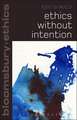
Ethics Without Intention: Bloomsbury Ethics
Autor Ezio Di Nuccien Limba Engleză Hardback – 28 aug 2014
Di Nucci approaches the doctrine of double effect from four key directions: its historical origins, which can be traced further back than the classic attribution to Aquinas; its theoretical coherence, which is the subject of a lively contemporary debate in philosophy; its moral intuitiveness, which has always been taken for granted but has recently begun to be questioned; and finally its relevance to the difficult moral and political decisions of our time. An engaging and comprehensive introduction to the doctrine of double effect.

Preț: 708.21 lei
Preț vechi: 936.87 lei
-24%
Puncte Express: 1062
Carte tipărită la comandă
Livrare economică 23 noiembrie-07 decembrie
Livrare prin curier în România Termenul estimat este afișat lângă disponibilitate.
Transport gratuit pentru acest produs Plată online sau ramburs, în funcție de opțiunile comenzii.
Retur gratuit în 14 zile Comandă securizată și suport în română.
Specificații
ISBN-13: 9781472523006
ISBN-10: 1472523008
Pagini: 280
Dimensiuni: 138 x 216 x 20 mm
Greutate: 0.45 kg
Ediția:New.
Editura: Bloomsbury Publishing
Colecția Bloomsbury Academic
Seria Bloomsbury Ethics
Locul publicării:London, United Kingdom
ISBN-10: 1472523008
Pagini: 280
Dimensiuni: 138 x 216 x 20 mm
Greutate: 0.45 kg
Ediția:New.
Editura: Bloomsbury Publishing
Colecția Bloomsbury Academic
Seria Bloomsbury Ethics
Locul publicării:London, United Kingdom
V-ar putea interesa
-
 Controlling Technology: Ethics and the Responsible EngineerStephen H. Unger-27%Preț: 655.88 lei898.47 lei
 -
 EthicsPeter Singer-11%Preț: 365.60 lei408.96 lei
 -
 Love's Knowledge: Essays on Philosophy and LiteratureMartha C. Nussbaum-21%Preț: 415.88 lei526.23 lei
 -
 Can God Be Trusted?: Faith and the Challenge of EvilJohn G. Stackhouse-16%Preț: 214.63 lei257.01 lei
 -
 Pluralism, Justice, and EqualityDavid Miller-28%Preț: 412.53 lei575.62 lei
 -
 Applied EthicsPeter Singer-13%Preț: 353.57 lei405.77 lei
 -
 -29%Preț: 436.87 lei611.59 lei
 -
 The Moral Philosophers: An Introduction to EthicsRichard Norman-11%Preț: 358.99 lei405.49 lei
 -
 The Language of MoralsR. M. Hare-27%Preț: 338.61 lei465.31 lei
 -
 Human Welfare and Moral Worth: Kantian PerspectivesThomas E. Hill, Jr.-28%Preț: 382.99 lei531.19 lei
 -
 Natural GoodnessPhilippa Foot-12%Preț: 354.27 lei404.53 lei
 -
 Ethics: and "The Nature of Moral Philosophy"G. E. Moore-17%Preț: 170.91 lei205.16 lei
 -
 The Practice of ValueJoseph Raz-12%Preț: 347.51 lei394.93 lei
 -
 Ancient Wisdom, Modern World: Ethics for the New MillenniumHis Holiness The Dalai Lama-27%Preț: 67.12 lei92.41 lei
 -
 NanoethicsFritz Allhoff-8%Preț: 417.36 lei453.66 lei
 -
 A Year to LiveStephen LevinePreț: 86.59 lei
 -
 What is Good?: The Search for the Best Way to LiveProf A.C. Grayling-27%Preț: 67.21 lei91.95 lei
 -
 Ethics: Key Concepts in PhilosophyDr Dwight Furrow-17%Preț: 156.37 lei187.91 lei
 -
 -14%Preț: 235.59 lei273.63 lei
Cuprins
Preface
1. Introductory Remarks: We Never Do Just One Thing
Part I: The Doctrine of Double Effect
2. Definitions First: Classic Formulations of the Doctrine
3. Back to the Beginning: Aristotle, Aquinas and the Origins of Double Effect
Part II: Double Effect in Theory
4. The Trolley Problem
5. An Experimental Approach to the Permissibility of Killing One to Save Five
6. A Theoretical Problem with Double Effect: Closeness
7. Kamm, Kant, and Double Effect
Part III: Double Effect in Practice
8. The Classic Application of Double Effect: Collateral Damages
9. An Experimental Approach to the Distinction between Intending and Merely Foreseeing
10. Bioethical Applications: The Example of Embryo Loss and Stem Cell Research
11. What Shall I Do? The Doctrine Cannot Tell Us How We May Permissibly Act
12. Concluding Remarks: Responsibility, Character and Mends
Notes
Bibliography
Index
1. Introductory Remarks: We Never Do Just One Thing
Part I: The Doctrine of Double Effect
2. Definitions First: Classic Formulations of the Doctrine
3. Back to the Beginning: Aristotle, Aquinas and the Origins of Double Effect
Part II: Double Effect in Theory
4. The Trolley Problem
5. An Experimental Approach to the Permissibility of Killing One to Save Five
6. A Theoretical Problem with Double Effect: Closeness
7. Kamm, Kant, and Double Effect
Part III: Double Effect in Practice
8. The Classic Application of Double Effect: Collateral Damages
9. An Experimental Approach to the Distinction between Intending and Merely Foreseeing
10. Bioethical Applications: The Example of Embryo Loss and Stem Cell Research
11. What Shall I Do? The Doctrine Cannot Tell Us How We May Permissibly Act
12. Concluding Remarks: Responsibility, Character and Mends
Notes
Bibliography
Index
Recenzii
In his "Ethics without Intention. An Essay on Double Effect" Ezio di Nucci provides the first in-depth action theoretic analysis of the infamous Doctrine of Double Effect, without already presupposing a particular ethical theory. He offers eight arguments against the doctrine, and convincingly shows that we cannot justify a particular immoral action by way of distinguishing between intended means and its merely foreseen side-effects.
His study is original, lucid, and analytically sharp. His book is a must read for everyone interested in the moral relevance of intentions.
His study is original, lucid, and analytically sharp. His book is a must read for everyone interested in the moral relevance of intentions.