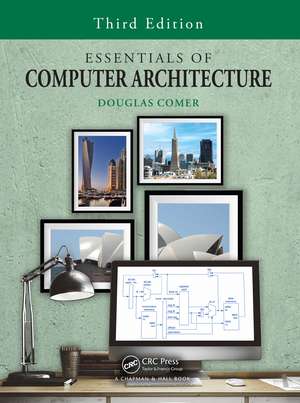
Essentials of Computer Architecture
Autor Douglas Comeren Limba Engleză Hardback – 20 mai 2024
Ceea ce diferențiază Essentials of Computer Architecture de documentația tehnică oficială sau de manualele clasice de inginerie este unghiul de abordare: autorul Douglas Comer scrie pentru programatori, nu pentru proiectanții de circuite. Subliniem faptul că, în loc să înceapă cu fizica tranzistorilor, volumul adoptă o strategie top-down, explicând mai întâi cum interacționează software-ul cu sistemul prin intermediul compilatoarelor, pentru ca ulterior să coboare spre detaliile hardware-ului. Ne-a atras atenția structura riguroasă a celor 22 de capitole, care ghidează cititorul de la interpretarea programelor și seturi de instrucțiuni până la concepte avansate precum ierarhiile de memorie virtuală și arhitecturile bus.
Complementar lucrării Computer Systems: A Programmer's Perspective, Global Edition, care pune accent pe interfața dintre software-ul de sistem și aplicații, volumul de față acoperă mult mai detaliat mecanismele fizice și logice ale procesoarelor moderne, inclusiv unitățile de execuție și microcodul. Suntem de părere că ediția a treia aduce un plus valoare necesar prin capitolele despre coerența memoriei în sistemele multicore și eficiența energetică, subiecte adesea ignorate în textele introductive.
Poziționată strategic în opera autorului, această carte face tranziția de la software-ul de bază descris în Operating System Design către infrastructura fizică pe care acesta rulează. Dacă în alte lucrări Douglas Comer explorează conectivitatea globală, aici acesta disecă „motorul” individual care face posibilă procesarea datelor. Progresia logică a cuprinsului — de la reprezentarea datelor la paralelism și pipelining — indică o acoperire completă, ideală pentru înțelegerea modului în care deciziile de programare influențează direct performanța hardware.
Preț: 691.87 lei
Preț vechi: 974.80 lei
-29%
Carte indisponibilă temporar
Specificații
ISBN-10: 1032727195
Pagini: 541
Ilustrații: 478
Dimensiuni: 177 x 228 x 33 mm
Greutate: 1.14 kg
Ediția:3
Editura: CRC Press
Colecția Chapman and Hall/CRC
Locul publicării:Boca Raton, United States
V-ar putea interesa
-
 The Art of Multiprocessor ProgrammingMaurice Herlihy-39%Preț: 379.07 lei620.73 lei
 -
 -41%Preț: 457.81 lei769.47 lei
 -
 -40%Preț: 493.65 lei820.18 lei
 -
 -39%Preț: 501.09 lei825.63 lei
 -
 -40%Preț: 493.92 lei823.98 lei
 -
 High Performance Computing: Modern Systems and PracticesThomas Sterling-40%Preț: 437.18 lei729.97 lei
 -
 Code: The Hidden Language of Computer Hardware and SoftwareCharles Petzold-20%Preț: 188.58 lei235.72 lei
 -
 Principles of Computer HardwareAlan Clements-28%Preț: 623.58 lei861.14 lei
 -
 Computer Architecture: A Quantitative ApproachJohn L. Hennessy-39%Preț: 539.69 lei882.55 lei
 -
 Foundations of Computer EngineeringMarilyn Wolf-40%Preț: 476.75 lei796.01 lei
 -
 -20%Preț: 1015.88 lei1269.85 lei
 -
 -62%Preț: 476.02 lei1242.56 lei
 -
 Computer Systems: A Programmer's Perspective, Global EditionRandal E. Bryant-20%Preț: 652.59 lei815.74 lei
 -
 Computer Organization and Architecture, Global EditionWilliam Stallings-20%Preț: 576.60 lei720.75 lei
 -
 -35%Preț: 304.57 lei468.39 lei
 -
 Dive Into Systems: A Gentle Introduction to Computer SystemsSuzanne J Matthews-35%Preț: 407.65 lei625.36 lei
 -
 Introduction to Computer Organization: ARM EditionRobert G. Plantz-35%Preț: 303.72 lei468.10 lei
 -
 Computer ArchitectureCharles Fox-35%Preț: 303.05 lei467.47 lei
 -
 Parallel ProgrammingThomas Rauber-20%Preț: 473.79 lei592.24 lei
 -
 Understanding Computer OrganizationPatricio Buli¿-20%Preț: 387.55 lei484.44 lei
Public țintă
Undergraduate CoreDe ce să citești această carte
Recomandăm această carte oricărui programator care dorește să înțeleagă ce se întâmplă „sub capotă” fără a se pierde în detalii de inginerie electrică. Veți câștiga o perspectivă clară asupra modului în care codul scris în limbaje de nivel înalt este executat de procesor și cum gestionarea memoriei sau a I/O-ului poate optimiza radical aplicațiile. Este un ghid practic care transformă hardware-ul dintr-o „cutie neagră” într-un instrument controlabil.
Despre autor
Douglas Comer este profesor la Universitatea Purdue, fiind o figură legendară în informatică datorită contribuțiilor sale la formarea Internetului în anii '70 și '80. Membru ACM Fellow și fost component al Internet Architecture Board, Comer a educat generații de studenți și profesioniști prin seria sa de succes despre rețele și sisteme de operare. Expertiza sa vastă, care îmbină cercetarea academică cu aplicațiile industriale, se reflectă în claritatea cu care explică arhitecturile complexe de calcul în lucrări precum The Cloud Computing Book sau seria sa despre TCP/IP.
Cuprins
Chapter 1 Introduction and Overview
Chapter 2 Program Interpretation and Transformation
Chapter 3 Data and Program Representation
Chapter 4 A High-Level Overview of Processors
Chapter 5 Instruction Stes and Operands
Chapter 6 Operand Addressing and Operand Types
Chapter 7 Assembly Languages and Programming Paradigm
Chapter 8 Main Memory and Memory Addressing
Chapter 9 Virtual Memory Technologies and Virtual Addressing
Chapter 10 Caches and Caching
Chapter 11 Storage: File Systems, Blocks and SSDs
Chapter 12 A Programmer's View of Devices, I/O, and Buffering
Chapter 13 Buses and Bus Architectures
Chapter 14 Programming Devices and Interrupt-Driven I/O
Chapter 15 Data Paths and Instruction Execution
Chapter 16 CPUs: Micrcode, Protection, and Processor Modes
Chapter 17 Parallelism
Chapter 18 Data Pipelining
Chapter 19 Assessing Performance
Chapter 20 Multicore Processors
Chapter 21 Power and Energy
Chapter 22 Building Blocks: Transistors, Gates and Clocks
Chapter 23 Hardware Modularity
Appendix 1 Rules for Boolean Algebra Simplification
Appendix 2 A Quick Introduction to x86 Assembly Language
Appendix 3 ARM Register Definitions and Calling Sequence
Appendix 4 Lab Exercises for a Computer Architecture Course
Descriere scurtă
This third edition is updated in view of advances in the field. Most students only have experience with high-level programming languages, and almost no experience tinkering with electronics and hardware. As such, this text is revised to follow a top-down approach, moving from discussions on how a compiler transforms a source program into binary code and data, to explanations of how a computer represents data and code in binary.
Additional chapters cover parallelism and data pipelining, assessing the performance of computer systems, and the important topic of power and energy consumption. Exclusive to this third edition, a new chapter explains multicore processors and how coherence hardware provides a consistent view of the values in memory even though each core has its own cache.
Suitable for a one-semester undergraduate course, this clear, concise, and easy-to-read textbook offers an ideal introduction to computer architecture for students studying computer programming.