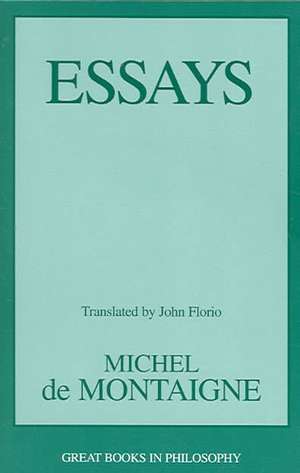
Essays
Autor Michel De Montaigne Traducere de John Florioen Limba Engleză Paperback – 15 dec 2004
În cadrul programelor de studii umaniste și filosofice, The Essays reprezintă textul fondator al introspecției moderne, fiind esențial pentru înțelegerea tranziției de la scolastică la umanismul Renașterii. Notăm cu interes că această ediție revizuită, îngrijită de M. A. Screech, nu este doar o simplă traducere, ci un instrument de lucru riguros, echipat cu un aparat critic ce include explicații ale simbolurilor și note detaliate. Structura volumului urmărește progresia intelectuală a lui Michel Montaigne, selectând capitole cheie din toate cele trei cărți originale pentru a oferi o imagine de ansamblu asupra evoluției sale, de la stoicismul timpuriu la scepticismul matur. Considerăm că această selecție este punctul de intrare ideal pentru cititorul academic. Aceasta acoperă aceeași arie tematică precum The Complete Essays, dar cu o abordare mai concentrată, eliminând redundanțele pentru a evidenția nucleul filosofic al autorului. Față de volumul On Solitude din seria Penguin Great Ideas, care se axează pe o singură temă, ediția de față oferă o perspectivă mult mai diversă, incluzând eseuri revoluționare despre educație, sexualitate și egalitatea sexelor (precum „On some lines of Virgil”). Opera se distinge prin vocea onestă a lui Montaigne, care transformă auto-analiza într-o metodă de cercetare universală. De la eseul „To philosophize is to learn how to die” până la concluziile din „On experience”, volumul ghidează cititorul printr-un proces de demistificare a prejudecăților umane, într-o epocă marcată, la fel ca a noastră, de conflicte religioase și intelectuale.
Preț: 89.69 lei
Carte disponibilă
Livrare economică 10-24 noiembrie
Specificații
ISBN-10: 1591022703
Pagini: 285
Dimensiuni: 139 x 214 x 16 mm
Greutate: 0.35 kg
Editura: Globe Pequot Publishing Group Inc
V-ar putea interesa
-
 How to LiveSarah Bakewell-18%Preț: 77.86 lei94.78 lei
 -
 The EssaysMichel Montaigne-24%Preț: 61.29 lei80.50 lei
 -
 The Complete EssaysMichel Montaigne-30%Preț: 139.24 lei197.68 lei
 -
 On FriendshipMichel De Montaigne-21%Preț: 44.27 lei55.87 lei
 -
 On SolitudeMichel De Montaigne-20%Preț: 44.36 lei55.74 lei
 -
 How We Weep and Laugh at the Same ThingMichel de Montaigne-31%Preț: 16.18 lei23.58 lei
 -
 Montaigne: A Very Short IntroductionWilliam M. HamlinPreț: 78.91 lei
 -
 Collected Maxims and Other ReflectionsFrançois de La RochefoucauldPreț: 66.03 lei
 -
 MeditationsMarcus AureliusPreț: 34.00 lei
 -
 Preț: 61.19 lei
 -
 Mystery and MannersFlannery O'ConnorPreț: 92.84 lei
 -
 Always RememberCharlie MackesyPreț: 157.44 lei
 -
 Essays by MontaigneMichel de MontaignePreț: 89.97 lei
 -
 Every Day I ReadHwang Bo-Reum-25%Preț: 70.49 lei94.39 lei
 -
 The Complete Essays of Michel de MontaigneMichel De MontaignePreț: 256.65 lei
 -
 Marcus AureliusMarcus AureliusPreț: 38.49 lei
 -
 -27%Preț: 1633.73 lei2227.60 lei
 -
 What Do I Know?Michel De MontaignePreț: 100.87 lei
 -
 The Complete WorksMichel De Montaigne-26%Preț: 175.96 lei239.06 lei
 -
 Table -Talk Essays on Men and Manners Volume IIWilliam HazlittPreț: 97.07 lei
De ce să citești această carte
Recomandăm această ediție oricărui student sau pasionat de filosofie care dorește să descopere originile eseului literar. Cititorul câștigă acces la o traducere de referință care păstrează umorul și onestitatea lui Montaigne, oferind o metodă practică de a naviga incertitudinea prin interogație personală. Este un volum esențial pentru a înțelege cum gândirea critică poate fi aplicată propriei vieți.
Despre autor
Michel Montaigne (1533-1592) a fost una dintre cele mai influente figuri ale Renașterii franceze și inventatorul genului literar al eseului. După o carieră în magistratură și administrație publică, servind ca primar al orașului Bordeaux, s-a retras la domeniile sale pentru a se dedica lecturii și reflecției. Lucrarea sa monumentală, Essays, începută în 1572, a revoluționat literatura europeană prin centrarea discursului filosofic pe experiența subiectivă și pe examinarea sinceră a sinelui.
Descriere scurtă
Despite his skepticism Montaigne realized that the intellectual horizon of his day was full of exciting new developments. The New World had only recently been discovered and explorers to many parts of the hitherto undiscovered world were bringing back reports of strange lands, people, and customs. At the same time the intellectual discoveries of the Renaissance had uncovered the powerful works of ancient Greek and Latin authors, and science, still in its infancy, was beginning to ask important new questions.
The essays reflect all these interests, plus a refreshing honesty about the frailties of human nature. Montaigne writes about vanity, the value of friendship, constancy, idleness, liars, virtue, cowardice, prognostication, cannibals, the greatness of Rome, "That to Study Philosophy Is to Learn to Die," and a host of other topics.
Filled with insights and keen observations that have inspired later writers as diverse as Shakespeare, Bacon, Voltaire, Rousseau, Flaubert, Virginia Woolf, and Roland Barthes, the Essays of Montaigne should be on the shelf of every student, scholar, and book lover.
Notă biografică
Cuprins
To the Reader
Book One
7. That our actions should be judged by our intentions
8. On idleness
9. On liars
10. That no man should be called happy until after his death
21. On the power of the imagination
22. That one man's profit is another's loss
26. On the education of children
27. That it is folly to measure truth and error by our own capacity
28. On friendship
31. On cannibals
36. On the custom of wearing clothes
47. On the uncertainty of our judgement
50. On Democritus and Heraclitus
55. On smells
Book Two
8. On the affection of fathers for their children
10. On books
11. On cruelty
17. On presumption
28. All things have their season
32. A defence of Seneca and Plutarch
Book Three
2. On repentance
3. On three kinds of relationships
6. On vehicles
8. On the art of conversation
12. On physiognomy
13. On experience
Descriere
Revealing the author's thoughts on sexuality, religion, cannibals, intellectuals, and other unexpected themes, this work includes titles such as: "On Solitude," "To Philosophize Is to Learn How to Die," and "On Experience".