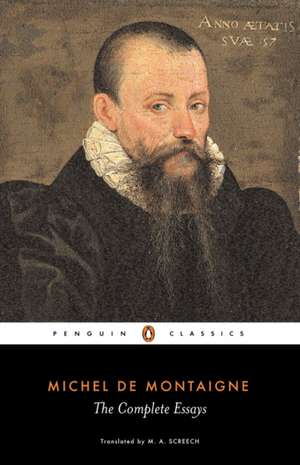
The Complete Essays
Autor Michel Montaigne Editat de M. A. Screechen Limba Engleză Paperback – 25 feb 1993
Observăm că, în ciuda disponibilității fragmentate a operei lui Michel Montaigne, literatura academică în limba engleză a dus mult timp lipsă de o ediție critică integrală care să echilibreze rigoarea filologică cu accesibilitatea modernă. The Complete Essays, în versiunea editată de M. A. Screech, completează exact această lacună, oferind cercetătorilor și studenților un text stabil, însoțit de un aparat critic masiv. Suntem de părere că această ediție Penguin Classics reușește să redea vocea autentică a autorului, păstrând nuanțele francezei renascentiste într-o formă lizibilă pentru cititorul contemporan. Această ediție extinde cadrul propus de The Essays (selecția de eseuri) cu date noi din întreg corpusul de scrieri ale lui Montaigne, incluzând toate cele trei cărți originale. Dacă în Selected Essays/Essais Choisis accentul era pus pe temele predilecte ale autorului, volumul de față permite observarea evoluției gândirii sale prin includerea tuturor adnotărilor și revizuirilor succesive. Structura cărții urmărește riguros progresia cronologică, de la notele scurte de lectură din „Cartea I” până la meditațiile complexe și introspective din capitolele finale. Cuprinsul relevă o tranziție de la stoicismul timpuriu către un scepticism matur, explorând condiția umană prin subiecte aparent disparate: de la tactici militare la natura minciunii sau pregătirea pentru moarte. Credem că relevanța acestui volum pentru curriculumul de filozofie și istoria ideilor este incontestabilă. Spre deosebire de un ghid introductiv, precum Montaigne din seria Very Short Introductions, ediția lui Screech oferă experiența directă a textului sursă, esențială pentru înțelegerea modului în care eseul a devenit un instrument de auto-examinare și critică socială în perioada modernă timpurie.
Preț: 139.56 lei
Preț vechi: 197.68 lei
-29%
Carte disponibilă
Livrare economică 19-25 noiembrie
Livrare express 30 octombrie-05 noiembrie pentru 113.85 lei
Specificații
ISBN-10: 0140446044
Pagini: 1360
Ilustrații: index
Dimensiuni: 129 x 196 x 65 mm
Greutate: 0.92 kg
Editura: Penguin Books
Locul publicării:London, United Kingdom
V-ar putea interesa
-
 BaudolinoUmberto Eco-17%Preț: 78.33 lei94.84 lei
 -
 How to LiveSarah Bakewell-18%Preț: 77.86 lei94.78 lei
 -
 EssaysMichel De MontaignePreț: 92.46 lei
 -
 The EssaysMichel Montaigne-24%Preț: 61.29 lei80.50 lei
 -
 City of GodAugustine-18%Preț: 121.74 lei149.22 lei
 -
 On FriendshipMichel De Montaigne-21%Preț: 44.27 lei55.87 lei
 -
 Speak, MemoryVladimir Nabokov-25%Preț: 59.37 lei79.02 lei
 -
 Montaigne: A Very Short IntroductionWilliam M. HamlinPreț: 78.91 lei
 -
 AusterlitzW. G. Sebald-25%Preț: 59.56 lei79.50 lei
 -
 The Age of EmpireEric HobsbawmPreț: 124.73 lei
 -
 Essays by MontaigneMichel de MontaignePreț: 89.97 lei
 -
 The Complete Essays of Michel de MontaigneMichel De MontaignePreț: 256.65 lei
 -
 -26%Preț: 258.70 lei348.82 lei
 -
 The Everything Pet Rabbit HandbookSarah MartinPreț: 85.79 lei
 -
 Sea Prayer: The Sunday Times and New York Times BestsellerKhaled Hosseini-36%Preț: 60.89 lei94.44 lei
 -
 What Do I Know?Michel De MontaignePreț: 100.87 lei
 -
 MicrocosmsClaudio Magris-31%Preț: 64.04 lei92.83 lei
 -
 Speak, MemoryVladimir Nabokov-22%Preț: 96.95 lei124.28 lei
 -
 The Complete WorksMichel De Montaigne-26%Preț: 175.96 lei239.06 lei
 -
 Hitler, Mein Kampf: Eine kritische EditionInstitut f.Zeitgeschichte-11%Preț: 842.65 lei946.80 lei
De ce să citești această carte
Recomandăm această ediție oricărui cititor pasionat de filozofia occidentală sau de istoria literaturii care dorește să exploreze integral mintea celui care a inventat eseul. Prin notele explicative ale lui M.A. Screech, textul devine accesibil chiar și celor fără studii de specialitate, oferind o perspectivă rară asupra tranziției de la gândirea medievală la cea umanistă. Câștigați astfel acces la o operă fundamentală, prezentată într-un format academic de prestigiu.
Despre autor
Michel de Montaigne (1533-1592) a fost un magistrat, primar al orașului Bordeaux și unul dintre cei mai influenți gânditori ai Renașterii franceze. După o carieră juridică și politică activă, s-a retras în 1572 în turnul castelului său pentru a se dedica lecturii și scrierii. Rezultatul a fost inventarea unui nou gen literar: eseul (de la francezul 'essayer' - a încerca, a testa). Opera sa este centrată pe studiul propriei persoane ca metodă de a înțelege natura umană universală, abordând cu un scepticism blând și o curiozitate neobosită complexitatea experienței subiective.
Notă biografică
Descriere scurtă
In 1572 Montaigne retired to his estates in order to devote himself to leisure, reading and reflection. There he wrote his constantly expanding 'assays', inspired by the ideas he found in books contained in his library and from his own experience. He discusses subjects as diverse as war-horses and cannibals, poetry and politics, sex and religion, love and friendship, ecstasy and experience. But, above all, Montaigne studied himself as a way of drawing out his own inner nature and that of men and women in general. The Essays are among the most idiosyncratic and personal works in all literature and provide an engaging insight into a wise Renaissance mind, continuing to give pleasure and enlightenment to modern readers.
With its extensive introduction and notes, M.A. Screech's edition of Montaigne is widely regarded as the most distinguished of recent times.
Michel de Montaigne (1533-1586) studied law and spent a number of years working as a counsellor before devoting his life to reading, writing and reflection.
If you enjoyed The Complete Essays, you might like Francois Rabelais's Gargantua and Pantagruel, also available in Penguin Classics.
'Screech's fine version ... must surely serve as the definitive English Montaigne'
A.C. Grayling, Financial Times
'A superb edition'
Nicholas Wollaston, Observer
Cuprins
Note on the Text
The Annotations
Note on the Translation
Explanation of the Symbols
Appendices
To the Reader
Book I
1. We reach the same end by discrepant means
2. On sadness
3. Our emotions get carried away beyond us
4. How the soul discharges its emotions against false objects when lacking real ones
5. Whether the governor of a besieged fortress should go out and parley
6. The hour of parleying is dangerous
7. That our deeds are judged by the intention
8. On idleness
9. On liars
10. On a ready or hesitant delivery
11. On prognostications
12. On constancy
13. Ceremonial at the meeting of kings
14. That the taste of good and evil things depends in large part on the opinion we have of them
15. One is punished for stubbornly defending a fort without good reason
16. On punishing cowardice
17. The doings of certain ambassadors
18. On fear
19. That we should not be deemed happy till after our death
20. To philosophize is to learn how to die
21. On the power of the imagination
22. One man's profit is another man's loss
23. On habit: and on never easily changing a traditional law
24. Same design: differing outcomes
25. On schoolmasters' learning
26. On educating children
27. That it is madness to judge the true and the false from our own capacities
28. On affectionate relationships
29. Nine and twenty sonnets of Estienne de La Boëtie
30. On moderation
31. On the Cannibals
32. Judgements on God's ordinances must be embarked upon with prudence
33. On fleeing from pleasures at the cost of one's life
34. Fortune is often found in Reason's train
35. Something lacking in our civil administrations
36. On the custom of wearing clothing
37. On Cato the Younger
38. How we weep and laugh at the same thing
39. On solitude
40. Reflections upon Cicero
41. On not sharing one's fame
42. On the inequality there is between us
43. On sumptuary laws
44. On sleep
45. On the Battle of Dreux
46. On names
47. On the uncertainty of our judgement
48. On war-horses
49. On ancient customs
50. On Democritus and Heraclitus
51. On the vanity of words
52. On the frugality of the Ancients
53. On one of Caesar's sayings
54. On vain cunning devices
55. On smells
56. On prayer
57. On the length of life
Book II
1. On the inconstancy of our actions
2. On drunkenness
3. A custom of the Isle of Cea
4. "Work can wait till tomorrow"
5. On conscience
6. On practice
7. On rewards for honour
8. On the affection of fathers for their children
9. On the armour of the Parthians
10. On books
11. On cruelty
12. An apology for Raymond Sebond
13. On judging someone else's death
14. How our mind tangles itself up
15. That difficulty increases desire
16. On glory
17. On presumption
18. On giving the lie
19. On freedom of conscience
20. We can savour nothing pure
21. Against indolence
22. On riding "in post"
23. On bad means to a good end
24. On the greatness of Rome
25. On not pretending to be ill
26. On thumbs
27. On cowardice, the mother of cruelty
28. There is a season for everything
29. On virtue
30. On a monster-child
31. On anger
32. In defence of Seneca and Plutarch
33. The tale of Spurina
34. Observations on Julius Caesar's methods of waging war
35. On three good wives
36. On the most excellent of men
37. On the resemblance of children to their fathers
Book III
1. On the useful and the honourable
2. On repenting
3. On three kinds of social intercourse
4. On diversion
5. On some lines of Virgil
6. On coaches
7. On high rank as a disadvantage
8. On the art of conversation
9. On vanity
10. On restraining your will
11. On the lame
12. On physiognomy
13. On experience
Index