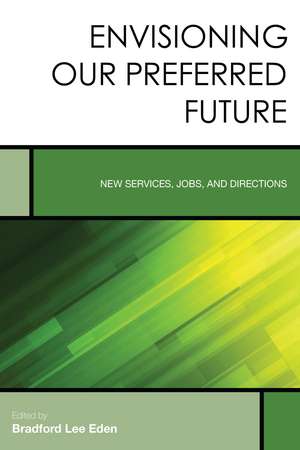
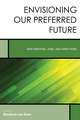
Envisioning Our Preferred Future: New Services, Jobs, and Directions: Creating the 21st-Century Academic Library
Editat de Bradford Lee Edenen Limba Engleză Hardback – 11 mai 2016
Case studies are include one that features QuestionPoint in the context of a cooperative virtual reference service; another shows how research and scholarship can be disseminated using social media tools such as blogs, Twitter, ResearchGate and Google Scholar, among others; a other studies explore the importance of user engagement and buy-in before moving forward on digitization; and one shows how information architecture and usability emerge from the redesign of a public library website and whose successful completion involves user surveying, focus groups, peer site reviews, needs analysis, and usability testing.
Two chapters deal with the changing legal context: the importance and understanding of copyright and author rights in the 21st-century academic library, and the basics Family Educational Rights and Privacy Act (FERPA).
It is hoped that this volume, and the series in general, will be a valuable and exciting addition to the discussions and planning surrounding the future directions, services, and careers in the 21st-century academic library.
Preț: 616.15 lei
Preț vechi: 870.33 lei
-29%
Puncte Express: 924
Carte tipărită la comandă
Livrare economică 02-16 decembrie
Livrare prin curier în România Termenul estimat este afișat lângă disponibilitate.
Transport gratuit pentru acest produs Plată online sau ramburs, în funcție de opțiunile comenzii.
Retur gratuit în 14 zile Comandă securizată și suport în română.
Specificații
ISBN-13: 9781442266919
ISBN-10: 1442266910
Pagini: 280
Ilustrații: 3 BW Illustrations, 34 BW Photos, 18 Tables
Dimensiuni: 162 x 239 x 26 mm
Greutate: 0.59 kg
Editura: Bloomsbury Publishing
Colecția Rowman & Littlefield
Seria Creating the 21st-Century Academic Library
Locul publicării:New York, United States
ISBN-10: 1442266910
Pagini: 280
Ilustrații: 3 BW Illustrations, 34 BW Photos, 18 Tables
Dimensiuni: 162 x 239 x 26 mm
Greutate: 0.59 kg
Editura: Bloomsbury Publishing
Colecția Rowman & Littlefield
Seria Creating the 21st-Century Academic Library
Locul publicării:New York, United States
V-ar putea interesa
-
 Managing Information Technology: A Handbook for Systems LibrariansPatricia Ingersoll-21%Preț: 324.83 lei408.95 lei
 -
 The Library's Legal Answer BookMary MinowPreț: 430.14 lei
 -
 Metadata Fundamentals for All LibrariansPriscilla CaplanPreț: 415.06 lei
 -
 Preț: 334.18 lei
 -
 Preț: 197.89 lei
 -
 -17%Preț: 326.92 lei393.08 lei
 -
 -20%Preț: 373.68 lei465.76 lei
 -
 Preț: 304.68 lei
 -
 -29%Preț: 429.71 lei608.72 lei
 -
 Intentional Marketing: A Practical Guide for LibrariansCarol Ottolenghi-30%Preț: 421.51 lei599.38 lei
 -
 Managing Archives and Archivists in the Information AgeRichard J. Cox-23%Preț: 529.00 lei687.01 lei
 -
 Preț: 316.34 lei
 -
 -24%Preț: 251.02 lei332.43 lei
 -
 Planning and Evaluating Library Networked Services and ResourcesJohn Carlo Bertot Ph.D.-20%Preț: 326.88 lei410.02 lei
 -
 -31%Preț: 388.47 lei562.29 lei
 -
 -21%Preț: 380.20 lei482.95 lei
 -
 -19%Preț: 297.59 lei365.22 lei
 -
 -19%Preț: 359.24 lei443.84 lei
 -
 -25%Preț: 293.50 lei389.14 lei
Cuprins
Introduction
Chapter 1 An overview of research data management in regional libraries in North Carolina
Mark Stoffan
Chapter 2 The future of library web services
Vincci Kwong
Chapter 3 QuestionPoint at the City University of New York: providing cooperative virtual reference services within and beyond a large academic institution
Robin Brown, Beth Evans, Courtney Walsh
Chapter 4 Becoming the library? Research librarians and the future of academic libraries
Rebecca Parker
Chapter 5 Physical library spaces and services: the uses and perceptions of humanities and social sciences undergraduate students
Sanjica Faletar Tanackovic, Boris Badurina, Kornelija Petr Balog
Chapter 6 The role of academic reference librarians in copyright
Eduardo Graziosi Silva
Chapter 7 Disseminating scholarly output through social media
Angel Borrego
Chapter 8 Information architecture and usability as new fields for librarians
Christopher Ewing
Chapter 9 Intentional synergy: the new librarian as co-learner
Topher Lawton
Chapter 10 Libraries and student privacy in the digital age: the Family Educational Rights and Privacy Act (FERPA)
Jennifer Wondracek
Chapter 11 Librarians as web designers
Jenny Brandon
Chapter 12 Change-making in the new librarianship
Le Yang, Li Fu
Chapter 13 Archives and special collections in the digital world
Katherine M. Crowe, Steven Fisher
Chapter 14 Lessons learned: a case study in digital collection missteps and recovery
Joy Marie Perrin
Index
About the Editor and Contributors
Chapter 1 An overview of research data management in regional libraries in North Carolina
Mark Stoffan
Chapter 2 The future of library web services
Vincci Kwong
Chapter 3 QuestionPoint at the City University of New York: providing cooperative virtual reference services within and beyond a large academic institution
Robin Brown, Beth Evans, Courtney Walsh
Chapter 4 Becoming the library? Research librarians and the future of academic libraries
Rebecca Parker
Chapter 5 Physical library spaces and services: the uses and perceptions of humanities and social sciences undergraduate students
Sanjica Faletar Tanackovic, Boris Badurina, Kornelija Petr Balog
Chapter 6 The role of academic reference librarians in copyright
Eduardo Graziosi Silva
Chapter 7 Disseminating scholarly output through social media
Angel Borrego
Chapter 8 Information architecture and usability as new fields for librarians
Christopher Ewing
Chapter 9 Intentional synergy: the new librarian as co-learner
Topher Lawton
Chapter 10 Libraries and student privacy in the digital age: the Family Educational Rights and Privacy Act (FERPA)
Jennifer Wondracek
Chapter 11 Librarians as web designers
Jenny Brandon
Chapter 12 Change-making in the new librarianship
Le Yang, Li Fu
Chapter 13 Archives and special collections in the digital world
Katherine M. Crowe, Steven Fisher
Chapter 14 Lessons learned: a case study in digital collection missteps and recovery
Joy Marie Perrin
Index
About the Editor and Contributors
Recenzii
As the eighth publication in the series on Creating the 21st-Century Academic Library, this volume looks at how academic libraries are changing through new jobs and services. It contains 14 papers that present a combination of case studies, original survey research, and thought pieces. A wide range of topics are covered, from web services, web design, the use of social media, virtual reference services, data curation, special collections, and institutional repositories. Like the other volumes in this series, it is international in nature with contributors representing five nations: Australia, Brazil, Croatia, Spain, and the U.S. Standout chapters include one that discusses librarians as change agents and another that looks at the future roles of academic librarians to support research. This collection will be of interest to academic librarians who are struggling to find their place within the ever-changing nature of higher education today and tomorrow.
[The book] will provide an examination of special collections in the 21st century and a specific case study on digitization that may inform a library's digitization program. The topics are current and the writing is clear and easy to understand. Academic librarians thinking about how their role might evolve in the near term will find this book to be a useful tool and conversation starter.. I would recommend this book to libraries that are currently exploring new roles, services, and directions on their campus, and would highly recommend this book to those that are exploring a topic covered in a given chapter within the book. The chapters.will provide worthwhile perspective and additional information on a topic of concern. Front-line librarians and managers in content areas will find relevant information about their specialty, and library administrators will find the book useful as an overview of current work in emerging areas of interest.
[The book] will provide an examination of special collections in the 21st century and a specific case study on digitization that may inform a library's digitization program. The topics are current and the writing is clear and easy to understand. Academic librarians thinking about how their role might evolve in the near term will find this book to be a useful tool and conversation starter.. I would recommend this book to libraries that are currently exploring new roles, services, and directions on their campus, and would highly recommend this book to those that are exploring a topic covered in a given chapter within the book. The chapters.will provide worthwhile perspective and additional information on a topic of concern. Front-line librarians and managers in content areas will find relevant information about their specialty, and library administrators will find the book useful as an overview of current work in emerging areas of interest.