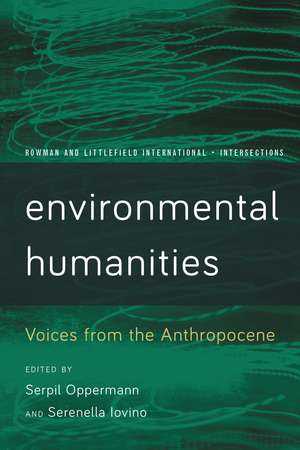
Environmental Humanities: Voices from the Anthropocene: Rowman and Littlefield International – Intersections
Editat de Serpil Oppermann, Serenella Iovinoen Limba Engleză Hardback – 15 dec 2016
At a time when the narrative and theoretical threads of the environmental humanities are more entwined than ever with the scientific, ethical, and political challenges of the global ecological crisis, this volume invites us to rethink the Anthropocene, the posthuman, and the environmental from various cross-disciplinary viewpoints. The book enriches the environmental debate with new conceptual tools and revitalizes thematic and methodological collaborations in the trajectory of ecocriticism and the environmental humanities. Alliances between the humanities and the social and natural sciences are vital in addressing and finding viable solutions to our planetary predicaments. Drawing on cutting-edge studies in all the major fields of the eco-cultural debate, the chapters in this book build a creative critical discourse that explores, challenges and enhances the field of environmental humanities.
Preț: 917.33 lei
Preț vechi: 1369.43 lei
-33%
Puncte Express: 1376
Carte tipărită la comandă
Livrare economică 25 noiembrie-09 decembrie
Livrare prin curier în România Termenul estimat este afișat lângă disponibilitate.
Transport gratuit pentru acest produs Plată online sau ramburs, în funcție de opțiunile comenzii.
Retur gratuit în 14 zile Comandă securizată și suport în română.
Specificații
ISBN-13: 9781783489381
ISBN-10: 1783489383
Pagini: 400
Dimensiuni: 156 x 232 x 30 mm
Greutate: 0.82 kg
Editura: Bloomsbury Publishing
Colecția Rowman & Littlefield
Seria Rowman and Littlefield International – Intersections
Locul publicării:New York, United States
ISBN-10: 1783489383
Pagini: 400
Dimensiuni: 156 x 232 x 30 mm
Greutate: 0.82 kg
Editura: Bloomsbury Publishing
Colecția Rowman & Littlefield
Seria Rowman and Littlefield International – Intersections
Locul publicării:New York, United States
Cuprins
Foreword, Richard Kerridge / Introduction: The Environmental Humanities and the Challenges of the Anthropocene, Serpil Oppermann and Serenella Iovino / Part I - Re-Mapping the Humanities / Posthuman Environs, Jeffrey Jerome Cohen / Environmental History between Institutionalization and Revolution: A Short Commentarywith Two Sites and One Experiment, Marco Armiero / Cultural Ecology, the Environmental Humanities, and the Transdisciplinary Knowledge of Literature, Hubert Zapf / Where is Feminism in the Environmental Humanities? Greta Gaard / Seasick Among the Waves of Ecocriticism: An Inquiry into Alternative Historiographic Metaphors, Scott Slovic / Part II - Voicing the Anthropocene / The Extraordinary Strata of the Anthropocene, Jan Zalasiewicz / Worldview Remediation in the First Century of the New Millennium, J. Baird Callicott / We Have Never Been "Anthropos": From Environmental Justice to Cosmopolitics, Joni Adamson / Resources (Un)Ltd: Of Planets, Mining and Biogeochemical Togetherness, Filippo Bertoni / Lacuna: Minding the Gaps of Place and Class, Lowell Duckert / Part III - Nature's Cultures and Creatures / Nature/Culture/Seawater: Theory Machines, Anthropology, Oceanization, Stefan Helmreich / Revisiting the Anthropological Difference, Matthew Calarco / Lively Ethography: Storying Animist Worlds, Thom van Dooren and Deborah Bird Rose / Religion and Ecology: Towards the Communion of Creatures, Kate Rigby / How the Earth Speaks Now: The Book of Nature and Biosemiotics as Theoretical Resource for the Environmental Humanities in the Twenty-First Century, Wendy Wheeler / Part IV - EcoStories and Conversations / How to Read a Bridge, Rob Nixon / The Martian Book of the Dead, Bronislaw Szerszynski / On Rivers, Juan Carlos Galeano / Can the Humanities Become Posthuman? A Conversation, Rosi Braidotti and Cosetta Veronese
Recenzii
Oppermann and Iovino have assembled a creative, diverse essay collection, international in scope, often speculative and passionate, and committed to transdisciplinarity. If the Anthropocene usually signifies boosterish techno-optimism or dire eco-apocalypse, this book offers the hope, at least, of keener intelligence about what the humanities can be as we enter an era of profound, geologic uncertainty.
If you read only one collection of essays in the new field of Environmental Humanities, you cannot currently do better than by choosing this one. It provides a great chorus of voices, a wide panorama of concepts and discourses, and a fascinating, at times troubling, exploration of the situation of humanity on an endangered planet.
"Has our planet entered the Anthropocene? Are we leaving behind the geological era that provided the climatic conditions for the birth and flowering of civilization? If so, all the categories that informed civilization - including that of anthropos itself - will be up for review. Such a renegotiation of the very terms of our existence is a task not so much for science as for a scientifically literate, re-awakened humanities, blasted open by crisis to new horizons of imagination and to unprecedented existential responsibilities. Voices from the Anthropocene is a powerful response to this extraordinary challenge."
the environmental humanities is well on its way to becoming a permanent fixture of contemporary university life. The field has two academic journals (Resilience and Environmental Humanities) and dozens of academic programs and institutes have proliferated in Europe and the United States. But there are other markers of academic legitimacy, such as handbooks, companions, and encyclopedias. These hefty-and often expensive-books collect key works and interventions by scholars in a particular subject.
If you read only one collection of essays in the new field of Environmental Humanities, you cannot currently do better than by choosing this one. It provides a great chorus of voices, a wide panorama of concepts and discourses, and a fascinating, at times troubling, exploration of the situation of humanity on an endangered planet.
"Has our planet entered the Anthropocene? Are we leaving behind the geological era that provided the climatic conditions for the birth and flowering of civilization? If so, all the categories that informed civilization - including that of anthropos itself - will be up for review. Such a renegotiation of the very terms of our existence is a task not so much for science as for a scientifically literate, re-awakened humanities, blasted open by crisis to new horizons of imagination and to unprecedented existential responsibilities. Voices from the Anthropocene is a powerful response to this extraordinary challenge."
the environmental humanities is well on its way to becoming a permanent fixture of contemporary university life. The field has two academic journals (Resilience and Environmental Humanities) and dozens of academic programs and institutes have proliferated in Europe and the United States. But there are other markers of academic legitimacy, such as handbooks, companions, and encyclopedias. These hefty-and often expensive-books collect key works and interventions by scholars in a particular subject.