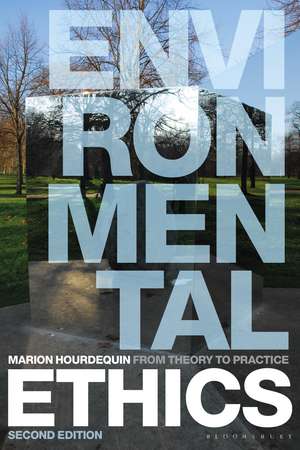
Environmental Ethics: From Theory to Practice
Autor Professor Marion Hourdequinen Limba Engleză Paperback – 8 feb 2024
Exploring these questions and more, this book provides an up-to-date and balanced introduction to environmental ethics. It first examines ethical theory, then ties theory to practice, showing how values guide environmental policies, but also how policies and institutions shape environmental values. Updated and expanded to engage with the latest scholarship, scientific findings, and societal challenges, this 2nd edition features:
New sections on food ethics, multispecies justice, intergenerational ethics, and the Anthropocene
Contemporary case studies focusing on the rights of nature, the use of biotechnology in ecological restoration, and just climate transitions
Expanded coverage of diverse philosophical traditions, including Confucian, Daoist, and Indigenous ethical perspectives
Updated discussion questions, further reading sections, and online resources
Exploring the possibilities and limitations inherent in both classical ethical models and modern theoretical approaches to the environment, this is a key resource for teaching students to think ethically about the world we live in.
Preț: 161.46 lei
Preț vechi: 200.41 lei
-19%
Puncte Express: 242
Carte disponibilă
Livrare economică 03-17 noiembrie
Livrare express 20-24 octombrie pentru 70.84 lei
Livrare prin curier în România Termenul estimat este afișat lângă disponibilitate.
Transport gratuit de la 400.00 lei Plată online sau ramburs, în funcție de opțiunile comenzii.
Retur gratuit în 14 zile Comandă securizată și suport în română.
Specificații
ISBN-13: 9781350185920
ISBN-10: 1350185922
Pagini: 320
Ilustrații: 4 bw illus
Dimensiuni: 154 x 232 x 22 mm
Greutate: 0.48 kg
Ediția:2nd edition
Editura: Bloomsbury Publishing
Colecția Bloomsbury Academic
Locul publicării:London, United Kingdom
ISBN-10: 1350185922
Pagini: 320
Ilustrații: 4 bw illus
Dimensiuni: 154 x 232 x 22 mm
Greutate: 0.48 kg
Ediția:2nd edition
Editura: Bloomsbury Publishing
Colecția Bloomsbury Academic
Locul publicării:London, United Kingdom
V-ar putea interesa
-
 -19%Preț: 74.16 lei91.83 lei
 -
 A Metaphysics for FreedomHelen Steward-19%Preț: 323.35 lei400.68 lei
 -
 Responsibility and Distributive JusticeCarl Knight-20%Preț: 303.66 lei381.10 lei
 -
 Nature, Reason, and the Good Life: Ethics for Human BeingsRoger Teichmann-20%Preț: 240.74 lei299.27 lei
 -
 From Rationality to EqualityJames P. Sterba-17%Preț: 239.48 lei290.18 lei
 -
 A Sentimentalist Theory of the MindMichael Slote-29%Preț: 503.44 lei704.94 lei
 -
 How We Fight: Ethics in WarHelen Frowe-28%Preț: 505.57 lei706.15 lei
 -
 Oxford Studies in Metaethics, Volume 8Russ Shafer-Landau-31%Preț: 867.99 lei1262.13 lei
 -
 Human Interests: or Ethics for PhysicalistsJoseph Mendola-31%Preț: 746.38 lei1079.76 lei
 -
 Oxford Studies in Agency and Responsibility, Volume 1David Shoemaker-11%Preț: 345.61 lei387.28 lei
 -
 From Individual to Collective Intentionality: New EssaysSara Rachel Chant-35%Preț: 626.06 lei960.03 lei
 -
 Empathy and MoralityHeidi L. Maibom-31%Preț: 629.19 lei910.97 lei
 -
 -34%Preț: 728.39 lei1101.63 lei
 -
 Environmental EthicsRobin AttfieldPreț: 226.05 lei
 -
 Ethics for OCR Religious StudiesMark CoffeyPreț: 396.64 lei
 -
 -24%Preț: 95.02 lei125.13 lei
 -
 This Is EthicsJussi SuikkanenPreț: 308.38 lei
 -
 Moral Matters: A Philosophy of HomecomingMark Dooley-11%Preț: 307.98 lei346.82 lei
 -
 The Bloomsbury Companion to EthicsDr Christian B. Miller-14%Preț: 281.47 lei326.83 lei
 -
 Unravelling EncountersCaitlin JanzenPreț: 328.25 lei
 -
 -27%Preț: 66.13 lei91.14 lei
 -
 After VirtueProfessor Alasdair MacIntyre-14%Preț: 169.56 lei197.15 lei
 -
 Nothing but WickednessTheodore Dalrymple-17%Preț: 95.42 lei115.38 lei
Cuprins
List of Illustrations
Acknowledgements
Part I: Environmental Values
1. Bringing Values to Light
2. Western Ethical Theories and the Environment
3. Anthropocentrism and its Critics: Broadening Moral Concern
4. The Social Dimensions of Environmental Problems
Part II: Environmental Ethics in Practice
5. Ethics, Institutions, and the Environment
6. Global Climate Change
7. Ecological Restoration
8. Engaging Environmental Concern, Promoting Change
Notes
References
Index
Acknowledgements
Part I: Environmental Values
1. Bringing Values to Light
2. Western Ethical Theories and the Environment
3. Anthropocentrism and its Critics: Broadening Moral Concern
4. The Social Dimensions of Environmental Problems
Part II: Environmental Ethics in Practice
5. Ethics, Institutions, and the Environment
6. Global Climate Change
7. Ecological Restoration
8. Engaging Environmental Concern, Promoting Change
Notes
References
Index
Recenzii
Hourdequin writes with clarity, depth, and passion, so the book is suitable for nonspecialists.
What most distinguishes this text ... is its emphasis on practical action ... [Hourdequin] presents a diversity of views sympathetically, explains them accurately and assesses them fairly.
The great strength of the text is the variety of ethical approaches on offer ... Houdequin's book serves as a solid and broad introductory textbook to environmental ethics at an intermediate or senior undergraduate level.
This well-written book works both as an introductory text as well as a review of the topic. The arguments and examples are helpful both for those readers interested in the theoretical background as well as for those more interested in the applied aspects. The examples are well chosen and well presented.
Hourdequin's book addresses environmental ethics from theory to practice through a series of well-structured and thought-provoking chapters. ... [It] stand[s] out from the present-day rich panorama of works regarding environmental ethics and may significantly mark the horizon of future publications in the field.
It is outstanding and commendable as a textbook for both undergraduate and postgraduate alike ... In short, the book is a pleasure to read ... Written at a level that any intelligent layperson will appreciate and enjoy. It is an ideal basic introductory to environmental ethics ... The book is essential reading.
In addition to discussing the usual topics and themes, in this engaging new introduction to environmental ethics Marion Hourdequin draws on the insights of Chinese philosophy and focuses on such issues of contemporary concern as climate change, ecological restoration and the problem of defining sustainability.
Few philosophers and fewer environmental scientists could have written a book that combines a solid grasp of real ethical theory, a full understanding of the current state of the science, and the wisdom that Marion Hourdequin brings to Environmental Ethics. This work is not only an utterly accessible introduction to the field, but a magisterial assessment of the inescapable alternatives it confronts us with.
This engaging and comprehensive introduction to environmental ethics combines directness and clarity with a depth of analysis and distinctiveness of approach that few texts in the field can match. The result is a feast for inquiring minds, an inspiration and aspiration for active ones; specifically, it helps us understand how an environmental ethic can become a lived ethic.
Marion Hourdequin is one of the leading voices in environmental ethics. Her clarity of thought, careful exposition, familiarity with the field, and commitment to expanding the scope of environmental conservation shines in this textbook.
This is the best introductory text on environmental ethics. With superb style, and sparkling prose that is accessible even for those new to ethical thinking, Hourdequin provides a robust analysis of the key issues, ideas, and debates in the field, including extensive discussion of relational approaches not often included in other books.
What most distinguishes this text ... is its emphasis on practical action ... [Hourdequin] presents a diversity of views sympathetically, explains them accurately and assesses them fairly.
The great strength of the text is the variety of ethical approaches on offer ... Houdequin's book serves as a solid and broad introductory textbook to environmental ethics at an intermediate or senior undergraduate level.
This well-written book works both as an introductory text as well as a review of the topic. The arguments and examples are helpful both for those readers interested in the theoretical background as well as for those more interested in the applied aspects. The examples are well chosen and well presented.
Hourdequin's book addresses environmental ethics from theory to practice through a series of well-structured and thought-provoking chapters. ... [It] stand[s] out from the present-day rich panorama of works regarding environmental ethics and may significantly mark the horizon of future publications in the field.
It is outstanding and commendable as a textbook for both undergraduate and postgraduate alike ... In short, the book is a pleasure to read ... Written at a level that any intelligent layperson will appreciate and enjoy. It is an ideal basic introductory to environmental ethics ... The book is essential reading.
In addition to discussing the usual topics and themes, in this engaging new introduction to environmental ethics Marion Hourdequin draws on the insights of Chinese philosophy and focuses on such issues of contemporary concern as climate change, ecological restoration and the problem of defining sustainability.
Few philosophers and fewer environmental scientists could have written a book that combines a solid grasp of real ethical theory, a full understanding of the current state of the science, and the wisdom that Marion Hourdequin brings to Environmental Ethics. This work is not only an utterly accessible introduction to the field, but a magisterial assessment of the inescapable alternatives it confronts us with.
This engaging and comprehensive introduction to environmental ethics combines directness and clarity with a depth of analysis and distinctiveness of approach that few texts in the field can match. The result is a feast for inquiring minds, an inspiration and aspiration for active ones; specifically, it helps us understand how an environmental ethic can become a lived ethic.
Marion Hourdequin is one of the leading voices in environmental ethics. Her clarity of thought, careful exposition, familiarity with the field, and commitment to expanding the scope of environmental conservation shines in this textbook.
This is the best introductory text on environmental ethics. With superb style, and sparkling prose that is accessible even for those new to ethical thinking, Hourdequin provides a robust analysis of the key issues, ideas, and debates in the field, including extensive discussion of relational approaches not often included in other books.
Caracteristici
Examines relationship between theory and practice, specifically how political philosophy is translated into policy & actions
Notă biografică
Marion Hourdequin is Associate Professor of Philosophy at Colorado College, USA. Her work in environmental ethics has appeared in a number of journals, including Environmental Ethics, Environmental Values and Ethics, Policy and Environment.