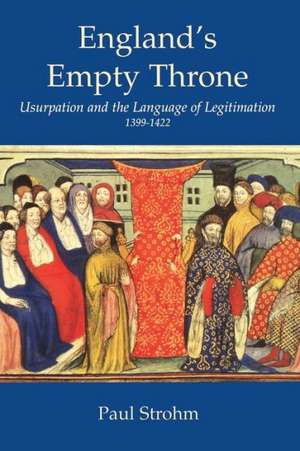
England's Empty Throne: Usurpation and the Language of Legitimation, 1399-1422
Autor Paul Strohmen Limba Engleză Paperback – 23 apr 2013
After the dethronement and subsequent murder of Richard II, the usurping Lancastrian dynasty faced an exceptional challenge. Interrupting a long period of Plantagenet rule, Henry IV and Henry V needed not only to establish physical possession of the English throne, but to occupy it symbolically as well. In this boldly revisionary book, Paul Strohm provides a new account of the Lancastrian revolution and its aftermath. Integrating techniques of literary and historical analysis, he explores the new dynasty`s quest for legitimacy and the importance of symbolic activity to the making of kingship.
Strohm reveals the Lancastrian monarchs as masters of outward display, persuasively "performing" their kingship in a variety of novel ceremonies. Henry IV is crowned with a newly discovered coronation oil. The murdered Richard II is elaborately reburied. Opinion is courted and deceived with invented chronicles, false prophecies, and bogus genealogies. Opponents of the new regime are subject to new varieties of trial and punishment. Far-reaching Lancastrian experiments in domination include the proscription of prophecy, the enlistment of poetry, the use of spies and hired informers, and, most ambitiously, the redefinition of treason to cover not only overt deeds but also things said and even thought. Strohm`s account of the Lancastrian quest for legitimacy and the uses of symbolic power illuminates—indeed recasts—our understanding of a period of unprecedented political upheaval.
Strohm reveals the Lancastrian monarchs as masters of outward display, persuasively "performing" their kingship in a variety of novel ceremonies. Henry IV is crowned with a newly discovered coronation oil. The murdered Richard II is elaborately reburied. Opinion is courted and deceived with invented chronicles, false prophecies, and bogus genealogies. Opponents of the new regime are subject to new varieties of trial and punishment. Far-reaching Lancastrian experiments in domination include the proscription of prophecy, the enlistment of poetry, the use of spies and hired informers, and, most ambitiously, the redefinition of treason to cover not only overt deeds but also things said and even thought. Strohm`s account of the Lancastrian quest for legitimacy and the uses of symbolic power illuminates—indeed recasts—our understanding of a period of unprecedented political upheaval.
Preț: 298.52 lei
Puncte Express: 448
Carte tipărită la comandă
Livrare economică 27 noiembrie-11 decembrie
Livrare prin curier în România Termenul estimat este afișat lângă disponibilitate.
Transport gratuit de la 400.00 lei Plată online sau ramburs, în funcție de opțiunile comenzii.
Retur gratuit în 14 zile Comandă securizată și suport în română.
Specificații
ISBN-13: 9780300198706
ISBN-10: 0300198701
Pagini: 288
Ilustrații: 5 b-w illus.
Dimensiuni: 156 x 235 x 16 mm
Greutate: 0.41 kg
Editura: Yale University Press
Colecția Yale University Press
ISBN-10: 0300198701
Pagini: 288
Ilustrații: 5 b-w illus.
Dimensiuni: 156 x 235 x 16 mm
Greutate: 0.41 kg
Editura: Yale University Press
Colecția Yale University Press
V-ar putea interesa
-
 The First Ladies of RomeAnnelise Freisenbruch-19%Preț: 98.81 lei121.87 lei
 -
 -31%Preț: 402.39 lei581.20 lei
 -
 Conscience: A Very Short IntroductionPaul Strohm-20%Preț: 56.92 lei71.00 lei
 -
 Parties and People: England 1914-1951Ross McKibbin-13%Preț: 278.17 lei320.37 lei
 -
 Palmerston: A BiographyDavid BrownPreț: 173.68 lei
 -
 Edward IISeymour PhillipsPreț: 229.13 lei
 -
 Aethelstan: The First King of EnglandSarah FootPreț: 159.31 lei
 -
 Chocolate: The British Chocolate IndustryPaul Chrystal-30%Preț: 53.99 lei77.60 lei
 -
 SAS: The AutobiographyJon E. LewisPreț: 193.93 lei
 -
 -25%Preț: 70.57 lei94.44 lei
Notă biografică
Paul Strohm is J. R. R. Tolkien Professor of English Language and Literature at Oxford University.
Recenzii
"Paul Strohm's strikingly original . . . book offers rich opportunities for thinking about the relationships between textual analysis and historical understanding. . . . [His] analysis of Lancastrian texts and imagination will undoubtedly prove immensely energizing in medieval English literary and cultural studies. If its full implications for medieval history are also recognized and explored, its impact will be even more profound and enduring." —Review of English Studies
"[Henry IV's] usurpation stands exposed as a scandalous rupture in the line of succession. Strohm's powerfully argued book deals with the usurper's efforts to mend the rift with lies and propaganda, and explores the unpredictable and often fantastical forms in which the Lancastrian repressed staged its return." —Times Literary Supplement
"England's Empty Throne . . . confirms Paul Strohm's extraordinary ability to disclose and interpret elements of social and political contestation in texts produced in late medieval England, even (or especially) when such disclosure seems farthest from the overt intent of their composers or sponsors." —Arthuriana
Descriere
Descriere de la o altă ediție sau format:
After the dethronement and subsequent murder of Richard II, the usurping Lancastrian dynasty faced an exceptional challenge. Interrupting a long period of Plantagenet rule, Henry IV and Henry V needed not only to establish physical possession of the English throne but to occupy it symbolically as well. In this boldly revisionary book, Paul Strohm provides a new account of the Lancastrian revolution and its aftermath.
Integrating techniques of literary and historical analysis, he reveals the Lancastrian monarchs as masters of outward display, persuasively "performing" their kingship through a variety of novel ceremonies in a quest for legitimacy. He also describes far-reaching Lancastrian experiments in domination, including the proscription of prophecy; the enlistment of poetry as court propaganda; the extensive use of spies and informers; and, most ambitiously, the redefinition of treason to cover not only overt deeds but words and thoughts as well.
Strohm's account of the Lancastrian quest for legitimacy, and the uses of symbolic power, illuminates—indeed, recasts—our understanding of a period of unprecedented political upheaval.
Strohm's account of the Lancastrian quest for legitimacy, and the uses of symbolic power, illuminates—indeed, recasts—our understanding of a period of unprecedented political upheaval.