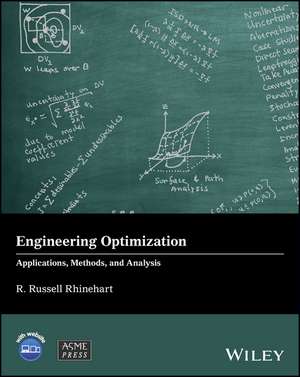
Engineering Optimization: Wiley-ASME Press Series
Autor R. Russell Rhineharten Limba Engleză Hardback – 18 mai 2018


Preț: 792.91 lei
Preț vechi: 1086.17 lei
-27%
Puncte Express: 1189
Carte tipărită la comandă
Livrare economică 07-21 noiembrie
Livrare prin curier în România Termenul estimat este afișat lângă disponibilitate.
Transport gratuit pentru acest produs Plată online sau ramburs, în funcție de opțiunile comenzii.
Retur gratuit în 14 zile Comandă securizată și suport în română.
Specificații
ISBN-13: 9781118936337
ISBN-10: 1118936337
Pagini: 756
Dimensiuni: 196 x 241 x 45 mm
Greutate: 1.58 kg
Editura: Wiley
Colecția Wiley-ASME Press Series
Seria Wiley-ASME Press Series
Locul publicării:Chichester, United Kingdom
ISBN-10: 1118936337
Pagini: 756
Dimensiuni: 196 x 241 x 45 mm
Greutate: 1.58 kg
Editura: Wiley
Colecția Wiley-ASME Press Series
Seria Wiley-ASME Press Series
Locul publicării:Chichester, United Kingdom
V-ar putea interesa
-
 Probability, Statistics, and Stochastic ProcessesPeter Olofsson-9%Preț: 839.16 lei922.15 lei
 -
 -9%Preț: 1180.41 lei1297.15 lei
 -
 Constrained Statistical InferenceSilvapulle-9%Preț: 1066.94 lei1172.47 lei
 -
 Approximation Theorems of Mathematical StatisticsRobert J Serfling-9%Preț: 1009.96 lei1109.84 lei
 -
 Methods of Multivariate StatisticsMuni S Srivastava-23%Preț: 1026.32 lei1332.88 lei
 -
 Theory of MeasuresVestrup-9%Preț: 1151.17 lei1265.02 lei
 -
 -20%Preț: 870.20 lei1087.74 lei
 -
 Topological Vector Spaces and DistributionsJohn HorvathPreț: 169.63 lei
 -
 Dispersion Decay and Scattering TheoryAlexander Komech-8%Preț: 660.57 lei718.01 lei
 -
 Exploring MathematicsRajee Amarasinghe-23%Preț: 890.80 lei1156.88 lei
 -
 -20%Preț: 1545.96 lei1932.45 lei
 -
 Imp 2e Y3 Orchard Hideout Teacher's GuideSherry FraserPreț: 92.81 lei
 -
 Imp 2e Y3 Small World, Isn't It? Teacher's GuideSherry FraserPreț: 93.85 lei
 -
 Imp 2e Y3 High Dive Teacher's GuideSherry FraserPreț: 91.99 lei
 -
 Exploring MathematicsRajee Amarasinghe-19%Preț: 483.44 lei596.84 lei
 -
 Raising Public Awareness of MathematicsEhrhard BehrendsPreț: 395.86 lei
 -
 Preț: 329.69 lei
 -
 Distance in Fuzzy GraphsSameena KalathodiPreț: 374.71 lei
 -
 Les ensembles paradoxauxThomas Kleyntssens-19%Preț: 575.90 lei710.99 lei
 -
 Sur L'Agregation Du Phytoplancton: Cas Du Riz de Kovie Au TogoNadjia El Saadi-15%Preț: 552.89 lei650.46 lei
 -
 Preț: 424.67 lei
 -
 Gestion durable des grands singesPatrick Armel MbossoPreț: 351.55 lei
Public țintă
Primary: Researchers and practitioners, and graduate students across all engineering disciplines (inc. mechanical, chemical, electrical, industrial) and mathematical sciences (physics, chemistry, statistics, computer science).Secondary: Industrial consultants and companies, and plant managers.
Notă biografică
R. Russell Rhinehart is an Emeritus Professor and Amoco Chair in the School of Chemical Engineering at Oklahoma State University. He was named as one of InTECH's 50 Most Influential Industry Innovators in 2004, and was inducted into the Automation Hall of Fame for the Process Industries in 2005. His research focuses on process improvement through modeling, optimization and control, and product improvement through modeling and design.
Cuprins
Preface xix
Acknowledgments xxvii
Nomenclature xxix
About the Companion Website xxxvii
Section 1 Introductory Concepts 1
1 Optimization: Introduction and Concepts 3
2 Optimization Application Diversity and Complexity 33
3 Validation: Knowing That the Answer Is Right 53
Section 2 Univariate Search Techniques 59
4 Univariate (Single DV) Search Techniques 61
5 Path Analysis 93
6 Stopping and Convergence Criteria: 1-D Applications 107
Section 3 Multivariate Search Techniques 117
7 Multidimension Application Introduction and the Gradient 119
8 Elementary Gradient-Based Optimizers: CSLSandISD135
9 Second-Order Model-Based Optimizers:SQandNR155
10 Gradient-Based Optimizer Solutions:LM, RLM, CG, BFGS, RG, and GRG173
11 Direct Search Techniques 187
12 Linear Programming 223
13 Dynamic Programming 233
14 Genetic Algorithms and Evolutionary Computation 243
15 Intuitive Optimization 253
16 Surface Analysis II 257
17 Convergence Criteria 2: N-D Applications 265
18 Enhancements to Optimizers 271
Section 4 Developing Your Application Statements 279
19 Scaled Variables and Dimensional Consistency 281
20 Economic Optimization 289
21 Multiple OF and Constraint Applications 305
22 Constraints 319
23 Multiple Optima 335
24 Stochastic Objective Functions 353
25 Effects of Uncertainty 367
26 Optimization of Probable Outcomes and Distribution Characteristics 381
27 Discrete and Integer Variables 391
28 Class Variables 397
29 Regression 403
Section 5 Perspective on Many Topics 441
30 Perspective 443
31 Response Surface Aberrations 459
32 Identifying the Models, OF, DV, Convergence Criteria, and Constraints 475
33 Evaluating Optimizers 489
34 Troubleshooting Optimizers 499
Section 6 Analysis of Leapfrogging Optimization 505
35 Analysis of Leapfrogging 507
Section 7 Case Studies 529
36 Case Study 1: Economic Optimization of a Pipe System 531
37 Case Study 2: Queuing Study 539
38 Case Study 3: Retirement Study 543
39 Case Study 4: AGoddard Rocket Study 551
40 Case Study 5: Reservoir 557
41 Case Study 6: Area Coverage 561
42 Case Study 7: Approximating Series Solution to an ODE 565
43 Case Study 8: Horizontal Tank Vapor-Liquid Separator 571
44 Case Study 9: In Vitro Fertilization 579
45 Case Study 10: Data Reconciliation 585
Section 8 Appendices 591
Section 9 References and Index 717
References and Additional Resources 719
Index 723
Acknowledgments xxvii
Nomenclature xxix
About the Companion Website xxxvii
Section 1 Introductory Concepts 1
1 Optimization: Introduction and Concepts 3
2 Optimization Application Diversity and Complexity 33
3 Validation: Knowing That the Answer Is Right 53
Section 2 Univariate Search Techniques 59
4 Univariate (Single DV) Search Techniques 61
5 Path Analysis 93
6 Stopping and Convergence Criteria: 1-D Applications 107
Section 3 Multivariate Search Techniques 117
7 Multidimension Application Introduction and the Gradient 119
8 Elementary Gradient-Based Optimizers: CSLSandISD135
9 Second-Order Model-Based Optimizers:SQandNR155
10 Gradient-Based Optimizer Solutions:LM, RLM, CG, BFGS, RG, and GRG173
11 Direct Search Techniques 187
12 Linear Programming 223
13 Dynamic Programming 233
14 Genetic Algorithms and Evolutionary Computation 243
15 Intuitive Optimization 253
16 Surface Analysis II 257
17 Convergence Criteria 2: N-D Applications 265
18 Enhancements to Optimizers 271
Section 4 Developing Your Application Statements 279
19 Scaled Variables and Dimensional Consistency 281
20 Economic Optimization 289
21 Multiple OF and Constraint Applications 305
22 Constraints 319
23 Multiple Optima 335
24 Stochastic Objective Functions 353
25 Effects of Uncertainty 367
26 Optimization of Probable Outcomes and Distribution Characteristics 381
27 Discrete and Integer Variables 391
28 Class Variables 397
29 Regression 403
Section 5 Perspective on Many Topics 441
30 Perspective 443
31 Response Surface Aberrations 459
32 Identifying the Models, OF, DV, Convergence Criteria, and Constraints 475
33 Evaluating Optimizers 489
34 Troubleshooting Optimizers 499
Section 6 Analysis of Leapfrogging Optimization 505
35 Analysis of Leapfrogging 507
Section 7 Case Studies 529
36 Case Study 1: Economic Optimization of a Pipe System 531
37 Case Study 2: Queuing Study 539
38 Case Study 3: Retirement Study 543
39 Case Study 4: AGoddard Rocket Study 551
40 Case Study 5: Reservoir 557
41 Case Study 6: Area Coverage 561
42 Case Study 7: Approximating Series Solution to an ODE 565
43 Case Study 8: Horizontal Tank Vapor-Liquid Separator 571
44 Case Study 9: In Vitro Fertilization 579
45 Case Study 10: Data Reconciliation 585
Section 8 Appendices 591
Section 9 References and Index 717
References and Additional Resources 719
Index 723