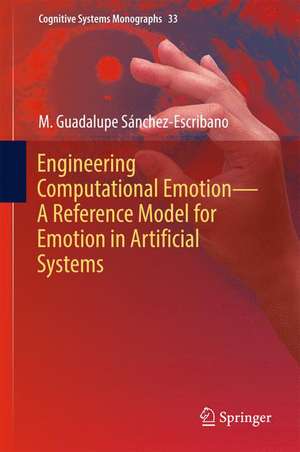
Engineering Computational Emotion - A Reference Model for Emotion in Artificial Systems: Cognitive Systems Monographs, cartea 33
Autor M. Guadalupe Sánchez-Escribanoen Limba Engleză Hardback – 5 iul 2017
This book provides a new perspective on emotion in artificial systems. It presents an insightful explanation of how emotion might emerge deep inside the systems, and emotional behaviour could be seen as a consequence of their internal management. The final approach attempts to account for a range of events associated with emotion, from functional and behavioural features to aspects related to the dynamics and the development of feeling.
The book provides a theoretical foundation for engineering and designing computational emotion as a framework for developing future adaptive systems. It includes a painstaking analysis of the rationales for the features of the final approach, including aspects from the fields of Artificial Intelligence, Psychology, the Cognitive Sciences and Model-based Systems. Synthesizing knowledge from a variety of disciplines, it ultimately presents a model conceptualization following the perspectives of Engineering and the CognitiveSciences.
Din seria Cognitive Systems Monographs
- 15%
 Preț: 622.59 lei
 - 20%
 Preț: 620.38 lei
 - 20%
 Preț: 942.75 lei
 - 18%
 Preț: 993.09 lei
 - 15%
 Preț: 635.22 lei
 - 15%
 Preț: 640.89 lei
 - 15%
 Preț: 619.12 lei
 - 20%
 Preț: 1453.01 lei
 - 15%
 Preț: 605.45 lei
 - 15%
 Preț: 666.53 lei
 - 15%
 Preț: 662.13 lei
 - 20%
 Preț: 665.83 lei
 - 15%
 Preț: 643.87 lei
 - 15%
 Preț: 668.28 lei
 - 5%
 Preț: 1060.90 lei
 - 15%
 Preț: 659.28 lei
 - 15%
 Preț: 674.64 lei
 - 20%
 Preț: 673.39 lei
 -
 Preț: 404.04 lei
 - 15%
 Preț: 666.11 lei
 - 20%
 Preț: 687.99 lei
 - 20%
 Preț: 675.79 lei
 - 20%
 Preț: 723.79 lei
 - 15%
 Preț: 663.25 lei
 - 20%
 Preț: 681.34 lei
 - 20%
 Preț: 1005.29 lei
 - 20%
 Preț: 671.16 lei
 - 18%
 Preț: 924.79 lei
 - 20%
 Preț: 670.28 lei
Preț: 674.03 lei
Preț vechi: 842.53 lei
-20%
Puncte Express: 1011
Carte tipărită la comandă
Livrare economică 23 noiembrie-07 decembrie
Livrare prin curier în România Termenul estimat este afișat lângă disponibilitate.
Transport gratuit pentru acest produs Plată online sau ramburs, în funcție de opțiunile comenzii.
Retur gratuit în 14 zile Comandă securizată și suport în română.
Specificații
ISBN-13: 9783319594293
ISBN-10: 331959429X
Pagini: 280
Ilustrații: XXI, 258 p. 82 illus., 27 illus. in color.
Dimensiuni: 160 x 241 x 21 mm
Greutate: 0.54 kg
Ediția:1st edition 2018
Editura: Springer
Colecția Cognitive Systems Monographs
Seria Cognitive Systems Monographs
Locul publicării:Cham, Switzerland
ISBN-10: 331959429X
Pagini: 280
Ilustrații: XXI, 258 p. 82 illus., 27 illus. in color.
Dimensiuni: 160 x 241 x 21 mm
Greutate: 0.54 kg
Ediția:1st edition 2018
Editura: Springer
Colecția Cognitive Systems Monographs
Seria Cognitive Systems Monographs
Locul publicării:Cham, Switzerland
V-ar putea interesa
-
 Open Problems in Spectral Dimensionality ReductionHarry Strange-20%Preț: 311.18 lei388.98 lei
 -
 -20%Preț: 1030.48 lei1288.10 lei
 -
 Advances onto the Internet of ThingsSalvatore Gaglio-20%Preț: 960.95 lei1201.19 lei
 -
 -20%Preț: 672.03 lei840.04 lei
 -
 Intelligent Strategies for Pathway MiningQingfeng Chen-31%Preț: 276.95 lei402.40 lei
 -
 Citizen in Sensor NetworksJordi Nin-20%Preț: 325.43 lei406.79 lei
 -
 Digital Enterprise Design & ManagementPierre¿Jean Benghozi-20%Preț: 963.71 lei1204.64 lei
 -
 Graph Structures for Knowledge Representation and ReasoningMadalina Croitoru-20%Preț: 330.98 lei413.72 lei
 -
 Advances in Robot LearningJeremy Wyatt-20%Preț: 316.03 lei395.04 lei
 -
 -20%Preț: 643.17 lei803.96 lei
 -
 -20%Preț: 318.67 lei398.33 lei
 -
 Active Conceptual Modeling of LearningPeter P. Chen-20%Preț: 319.10 lei398.88 lei
 -
 Formal Concept AnalysisRaoul Medina-20%Preț: 324.22 lei405.27 lei
 -
 -20%Preț: 323.86 lei404.83 lei
 -
 New Frontiers in Artificial IntelligenceKen Satoh-20%Preț: 341.23 lei426.53 lei
 -
 Inductive Logic ProgrammingHendrik Blockeel-20%Preț: 323.60 lei404.50 lei
 -
 -20%Preț: 656.24 lei820.30 lei
 -
 -20%Preț: 664.45 lei830.56 lei
 -
 Possibility Theory and the RiskIrina Georgescu-20%Preț: 613.08 lei766.34 lei
 -
 -34%Preț: 735.47 lei1122.53 lei
 -
 -20%Preț: 556.83 lei696.04 lei
 -
 Autonomous SearchYoussef Hamadi-20%Preț: 630.31 lei787.89 lei
 -
 Industrial Applications of Evolutionary AlgorithmsErnesto Sanchez-20%Preț: 640.65 lei800.81 lei
 -
 Fuzzy Evidence in Identification, Forecasting and DiagnosisAlexander P. Rotshtein-20%Preț: 954.49 lei1193.11 lei
 -
 -20%Preț: 956.44 lei1195.55 lei
 -
 Recommender Systems for the Social WebJosé J. Pazos Arias-20%Preț: 645.95 lei807.45 lei
 -
 Soft Computing for Business IntelligenceRafael Espin-20%Preț: 683.12 lei853.89 lei
 -
 Transactions on Computational Collective Intelligence XIINgoc-Thanh Nguyen-20%Preț: 290.62 lei363.28 lei
 -
 Supply Chain Management Under FuzzinessCengiz Kahraman-20%Preț: 1051.04 lei1313.80 lei
Cuprins
Introduction.- Models.- Principles for Computational Emotion.- A model of Computational Emotion.- Discussion.- Future Works.
Textul de pe ultima copertă
This book provides a new perspective on emotion in artificial systems. It presents an insightful explanation of how emotion might emerge deep inside the systems, and emotional behaviour could be seen as a consequence of their internal management. The final approach attempts to account for a range of events associated with emotion, from functional and behavioural features to aspects related to the dynamics and the development of feeling.
The book provides a theoretical foundation for engineering and designing computational emotion as a framework for developing future adaptive systems. It includes a painstaking analysis of the rationales for the features of the final approach, including aspects from the fields of Artificial Intelligence, Psychology, the Cognitive Sciences and Model-based Systems. Synthesizing knowledge from a variety of disciplines, it ultimately presents a model conceptualization following the perspectives of Engineering and the CognitiveSciences.
Caracteristici
Provides a wide analysis of emotion from the perspective of artificial systems, a theoretical foundation for designing computational emotion, and a reference model proposed as a framework for designing artificial systems with emotion Presents the unification of theories in order to provide a complete perspective and understanding of the computational mechanisms that might underlie artificial emotion from a multidisciplinary perspective Offers a state-of-the-art set of essential assumptions from the basis of many existing emotion theories