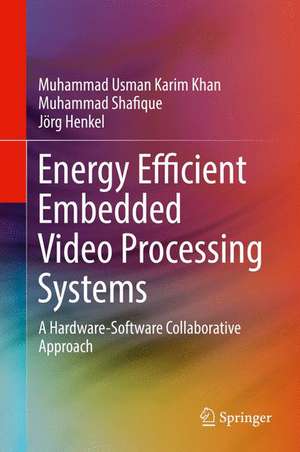
Energy Efficient Embedded Video Processing Systems
Autor Muhammad Usman Karim Khan, Muhammad Shafique, Jörg Henkelen Limba Engleză Hardback – 5 oct 2017
Autorii Muhammad Shafique, Muhammad Usman Karim Khan și Jörg Henkel aduc în această lucrare o vastă expertiză practică din ecosistemul sistemelor integrate, concentrându-se pe optimizarea consumului de energie în procesarea video, o provocare critică pentru dispozitivele mobile și IoT. Observăm cum aceștia abordează sistemul video ca un tot unitar, căutând sinergia între componentele software și hardware pentru a maximiza raportul throughput-per-watt. Pe linia practică a volumului Hardware/Software Architectures for Low-Power Embedded Multimedia Systems, dar cu un focus specific pe standardele moderne de compresie, această carte analizează în profunzime implementarea H.264/AVC și High Efficiency Video Coding (HEVC). Structura volumului este riguros organizată pentru a ghida cititorul de la fundamentele teoretice către aplicații avansate. După o introducere în stadiul actual al tehnologiei, capitolele 4 și 5 detaliază designul software și hardware, oferind soluții pentru paralelism în sisteme eterogene multi-core și utilizarea acceleratorilor hardware. Apreciem includerea capitolului 6, care prezintă benchmark-uri și rezultate concrete, oferind date factuale pentru validarea modelelor propuse. Spre deosebire de 3D Video Coding for Embedded Devices, care se axează pe fluxuri video multiview, lucrarea de față prioritizează eficiența energetică generală și fiabilitatea pe termen lung a sistemelor video complexe, fiind un instrument esențial pentru inginerii care proiectează arhitecturi VLSI moderne.
Preț: 668.64 lei
Preț vechi: 786.63 lei
-15%
Carte disponibilă
Livrare economică 07-21 noiembrie
Specificații
ISBN-10: 3319614541
Pagini: 248
Ilustrații: VIII, 238 p. 107 illus., 105 illus. in color.
Dimensiuni: 160 x 241 x 19 mm
Greutate: 0.53 kg
Ediția:1st edition 2018
Editura: Springer
Locul publicării:Cham, Switzerland
V-ar putea interesa
-
 -41%Preț: 457.81 lei769.47 lei
 -
 Multicore and GPU Programming: An Integrated ApproachGerassimos Barlas-40%Preț: 530.07 lei888.37 lei
 -
 -40%Preț: 492.21 lei824.42 lei
 -
 Embedded Systems: ARM Programming and OptimizationJason D. Bakos-34%Preț: 412.11 lei624.90 lei
 -
 High Performance Computing: Modern Systems and PracticesThomas Sterling-40%Preț: 437.18 lei729.97 lei
 -
 -40%Preț: 458.81 lei768.90 lei
 -
 -20%Preț: 580.64 lei725.81 lei
 -
 -31%Preț: 441.34 lei639.30 lei
 -
 Voice & Vision: A Creative Approach to Narrative FilmmakingMick Hurbis-Cherrier-8%Preț: 543.81 lei591.10 leiRecomandat
 -
 Computer Architecture: A Quantitative ApproachJohn L. Hennessy-39%Preț: 534.37 lei882.55 lei
 -
 Embedded System Design: Methodologies and IssuesLawrence J. Henschen-40%Preț: 431.09 lei719.49 lei
 -
 Coding VideoIain E. Richardson-23%Preț: 605.27 lei786.07 lei
 -
 Artificial Intelligence Hardware DesignAlbert Chun-Chen Liu-20%Preț: 716.17 lei895.22 lei
 -
 Making Embedded SystemsElecia White-38%Preț: 200.48 lei324.68 lei
 -
 -20%Preț: 544.99 lei681.24 lei
 -
 Heterogeneous SoC Design and VerificationKhaled Salah MohamedPreț: 394.07 lei
 -
 -18%Preț: 904.89 lei1103.53 lei
 -
 Greening Video Distribution NetworksAdrian Popescu-20%Preț: 324.30 lei405.37 lei
 -
 -20%Preț: 325.79 lei407.24 lei
De ce să citești această carte
Această carte este indispensabilă inginerilor de sistem și proiectanților hardware care lucrează cu standardele HEVC și H.264. Cititorul câștigă strategii clare de optimizare a consumului de energie prin tehnici de design cross-layer. Este o resursă tehnică solidă pentru oricine dorește să implementeze sisteme video de înaltă performanță pe dispozitive cu resurse limitate, asigurând în același timp o fiabilitate ridicată a componentelor.
Despre autor
Muhammad Shafique este un cercetător de renume în domeniul sistemelor integrate, cu o experiență vastă în arhitecturi hardware/software pentru procesare multimedia, fiind anterior afiliat Institutului de Tehnologie din Karlsruhe (KIT). Jörg Henkel este profesor titular la KIT, deținând catedra de Sisteme Integrate, și este recunoscut la nivel internațional pentru contribuțiile sale în managementul termic și energetic al microprocesoarelor. Împreună cu Muhammad Usman Karim Khan, aceștia formează o echipă de experți care au publicat numeroase lucrări de referință în domeniul eficienței energetice și al designului de circuite VLSI.
Descriere scurtă
Cuprins
Notă biografică
Research & Development GmbH, Böblingen, Germany, since Nov. 2015. His responsibilities include leading a performance analysis group, collaboration with international teams, investigating enterprise software bottlenecks and reporting analysis to different teams, determining software-level best-practices and configurations to efficiently utilize hardware resources, investigating use-cases for hardware accelerators.
Muhammad Shafique is a Professor in the Embedded Computing Systems Group, of the Department of Computer Engineering, at Vienna University of Technology. He received his Ph.D. in Computer Science from Karlsruhe Institute of Technology (KIT) , Germany in 2011. Before, he was with Streaming Networks Pvt. Ltd. (2003-06) and WorldCall Multimedia (2001). Mr. Shafique received his B.Sc. Engineering degree (4 Gold Medals) from University of Engineering and Technology (UET) Lahore, Pakistan in 2000. He then completed his Masters in Information Technology (2 Gold Medals) from Pakistan Institute of Engineering and Applied Sciences (PIEAS) in 2003. He has also acquired an in-depth understanding of various video coding standards (HEVC , H.264/AVC , MVC, MPEG-1/2/4).
Prof. Dr. Jörg Henkel is currently with Karlsruhe Institute of Technology (KIT), Germany, where he is directing the Chair for Embedded Systems CES. Before, he was a Senior Research Staff Member at NEC Laboratories in Princeton, NJ. He received his PhD from Braunschweig University with "Summa cum Laude".
Prof. Henkel has/is organizing various embedded systems and low power ACM/IEEE conferences/symposia as General Chair and Program Chair and was a Guest Editor on these topics in various Journals like the IEEE Computer Magazine.
He was Program Chair of CODES'01, RSP'02, ISLPED’06, SIPS'08 and CASES'09, Estimedia'11, VLSI Design'12, ICCAD’12, PATMOS’13, NOCS’14 and served as General Chair for CODES'02, ISLPED’09 and Estimedia’12, ICCAD’13. He is/has been a steering committee member of major conferences in the embedded systems field like at ICCAD, ISLPED, Codes+ISSS, CASES and is/has been an editorial board member of various journals like the IEEE TVLSI, IEEE TCAD, JOLPE etc.
In recent years, Prof. Henkel has given several keynotes at various international conferences primarily with focus on embedded systems dependability. He has given full/half-day tutorials at leading conferences like DAC, ICCAD, DATE etc. Prof. Henkel received the 2008 DATE Best Paper Award, the 2009 IEEE/ACM William J. Mc Calla ICCAD Best Paper Award, the Codes+ISSS 2011 Best Paper Award and the MaXentric Technologies AHS 2011 Best Paper Award as well as the DATE 2013 Best IP Award and the DAC 2014 Designer Track Best Poster Award. He is the Chairman of the IEEE Computer Society, Germany Section, and was the Editor-in-Chief of the ACM Transactionson Embedded Computing Systems (ACM TECS) for two consecutive terms.
He is an initiator and the coordinator of the German Research Foundation's (DFG) program on 'Dependable Embedded Systems' (SPP 1500). He is the site coordinator (Karlsruhe site) of the Three- University Collaborative Research Center on "Invasive Computing" (DFG TR89). Since 2012 he is an elected Board Member of the German Research Foundation’s (DFG) board on “Computer Architecture and Embedded Systems. He holds ten US patents.