
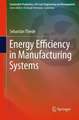
Energy Efficiency in Manufacturing Systems: Sustainable Production, Life Cycle Engineering and Management
Autor Sebastian Thiedeen Limba Engleză Hardback – 20 apr 2012
Din seria Sustainable Production, Life Cycle Engineering and Management
- 15%
 Preț: 651.43 lei
 - 18%
 Preț: 922.44 lei
 - 18%
 Preț: 902.39 lei
 - 18%
 Preț: 779.06 lei
 - 15%
 Preț: 532.62 lei
 - 15%
 Preț: 668.28 lei
 - 18%
 Preț: 942.06 lei
 - 15%
 Preț: 667.41 lei
 -
 Preț: 443.40 lei
 - 18%
 Preț: 1438.19 lei
 - 18%
 Preț: 782.32 lei
 - 15%
 Preț: 663.90 lei
 -
 Preț: 358.19 lei
 - 15%
 Preț: 670.71 lei
 - 18%
 Preț: 894.63 lei
 - 15%
 Preț: 663.45 lei
 - 15%
 Preț: 615.02 lei
 - 15%
 Preț: 639.64 lei
 - 18%
 Preț: 889.50 lei
 - 15%
 Preț: 661.49 lei
 - 15%
 Preț: 653.95 lei
 - 15%
 Preț: 663.03 lei
 - 15%
 Preț: 664.14 lei
 - 15%
 Preț: 668.10 lei
 - 15%
 Preț: 633.43 lei
 - 18%
 Preț: 955.31 lei
 - 15%
 Preț: 664.79 lei
 - 15%
 Preț: 665.01 lei
Preț: 665.43 lei
Preț vechi: 782.86 lei
-15%
Puncte Express: 998
Carte tipărită la comandă
Livrare economică 23 noiembrie-07 decembrie
Livrare prin curier în România Termenul estimat este afișat lângă disponibilitate.
Transport gratuit pentru acest produs Plată online sau ramburs, în funcție de opțiunile comenzii.
Retur gratuit în 14 zile Comandă securizată și suport în română.
Specificații
ISBN-13: 9783642259135
ISBN-10: 3642259138
Pagini: 220
Ilustrații: XXII, 198 p.
Dimensiuni: 160 x 241 x 16 mm
Greutate: 0.45 kg
Ediția:2012
Editura: Springer
Colecția Sustainable Production, Life Cycle Engineering and Management
Seria Sustainable Production, Life Cycle Engineering and Management
Locul publicării:Berlin, Heidelberg, Germany
ISBN-10: 3642259138
Pagini: 220
Ilustrații: XXII, 198 p.
Dimensiuni: 160 x 241 x 16 mm
Greutate: 0.45 kg
Ediția:2012
Editura: Springer
Colecția Sustainable Production, Life Cycle Engineering and Management
Seria Sustainable Production, Life Cycle Engineering and Management
Locul publicării:Berlin, Heidelberg, Germany
V-ar putea interesa
-
 Open Services InnovationHenry ChesbroughPreț: 203.88 lei
 -
 Maintenance Planning, Coordination, & SchedulingDonald H Nyman-19%Preț: 466.70 lei576.18 lei
 -
 -15%Preț: 671.81 lei790.36 lei
 -
 Preț: 349.23 lei
 -
 Preț: 378.79 lei
 -
 Planning and Scheduling in Manufacturing and ServicesMichael L Pinedo-15%Preț: 662.93 lei779.91 lei
 -
 Efficiency and Innovation in LogisticsUwe Clausen-43%Preț: 839.57 lei1479.79 lei
 -
 -15%Preț: 671.79 lei790.34 lei
 -
 -15%Preț: 561.73 lei660.86 lei
 -
 Preț: 368.38 lei
 -
 Handbook on Continuous Improvement TransformationAristide van Aartsengel-9%Preț: 1857.85 lei2041.60 lei
 -
 Lieferantenmanagement in der AutomobilindustrieJohannes E. Dölle-15%Preț: 424.67 lei499.62 lei
Public țintă
ResearchCuprins
Introduction.- Theoretical Background.- Derivation of requirements and methodological approach.- State of research.- Concept development.- Application of concept.- Summary and Outlook.
Textul de pe ultima copertă
Energy consumption is of great interest to manufacturing companies. Beyond considering individual processes and machines, the perspective on process chains and factories as a whole holds major potentials for energy efficiency improvements. To exploit these potentials, dynamic interactions of different processes as well as auxiliary equipment (e.g. compressed air generation) need to be taken into account. In addition, planning and controlling manufacturing systems require balancing technical, economic and environmental objectives. Therefore, an innovative and comprehensive methodology – with a generic energy flow-oriented manufacturing simulation environment as a core element – is developed and embedded into a step-by-step application cycle. The concept is applied in its entirety to a wide range of case studies such as aluminium die casting, weaving mills, and printed circuit board assembly in order to demonstrate the broad applicability and the benefits that can be achieved.
Caracteristici
An innovative and comprehensive methodology towards energy efficiency in manufacturing is presented Latest research on energy efficiency Step-by-step procedures for application The Contents are generic in nature but transferable to different branches Three different case studies are provided