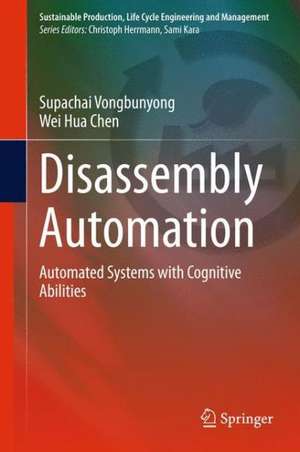
Disassembly Automation: Sustainable Production, Life Cycle Engineering and Management
Autor Supachai Vongbunyong, Wei Hua Chenen Limba Engleză Hardback – 23 mar 2015
Din seria Sustainable Production, Life Cycle Engineering and Management
- 15%
 Preț: 663.97 lei
 - 18%
 Preț: 922.44 lei
 - 18%
 Preț: 902.39 lei
 - 18%
 Preț: 779.06 lei
 - 15%
 Preț: 532.62 lei
 - 15%
 Preț: 668.28 lei
 - 18%
 Preț: 942.06 lei
 - 15%
 Preț: 667.41 lei
 -
 Preț: 443.40 lei
 - 18%
 Preț: 1438.19 lei
 - 18%
 Preț: 782.32 lei
 - 15%
 Preț: 663.90 lei
 -
 Preț: 358.19 lei
 - 15%
 Preț: 670.71 lei
 - 18%
 Preț: 923.32 lei
 - 15%
 Preț: 663.45 lei
 - 15%
 Preț: 615.02 lei
 - 15%
 Preț: 639.64 lei
 - 18%
 Preț: 889.50 lei
 - 15%
 Preț: 661.49 lei
 - 15%
 Preț: 653.95 lei
 - 15%
 Preț: 663.03 lei
 - 15%
 Preț: 664.14 lei
 - 15%
 Preț: 668.10 lei
 - 15%
 Preț: 633.43 lei
 - 18%
 Preț: 955.31 lei
 - 15%
 Preț: 664.79 lei
Preț: 665.01 lei
Preț vechi: 782.36 lei
-15%
Puncte Express: 998
Carte tipărită la comandă
Livrare economică 27 noiembrie-11 decembrie
Livrare prin curier în România Termenul estimat este afișat lângă disponibilitate.
Transport gratuit pentru acest produs Plată online sau ramburs, în funcție de opțiunile comenzii.
Retur gratuit în 14 zile Comandă securizată și suport în română.
Specificații
ISBN-13: 9783319151823
ISBN-10: 3319151827
Pagini: 212
Ilustrații: XVII, 193 p. 96 illus.
Dimensiuni: 160 x 241 x 18 mm
Greutate: 0.44 kg
Ediția:2015
Editura: Springer
Colecția Sustainable Production, Life Cycle Engineering and Management
Seria Sustainable Production, Life Cycle Engineering and Management
Locul publicării:Cham, Switzerland
ISBN-10: 3319151827
Pagini: 212
Ilustrații: XVII, 193 p. 96 illus.
Dimensiuni: 160 x 241 x 18 mm
Greutate: 0.44 kg
Ediția:2015
Editura: Springer
Colecția Sustainable Production, Life Cycle Engineering and Management
Seria Sustainable Production, Life Cycle Engineering and Management
Locul publicării:Cham, Switzerland
V-ar putea interesa
-
 -40%Preț: 177.22 lei295.87 lei
 -
 CNC RoboticsGeoff WilliamsPreț: 285.65 lei
 -
 Preț: 189.94 lei
 -
 Computational Principles of Mobile RoboticsGregory Dudek-20%Preț: 350.17 lei437.35 lei
 -
 Edison's EveGaby WoodPreț: 115.98 lei
 -
 Preț: 347.73 lei
 -
 The Unofficial Lego Mindstorms Nxt 2.0 Inventor's GuideDavid J. PerduePreț: 156.37 lei
 -
 Logistik-Wörterbuch. Dictionary of LogisticsVanessa Scott-Sabic-18%Preț: 838.28 lei1022.30 lei
Public țintă
ResearchCuprins
Introduction.- General Disassembly Process.- Disassembly Automation.- Vision System.- Cognitive Robotics.- Implementation and Case-Study.- Conclusions.
Textul de pe ultima copertă
This book presents a number of aspects to be considered in the development of disassembly automation, including the mechanical system, vision system and intelligent planner. The implementation of cognitive robotics increases the flexibility and degree of autonomy of the disassembly system. Disassembly, as a step in the treatment of end-of-life products, can allow the recovery of embodied value left within disposed products, as well as the appropriate separation of potentially-hazardous components. In the end-of-life treatment industry, disassembly has largely been limited to manual labor, which is expensive in developed countries. Automation is one possible solution for economic feasibility. The target audience primarily comprises researchers and experts in the field, but the book may also be beneficial for graduate students.
Caracteristici
Presents a broad overview of automated disassembly systems Includes a detailed description of a case-study implementation Written by experts in the field Includes supplementary material: sn.pub/extras