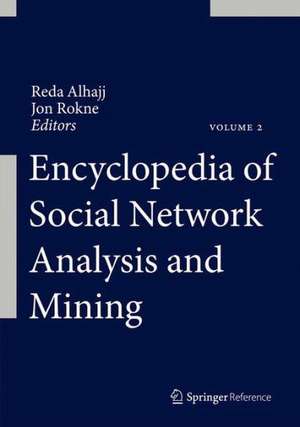
Encyclopedia of Social Network Analysis and Mining
Editat de Reda Alhajj, Jon Rokneen Limba Engleză Hardback – 24 aug 2014
Descoperim aici un exercițiu riguros de modelare a rețelelor sociale, unde construcția și evoluția modelelor sunt analizate prin prisma geometriei computaționale aplicate. Encyclopedia of Social Network Analysis and Mining nu este doar un dicționar de termeni, ci o resursă tehnică ce demonstrează cum algoritmii de machine learning pot fi utilizați pentru a extrage sens din volume uriașe de date colectate din comunitățile online. Reținem abordarea progresivă a celor doi editori, Reda Alhajj și Jon Rokne, care pornesc de la bazele matematice — algebra liniară și statistica — pentru a ajunge la aplicații critice în securitatea cibernetică și analiza sentimentelor. Ca și Nasrullah Memon în From Sociology to Computing in Social Networks, autorii distilează experiența reală în principii acționabile, făcând puntea necesară între teoriile sociologice clasice și puterea de calcul modernă. Această ediție a doua, publicată de Springer, reflectă maturizarea domeniului prin includerea unor secțiuni dedicate Web 2.0 și Web-ului Semantic. Structura este organizată tematic, facilitând tranziția de la managementul datelor și extragerea acestora la analize complexe de fuziune a informațiilor și influență în social media. În contextul operei editorului Reda Alhajj, această enciclopedie reprezintă punctul culminant al cercetărilor sale anterioare. Dacă în Disease Control Through Social Network Surveillance acesta se concentra pe un domeniu de nișă, iar în Data Management and Analysis punea bazele infrastructurii informaționale, aici livrează o viziune panoramică. Lucrarea integrează armonios metodele de data mining cu aplicații practice în business și securitate, oferind un instrumentar complet pentru oricine dorește să înțeleagă arhitectura invizibilă a interacțiunilor umane digitale.
Preț: 2765.00 lei
Preț vechi: 3456.25 lei
-20%
Carte indisponibilă temporar
Specificații
ISBN-10: 1461461693
Pagini: 2437
Ilustrații: XLVIII, 2437 p. 611 illus., 425 illus. in color. In 3 volumes, not available separately.
Dimensiuni: 183 x 260 x 154 mm
Greutate: 5.35 kg
Ediția:2014 edition
Editura: Springer
Locul publicării:New York, NY, United States
V-ar putea interesa
-
 NetworksMark Newman-29%Preț: 475.01 lei666.77 lei
 -
 Networks: OxfordGuido Caldarelli-37%Preț: 45.22 lei71.99 lei
 -
 Analyzing and Securing Social NetworksBhavani Thuraisingham-20%Preț: 373.07 lei466.34 lei
 -
 -9%Preț: 993.05 lei1091.26 lei
 -
 Knowledge Co-Construction in Online Learning: Applying Social Learning Analytic Methods and Artificial IntelligenceCharlotte Nirmalani GunawardenaPreț: 396.10 lei
 -
 Social Network Analysis: Research MethodsProf. John Scott-17%Preț: 121.82 lei147.27 lei
 -
 Social Network AnalysisFranziska B Keller-26%Preț: 642.09 lei867.69 lei
 -
 Research Methods and Design in Sport ManagementDamon P.s. Andrew-9%Preț: 654.51 lei719.25 lei
 -
 Preț: 343.18 lei
 -
 Recognition in the Age of Social MediaBruno CampanellaPreț: 142.20 lei
 -
 The Dark Forest Theory of the InternetBogna KoniorPreț: 83.83 lei
 -
 NexusYuval Noah HarariPreț: 90.48 leiRecomandat
 -
 Social Networks: Development, Evaluation & InfluenceHanna L Schneider-30%Preț: 993.75 lei1424.06 lei
 -
 -30%Preț: 1118.37 lei1603.76 lei
 -
 The Atomic HumanNeil D. LawrencePreț: 89.93 lei
 -
 Systems UltraGeorgina VossPreț: 124.23 lei
 -
 -20%Preț: 313.10 lei391.37 lei
 -
 Principles of Social NetworkingAnupam Biswas-18%Preț: 1069.46 lei1304.22 lei
Public țintă
Upper undergraduateDe ce să citești această carte
Recomandăm această enciclopedie cercetătorilor și profesioniștilor IT care au nevoie de o fundamentare teoretică și practică solidă în analiza datelor de rețea. Cititorul câștigă acces la o sinteză vastă de metodologii, de la teoria grafurilor la tehnici de opinion mining. Este o investiție esențială pentru bibliotecile academice și specialiștii în data science care doresc să stăpânească complexitatea rețelelor sociale moderne.
Despre autor
Reda Alhajj și Jon Rokne sunt figuri proeminente în domeniul informaticii, cu o activitate editorială și de cercetare axată pe data mining și analiza sistemelor complexe. Reda Alhajj, profesor și cercetător prolific, a coordonat numeroase lucrări de referință la Springer, explorând intersecția dintre managementul datelor și comportamentul social. Expertiza sa se extinde de la supravegherea rețelelor pentru controlul bolilor până la analiza influenței în social media. Împreună cu Jon Rokne, a reușit să transforme Encyclopedia of Social Network Analysis and Mining în standardul de aur al literaturii de specialitate, integrând contribuții din matematică, statistică și științe comportamentale.
Descriere scurtă
Reflecting the interdisciplinary nature of this unique field, the essential contributions of diverse disciplines, from computer science, mathematics, and statistics to sociology and behavioral science, are described among the 300 authoritative yet highly readable entries. Students will find a world of information and insight behind the familiar façade of the social networks in which they participate. Researchers and practitioners will benefit from a comprehensive perspective on the methodologies for analysis of constructed networks, and the data mining and machine learning techniques that have proved attractive for sophisticated knowledge discovery in complex applications. Also addressed is the application of social network methodologies to other domains, such as web networks and biological networks.
Cuprins
Notă biografică
Jon Rokne is a Professor in the Department of Computer Science at the University of Calgary where he chaired the department from 1989 to 1996. He obtained an M. Sc. from the University of Alberta and a Ph. D. from the University of Calgary, both in the area of applied mathematics with a numerical analysis emphasis. His main applied mathematics interests have been interval analysis and global optimization and he has co-authored three books in these areas. In computer science the focus has been computer graphics and physically and biologically based computer simulations with publications on the visual simulation of leaves, auroras, sky, Chinese calligraphy, seismic visualization and ball lightening. He has published one jointly authored computer science book entitled "Light Interaction with Plants". He has also published papers in the areas of computational geometry, computer-aided design and social networks. In 2009 and 2010 he was the publicity chair for ASONAM. His extracurricular activities have included skiing, hiking and mountaineering. He is married and his wife teaches in the Faculty of Education of the University of Calgary. He has two sons.