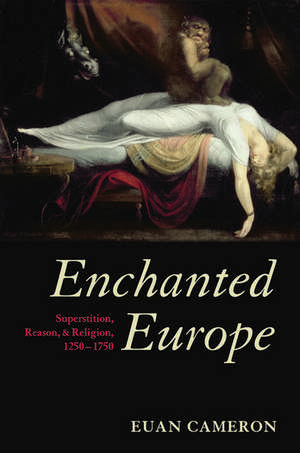
Enchanted Europe: Superstition, Reason, and Religion 1250-1750
Autor Euan Cameronen Limba Engleză Hardback – 18 mar 2010
Preț: 603.53 lei
Preț vechi: 778.60 lei
-22%
Puncte Express: 905
Carte tipărită la comandă
Livrare economică 10-15 decembrie
Livrare prin curier în România Termenul estimat este afișat lângă disponibilitate.
Transport gratuit pentru acest produs Plată online sau ramburs, în funcție de opțiunile comenzii.
Retur gratuit în 14 zile Comandă securizată și suport în română.
Specificații
ISBN-13: 9780199257829
ISBN-10: 0199257825
Pagini: 488
Dimensiuni: 164 x 241 x 33 mm
Greutate: 0.88 kg
Ediția:New.
Editura: OUP OXFORD
Colecția OUP Oxford
Locul publicării:Oxford, United Kingdom
ISBN-10: 0199257825
Pagini: 488
Dimensiuni: 164 x 241 x 33 mm
Greutate: 0.88 kg
Ediția:New.
Editura: OUP OXFORD
Colecția OUP Oxford
Locul publicării:Oxford, United Kingdom
V-ar putea interesa
-
 The Life of Irene NemirovskyOlivier PhilipponnatPreț: 122.56 lei
 -
 -17%Preț: 103.01 lei124.36 lei
 -
 Europe after Rome: A New Cultural History 500-1000Julia M. H. Smith-11%Preț: 302.21 lei338.13 lei
 -
 Early Modern Europe: An Oxford HistoryEuan Cameron-10%Preț: 319.17 lei356.18 lei
 -
 Thatcherism and British Politics: The End of Consensus?Dennis Kavanagh-28%Preț: 367.69 lei509.75 lei
 -
 The Smile Revolution: In Eighteenth-Century ParisColin Jones CBE-19%Preț: 104.40 lei128.93 lei
 -
 The Sixteenth CenturyEuan Cameron-21%Preț: 279.72 lei352.31 lei
 -
 -22%Preț: 384.69 lei493.41 lei
 -
 The Habsburg Empire: A Very Short IntroductionMartyn Rady-19%Preț: 57.46 lei71.12 lei
 -
 The Allegiance of Thomas HobbesJeffrey R. Collins-10%Preț: 374.46 lei414.40 lei
 -
 France since 1800D.L.L. Parry-19%Preț: 297.02 lei368.02 lei
 -
 Clausewitz: His Life and WorkDonald Stoker-22%Preț: 150.84 lei193.83 lei
 -
 The European ReformationEuan Cameron-19%Preț: 402.66 lei496.49 lei
 -
 The White Man's WorldBill Schwarz-16%Preț: 365.86 lei437.05 lei
 -
 In Search of a Beginning: My Life with Graham GreeneYvonne Cloetta-27%Preț: 78.84 lei107.43 lei
Recenzii
Fresh and exciting...a significant contribution to the history of ideas.
Enchanted Europe gives the history of superstition this strong, if necessarily teleological shape, together with some much needed rigour. It also shifts the history of Europe's intellectual disenchantment from its usual focus on the fortunes of magic and witchcraft... these are considerable achievements.
Thorough and enthralling
Enchanted Europe is a major contribution to the religious and intellectual history of late medieval and early modern Europe...a striking intervention in a debate that has lately been in danger of stagnation. Euan Cameron has written an immensely learned book that greatly advances our understanding of the mental universe of the early modern intelligentsia and seems set to stimulate ongoing discussion of its challenging subject.
Enchanted Europe gives the history of superstition this strong, if necessarily teleological shape, together with some much needed rigour. It also shifts the history of Europe's intellectual disenchantment from its usual focus on the fortunes of magic and witchcraft... these are considerable achievements.
Thorough and enthralling
Enchanted Europe is a major contribution to the religious and intellectual history of late medieval and early modern Europe...a striking intervention in a debate that has lately been in danger of stagnation. Euan Cameron has written an immensely learned book that greatly advances our understanding of the mental universe of the early modern intelligentsia and seems set to stimulate ongoing discussion of its challenging subject.
Notă biografică
Euan Cameron received his B.A. and D.Phil. degrees from Oxford University. He was a Fellow of All Souls College, Oxford from 1979 to 1986, and a member of the Department of History of the University of Newcastle upon Tyne from 1985 to 2002. Since 2002 he has been Henry Luce III Professor of Reformation Church History at Union Theological Seminary in New York City, where he has also served as Vice-President for Academic Affairs and Dean of the Faculty. He is a member of the departments of Religion and History at Columbia University.