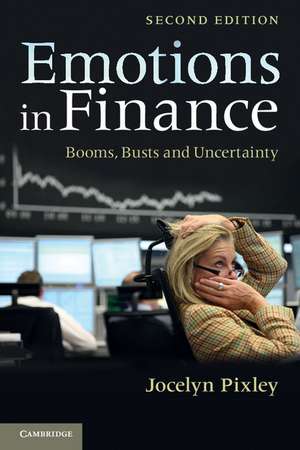
Emotions in Finance: Booms, Busts and Uncertainty
Autor Jocelyn Pixleyen Limba Engleză Paperback – 16 mai 2012
Urgența înțelegerii mecanismelor financiare nu a fost niciodată mai mare; într-o lume dominată de algoritmi, tindem să uităm că banii sunt, în esență, o promisiune simbolică despre un viitor incert. Apreciem modul în care Jocelyn Pixley demontează iluzia raționalității pure în Emotions in Finance, demonstrând că sectorul financiar este un câmp de luptă al emoțiilor umane. Cititorul va învăța cum incertitudinea, imposibil de eliminat prin calcule, este gestionată prin structuri de încredere și suspiciune care dictează succesul sau colapsul instituțiilor globale.
Ca și D. Tuckett în Minding the Markets, autorul distilează experiență reală în principii acționabile, subliniind că ignorarea psihologiei și a valorilor umane duce inevitabil la catastrofe economice. Cartea este organizată riguros, pornind de la natura banilor moderni și evoluând spre analize critice ale presei financiare, ierarhiilor de neîncredere și rolului băncilor centrale. Această progresie oferă o imagine de ansamblu asupra modului în care „utopia timpului” și obsesia pentru cifre pot orbi liderii de piață.
În contextul operei sale, Emotions in Finance reprezintă punctul culminant al cercetărilor lui Pixley despre puterea financiară. Dacă în Central Banks, Democratic States and Financial Power se concentra pe limitările politicii monetare, aici autorul pătrunde în substratul sociologic al acestor instituții. Ne-a atras atenția în mod deosebit capitolul despre „neîncrederea obligatorie” și sistemele de bonusuri, care explică de ce comportamentele toxice persistă în ciuda reglementărilor. Este o lectură esențială pentru profesioniștii care doresc să descifreze nu doar ce se întâmplă pe piață, ci mai ales de ce.
Preț: 333.21 lei
Carte tipărită la comandă
Livrare economică 04-18 iunie
Specificații
ISBN-10: 1107633370
Pagini: 304
Dimensiuni: 152 x 228 x 14 mm
Greutate: 0.5 kg
Ediția:Revised
Editura: Cambridge University Press
Colecția Cambridge University Press
Locul publicării:New York, United States
V-ar putea interesa
-
 Panic!Michael Lewis-31%Preț: 61.95 lei89.68 lei
 -
 Too Big To FailAndrew Ross SorkinPreț: 131.12 lei
 -
 Whoops!John LanchesterPreț: 75.05 lei
 -
 Crisis Economics: A Crash Course in the Future of FinanceNouriel Roubini-20%Preț: 60.82 lei75.89 lei
 -
 -19%Preț: 76.63 lei94.11 lei
 -
 The Great Crash 1929John Kenneth Galbraith-28%Preț: 53.65 lei74.50 lei
 -
 -27%Preț: 65.77 lei89.82 lei
 -
 No More TearsGardiner HarrisPreț: 185.84 lei
 -
 1929Andrew Ross SorkinPreț: 207.19 lei
 -
 Animal SpiritsGeorge A. AkerlofPreț: 154.57 lei
 -
 Inside the Black BoxRishi K NarangPreț: 278.03 lei
 -
 The Only Three Questions That Still CountKen FisherPreț: 159.01 lei
 -
 The Collapse of Global LiberalismPhilip PilkingtonPreț: 109.56 lei
 -
 Shocks, Crises and False AlarmsPhilipp Carlsson-SzlezakPreț: 199.23 lei
 -
 How to Listen When Markets SpeakLawrence McDonaldPreț: 88.30 lei
 -
 The Origin of Financial CrisesGeorge Cooper-22%Preț: 68.79 lei88.76 lei
 -
 The Politics of FeelingAnna SecorPreț: 185.91 lei
 -
 Stealing the FutureDavid MorrisPreț: 108.28 lei
 -
 Your Money Has FeelingsShannon RyanPreț: 101.44 lei
De ce să citești această carte
Recomandăm această carte profesioniștilor din finanțe și cercetătorilor care vor să treacă dincolo de modelele matematice rigide. Veți câștiga o perspectivă critică asupra modului în care emoțiile colective modelează piețele. Este instrumentul ideal pentru a înțelege dinamica dintre încredere și criză, oferind un avantaj strategic în anticiparea instabilității economice prin recunoașterea semnalelor sociologice pe care economiștii clasici le ignoră de peste un secol.
Despre autor
Jocelyn Pixley este cercetător onorific principal în cadrul Departamentului de Sociologie de la Universitatea Macquarie din Sydney și cercetător la Global Policy Institute din Londra. Cu o carieră dedicată studiului intersecției dintre sociologie și economie, Pixley s-a impus ca o voce autoritară în analiza crizelor financiare. Opera sa, care include titluri precum Financial Crises and the Nature of Capitalist Money și Critical Junctures in Mobile Capital, investighează raporturile de putere dintre state și bănci. Expertiza sa în colectarea datelor empirice prin interviuri cu lideri din sistemul bancar îi conferă o perspectivă unică asupra comportamentelor umane din spatele marilor fluxuri de capital.
Descriere scurtă
Cuprins
Recenzii
'Dr Pixley's fine book of [2005] certainly justifies the publication of this new, up-to-date edition because her original argument is further vindicated by the current troubles. She combines a deep critical analytical mind with extensive case studies and interviews to provide a unique, sustained narrative of the causes of the malfunctions in global financial markets when abuse of trust, over-fervent and unreal desires for quick and impossible-to-sustain returns dominate their workings. The author couples insights gained from the writings of pioneering sociologists, old and new, especially those of Max Weber and onwards, with the writings of the modern world's greatest monetary theorists, including Maynard Keynes.' G. C. Harcourt, University of New South Wales
'For more than a century economists have ignored the role that emotions play in the economy … this has begun to change - and Pixley's well-known book, now in an expanded and reworked 2nd edition, is part of this important turnaround. Through her empirical data, in combination with a sharp theoretical argument, Jocelyn Pixley has provided us with the best account so far of the crucial role that emotions play in finance, including the current financial crisis.' Richard Swedberg, Cornell University