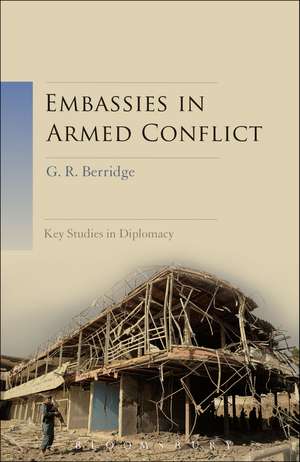
Embassies in Armed Conflict: Key Studies in Diplomacy
Autor Professor G. R. Berridgeen Limba Engleză Paperback – 5 apr 2012


Preț: 197.16 lei
Preț vechi: 240.56 lei
-18%
Puncte Express: 296
Carte disponibilă
Livrare economică 18 mai-01 iunie
Specificații
ISBN-13: 9781441180070
ISBN-10: 1441180079
Pagini: 192
Dimensiuni: 136 x 214 x 16 mm
Greutate: 0.3 kg
Ediția:New.
Editura: Bloomsbury Publishing
Colecția Continuum
Seria Key Studies in Diplomacy
Locul publicării:New York, United States
ISBN-10: 1441180079
Pagini: 192
Dimensiuni: 136 x 214 x 16 mm
Greutate: 0.3 kg
Ediția:New.
Editura: Bloomsbury Publishing
Colecția Continuum
Seria Key Studies in Diplomacy
Locul publicării:New York, United States
V-ar putea interesa
-
 Russia, the West, and Military InterventionRoy Allison-28%Preț: 782.79 lei1086.16 lei
 -
 -17%Preț: 163.54 lei197.51 lei
 -
 Preț: 157.19 lei
 -
 The Spanish Ambassador's SuitcaseAndrew BrysonPreț: 89.32 lei
 -
 American Foreign PolicyBruce W Jentleson-15%Preț: 635.35 lei747.47 lei
 -
 -18%Preț: 1196.24 lei1458.83 lei
 -
 Preț: 422.23 lei
 -
 Strategic Vision: America and the Crisis of Global PowerZbigniew Brzezinski-29%Preț: 77.41 lei108.44 lei
 -
 Pathways to PeaceD. KurtzerPreț: 205.97 lei
 -
 European Public DiplomacyMai'a K Davis CrossPreț: 404.28 lei
 -
 A History of DiplomacyJeremy BlackPreț: 177.99 lei
Cuprins
Preface
List of abbreviations used in text and citation
Introduction
1 The Military Component
Defence section
Military advisers
Intelligence officers
2 Embassies in Enemy States
Initial siege
Prompt and dignified departures
Internment pending exchange
Preserving diplomatic relations
3 Neutral Embassies to Belligerents
Helping expatriates
Reporting the war
Commercial work
Protecting foreign interests
4 Belligerent Embassies to Neutrals
Propaganda
Espionage and special operations
Evaders and escapers
Placating the host
Handling peace feelers
5 Embassies to Frontline Allies
In conventional warfare
In low-intensity warfare
The risk of militarization
Conclusion
Appendix 1 Heads of British mission at Kabul, 2001-10
Appendix 2 Appointment of Protecting Powers and of their Substitute: Article 5 of the Protocol Additional to the Geneva Conventions of 12 August 1949, and relating to the Protection of Victims of International Armed Conflicts, 8 June 1977
References
Index
List of abbreviations used in text and citation
Introduction
1 The Military Component
Defence section
Military advisers
Intelligence officers
2 Embassies in Enemy States
Initial siege
Prompt and dignified departures
Internment pending exchange
Preserving diplomatic relations
3 Neutral Embassies to Belligerents
Helping expatriates
Reporting the war
Commercial work
Protecting foreign interests
4 Belligerent Embassies to Neutrals
Propaganda
Espionage and special operations
Evaders and escapers
Placating the host
Handling peace feelers
5 Embassies to Frontline Allies
In conventional warfare
In low-intensity warfare
The risk of militarization
Conclusion
Appendix 1 Heads of British mission at Kabul, 2001-10
Appendix 2 Appointment of Protecting Powers and of their Substitute: Article 5 of the Protocol Additional to the Geneva Conventions of 12 August 1949, and relating to the Protection of Victims of International Armed Conflicts, 8 June 1977
References
Index
Recenzii
"The study of the resident embassy is a key component of diplomatic studies degrees and an expanding area of interest among scholars -- largely because the Embassy itself remains an essential institution of international communication. In this, his latest book, the leading scholar of diplomacy G.R. Berridge explores a little-studied aspect of the subject, the performance of embassies in times of war. Clearly structured, lucid in style and with a host of historical examples, the book will be read with interest by students, academics and practitioners alike." -- John W. Young, Professor of International History, University of Nottingham, UK and author of Twentieth Century Diplomacy.
[I]t is difficult to identify another scholar with Berridge's depth and breadth of insight into this material. The volume is not a text book, but the author writes with a clarity and wit that will make the material accessible to students of diplomacy as well as offering significant pause for thought to more seasoned scholars.This is an excellent book that will be of use to a wide range of scholars of international diplomacy. The depth of its erudition and the range of its scope will appeal not only to scholars of diplomatic theory but to diplomatic practitioners anxious to know the heritage of their profession. Its brevity - the book is a mere 177 pages - will also appeal to students keen to get to the heart of cutting-edge thinking on diplomacy quickly. While the book's excellent bibliography offers not only opportunities for further research but helps place Berridge's oeuvre within its wider historiographical context. I highly recommend this book.
The book will be extremely useful to practitioners and to students of diplomacy, and the history of diplomacy, alike ... It is well written and demonstrates a mastery of the subject.
[I]t is difficult to identify another scholar with Berridge's depth and breadth of insight into this material. The volume is not a text book, but the author writes with a clarity and wit that will make the material accessible to students of diplomacy as well as offering significant pause for thought to more seasoned scholars.This is an excellent book that will be of use to a wide range of scholars of international diplomacy. The depth of its erudition and the range of its scope will appeal not only to scholars of diplomatic theory but to diplomatic practitioners anxious to know the heritage of their profession. Its brevity - the book is a mere 177 pages - will also appeal to students keen to get to the heart of cutting-edge thinking on diplomacy quickly. While the book's excellent bibliography offers not only opportunities for further research but helps place Berridge's oeuvre within its wider historiographical context. I highly recommend this book.
The book will be extremely useful to practitioners and to students of diplomacy, and the history of diplomacy, alike ... It is well written and demonstrates a mastery of the subject.