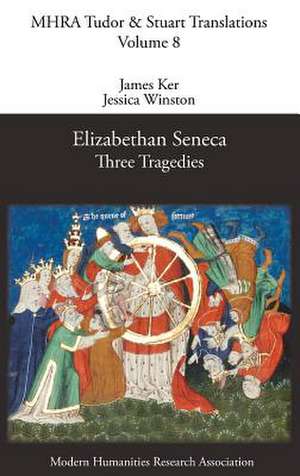
Elizabethan Seneca: MHRA Tudor and Stuart Translations, cartea 8
Autor Seneca Editat de James Ker, Jessica Winstonen Limba Engleză Hardback – 10 mai 2013
Din seria MHRA Tudor and Stuart Translations
-
 Preț: 268.38 lei
 -
 Preț: 257.55 lei
 -
 Preț: 269.00 lei
 -
 Preț: 268.62 lei
 -
 Preț: 259.10 lei
 -
 Preț: 252.95 lei
 -
 Preț: 255.98 lei
 - 8%
 Preț: 490.56 lei
 -
 Preț: 246.23 lei
 -
 Preț: 254.01 lei
 -
 Preț: 271.24 lei
 -
 Preț: 240.87 lei
 -
 Preț: 258.43 lei
 -
 Preț: 245.85 lei
 - 8%
 Preț: 477.09 lei
 -
 Preț: 260.34 lei
 - 8%
 Preț: 490.45 lei
 -
 Preț: 264.97 lei
 - 8%
 Preț: 489.45 lei
Preț: 484.50 lei
Preț vechi: 526.64 lei
-8%
Puncte Express: 727
Carte tipărită la comandă
Livrare economică 07-21 decembrie
Livrare prin curier în România Termenul estimat este afișat lângă disponibilitate.
Transport gratuit pentru acest produs Plată online sau ramburs, în funcție de opțiunile comenzii.
Retur gratuit în 14 zile Comandă securizată și suport în română.
Specificații
ISBN-13: 9781781880821
ISBN-10: 1781880824
Pagini: 352
Dimensiuni: 161 x 240 x 23 mm
Greutate: 0.69 kg
Editura: Texts and Translations
Colecția MHRA Tudor and Stuart Translations
Seria MHRA Tudor and Stuart Translations
ISBN-10: 1781880824
Pagini: 352
Dimensiuni: 161 x 240 x 23 mm
Greutate: 0.69 kg
Editura: Texts and Translations
Colecția MHRA Tudor and Stuart Translations
Seria MHRA Tudor and Stuart Translations
V-ar putea interesa
-
 -31%Preț: 773.20 lei1123.20 lei
 -
 The Deaths of SenecaJames Ker-11%Preț: 364.01 lei408.11 lei
 -
 Letters on Ethics: To LuciliusLucius Annaeus SenecaPreț: 322.14 lei
 -
 Hardship and HappinessLucius Annaeus SenecaPreț: 310.27 lei
 -
 Fade (Saracho)Tanya SarachoPreț: 113.12 lei
 -
 Friend ArtSofia AlvarezPreț: 113.12 lei
 -
 Romance Novels for DummiesBoo KillebrewPreț: 113.35 lei
 -
 Night of the Living Dead LiveChristopher BondPreț: 114.20 lei
 -
 The HarvestSamuel D HunterPreț: 101.37 lei
 -
 The Behavior of BroadusAlbert DayanPreț: 113.96 lei
 -
 Off Off Broadway Festival Plays, 41st SeriesFrance-Luce BensonPreț: 93.12 lei
 -
 Nat Turner in JerusalemNathan Alan DavisPreț: 112.50 lei
 -
 Dontrell, Who Kissed the SeaNathan Alan DavisPreț: 113.12 lei
 -
 Among the DeadHansol JungPreț: 112.69 lei
 -
 Marie and RosettaGeorge BrantPreț: 113.53 lei
 -
 The AnarchistDavid MametPreț: 112.69 lei
 -
 The PenitentDavid MametPreț: 112.69 lei
 -
 Preț: 162.64 lei
 -
 Preț: 170.29 lei
 -
 La Devineresse Ou Les Faux EnchantemensJean Donneau de ViséPreț: 164.18 lei
 -
 Raising U.S. Exports: Federal Promotion Efforts & ConsiderationsJessica M Winston-26%Preț: 394.77 lei531.37 lei
 -
 Seer January 2013Robin Aizlewood-8%Preț: 450.15 lei489.29 lei
 -
 The Spanish BawdJames MabbePreț: 257.55 lei
 -
 Early English Drama (Yearbook of English Studies (43) 2013)Pamela M. King-9%Preț: 830.62 lei912.78 lei
 -
 Gustave-WasaAlexis PironPreț: 168.34 lei
 -
 Preț: 169.97 lei
 -
 'Théâtre D'Amour' & 'L'art de Foutre, Ou Paris Foutant'Delisle de SalesPreț: 171.30 lei
 -
 Valuing the Past in the Greco-Roman WorldChristoph Pieper-23%Preț: 1280.30 lei1662.72 lei
Notă biografică
Lucius Annaeus Seneca, commonly known as Seneca the Younger, was a Roman philosopher, statesman, and playwright who lived from around 4 BC to 65 AD. He was born in Corduba (present-day Córdoba, Spain) into a wealthy Roman family. Seneca was educated in Rome and was deeply influenced by Stoic philosophy, particularly the teachings of Stoic thinkers such as Epictetus and Seneca's own teacher, Attalus. Seneca's life was marked by a combination of political influence and philosophical pursuits. He held various positions in the Roman government, serving as a senator and later as an advisor to Emperor Nero. Despite his political career, Seneca remained committed to his philosophical principles, advocating for a life of virtue, wisdom, and self-mastery. As a playwright, Seneca wrote several tragedies that were influenced by Greek models but had a distinct Roman flavor. His tragedies, including "Phaedra" and "Medea," explore themes of fate, morality, and the human condition. Seneca's philosophical works, including "Letters to Lucilius" and "On the Shortness of Life," are some of his most enduring contributions. In these writings, Seneca offers practical advice on how to live a virtuous and fulfilling life in accordance with Stoic principles. He explores topics such as the nature of happiness, the importance of self-control, and the acceptance of fate. Despite his philosophical beliefs, Seneca's association with Nero led to his eventual downfall. In 65 AD, Seneca was accused of involvement in a conspiracy against the emperor and was ordered to take his own life. He complied with stoic dignity, calmly facing his fate in accordance with his philosophical principles. Seneca's writings have continued to influence thinkers throughout the centuries, earning him a reputation as one of the most important Stoic philosophers of antiquity. His works remain widely read and studied today for their timeless wisdom and insights into the human condition.