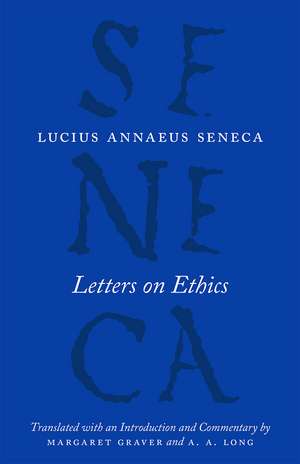
Letters on Ethics: To Lucilius: The Complete Works of Lucius Annaeus Seneca
Autor Lucius Annaeus Seneca Traducere de Margaret Graver, A. A. Longen Limba Engleză Paperback – 6 noi 2017
The Roman statesman and philosopher Seneca (4 BCE–65 CE) recorded his moral philosophy and reflections on life as a highly original kind of correspondence. Letters on Ethics includes vivid descriptions of town and country life in Nero’s Italy, discussions of poetry and oratory, and philosophical training for Seneca’s friend Lucilius. This volume, the first complete English translation in nearly a century, makes the Letters more accessible than ever before.
Written as much for a general audience as for Lucilius, these engaging letters offer advice on how to deal with everything from nosy neighbors to sickness, pain, and death. Seneca uses the informal format of the letter to present the central ideas of Stoicism, for centuries the most influential philosophical system in the Mediterranean world. His lively and at times humorous expositions have made the Letters his most popular work and an enduring classic. Including an introduction and explanatory notes by Margaret Graver and A. A. Long, this authoritative edition will captivate a new generation of readers.
Written as much for a general audience as for Lucilius, these engaging letters offer advice on how to deal with everything from nosy neighbors to sickness, pain, and death. Seneca uses the informal format of the letter to present the central ideas of Stoicism, for centuries the most influential philosophical system in the Mediterranean world. His lively and at times humorous expositions have made the Letters his most popular work and an enduring classic. Including an introduction and explanatory notes by Margaret Graver and A. A. Long, this authoritative edition will captivate a new generation of readers.

Preț: 322.14 lei
Puncte Express: 483
Carte disponibilă
Livrare economică 17 noiembrie-01 decembrie
Livrare express 31 octombrie-06 noiembrie pentru 45.26 lei
Livrare prin curier în România Termenul estimat este afișat lângă disponibilitate.
Transport gratuit de la 400.00 lei Plată online sau ramburs, în funcție de opțiunile comenzii.
Retur gratuit în 14 zile Comandă securizată și suport în română.
Specificații
ISBN-13: 9780226528434
ISBN-10: 022652843X
Pagini: 604
Dimensiuni: 140 x 216 x 38 mm
Greutate: 0.68 kg
Ediția:1
Editura: University of Chicago Press
Colecția University of Chicago Press
Seria The Complete Works of Lucius Annaeus Seneca
ISBN-10: 022652843X
Pagini: 604
Dimensiuni: 140 x 216 x 38 mm
Greutate: 0.68 kg
Ediția:1
Editura: University of Chicago Press
Colecția University of Chicago Press
Seria The Complete Works of Lucius Annaeus Seneca
V-ar putea interesa
-
 The Soul of the Greeks: An InquiryMichael DavisPreț: 266.81 lei
 -
 Preț: 313.34 lei
 -
 Preț: 281.43 lei
 -
 The Lost Second Book of Aristotle's "Poetics"Walter WatsonPreț: 286.25 lei
 -
 Plotinus: Myth, Metaphor, and Philosophical PracticeStephen R. L. ClarkPreț: 311.30 lei
 -
 Socrates and AristophanesLeo StraussPreț: 319.50 lei
 -
 The Socratic Paradox and Its EnemiesRoslyn WeissPreț: 254.89 lei
 -
 Elizabethan SenecaSenecaPreț: 268.38 lei
 -
 Vom Gluckseligen LebenLucius Annaeus SenecaPreț: 35.42 lei
 -
 Étude Sur La Philosophie de DanteÉmile BeaussirePreț: 75.14 lei
 -
 L. Annaei Senecae opera quae supersuntLucius Annaeus Seneca-23%Preț: 723.78 lei939.97 lei
 -
 ApocolocyntosisLucius Annaeus Seneca-23%Preț: 724.43 lei940.82 lei
 -
 ACTA Alexandrinorum: Entre as Vozes Em Coro E O SilencioJoana Campos ClímacoPreț: 235.42 lei
 -
 OS Servidores Funerarios Do Museu Nacional Do Rio de Janeiro: Retratos de Uma Morte FelizCintia A. Gama-Rolland-8%Preț: 571.17 lei620.85 lei
 -
 A honra, a glória e a morte na IlíadaAntônio de Pádua PachecoPreț: 365.39 lei
 -
 Helenizacao E Egipcianizacao: Modelagem E Analise de Sistemas UrbanosRonaldo Guilherme Gurgel PereiraPreț: 356.09 lei
 -
 Preț: 75.16 lei
 -
 Platon, PhilebosPeter BrendebachPreț: 64.80 lei
 -
 Platons StaatMartin WohlrabPreț: 150.19 lei
 -
 Preț: 155.51 lei
Notă biografică
Margaret Graver is the Aaron Lawrence Professor of Classics at Dartmouth College. She is the author of Cicero on the Emotions: Tusculan Disputations 3 and 4 and Stoicism and Emotion. A. A. Long is Chancellor’s Professor Emeritus of Classics at the University of California, Berkeley. He is the author of many books on ancient philosophy, including Epictetus: A Stoic and Socratic Guide to Life and Greek Models of Mind and Self.
Cuprins
Seneca and His World
Introduction to the Letters on Ethics
Letters on Ethics
1 Taking charge of your time
2 A beneficial reading program
3 Trusting one’s friends
4 Coming to terms with death
5 Our inward and outward lives
6 Intimacy within friendship
7 Avoiding the crowd
8 Writing as a form of service
9 Friendship and self-sufficiency
10 Communing with oneself
11 Blushing
12 Visiting a childhood home
13 Anxieties about the future
14 Safety in a dangerous world
15 Exercises for the body and the voice
16 Daily study and practice
17 Saving for retirement
18 The Saturnalia festival
19 The satisfactions of retirement
20 The importance of being consistent
21 How reading can make you famous
22 Giving up a career
23 Real joy is a serious matter
24 Courage in a threatening situation
25 Effective teaching
26 Growing old
27 Real joy depends on real study
28 Travel is no cure for depression
29 A disillusioned friend
30 An Epicurean on his deathbed
31 Our mind’s godlike potential
32 Steadiness of aim
33 The use of philosophical maxims
34 Willingness is the key
35 Learning to be a friend
36 Helping another maintain his commitment
37 Service to philosophy is true freedom
38 Fewer words achieve more
39 Healthy and unhealthy desires
40 Oratory and the philosopher
41 God dwells within us
42 Good people are rare
43 Being the subject of gossip
44 Noble birth
45 A gift of books
46 A book by Lucilius
47 How we treat our slaves
48 Tricks of logic
49 Remembering old times
50 Blindness to one’s own faults
51 The party town of Baiae
52 Good learners and good teachers
53 A bad experience at sea
54 A near-fatal asthma attack
55 Passing the home of a recluse
56 Noisy lodgings above a bathhouse
57 A dark tunnel
58 A conversation about Plato
59 Steadiness of joy
60 Our prayers are all amiss
61 Preparing for death
62 Living the inner life
63 Consolation for the death of a friend
64 Our predecessors in philosophy
65 Some analyses of causation
66 All goods are equal
67 All goods are choiceworthy
68 The uses of retirement
69 Combating one’s faults
70 Ending one’s own life
71 Life’s highest good
72 Finding time for study
73 Gratitude toward rulers
74 Only the honorable is good
75 What it means to make progress
76 Some proofs that only the honorable is good
77 Facing death with courage
78 Coping with bodily pain
79 A trip around Sicily brings thoughts of glory
80 A quiet day at home
81 Gratitude for benefits received
82 Syllogisms cannot make us brave
83 Heavy drinking
84 The writer’s craft
85 Some objections to Stoic ethics
86 The rustic villa of Scipio Africanus
87 Poverty and wealth
88 The liberal arts
89 The divisions of philosophy
90 The beginnings of civilization
91 A terrible fire at Lyon
92 What we need for happiness
93 A premature death
94 The role of precepts in philosophy
95 The role of general principles
96 Complaints
97 A trial in the time of Cicero
98 The power of the mind
99 Consolation for the death of a child
100 A book by Papirius Fabianus
101 A sudden death
102 Renown and immortality
103 Those we meet may be dangerous to us
104 Why travel cannot set you free
105 How to avoid being harmed by other people
106 The corporeal nature of the good
107 An unexpected misfortune
108 Vegetarianism and the use of literature
109 Mutual aid among the wise
110 False fears and mistaken ideas of wealth
111 What we lose with our tricks of logic
112 A difficult pupil
113 Is a virtue an animate creature?
114 A debased style of eloquence
115 Fine language will not help us
116 The Stoic view of emotion
117 Propositions and incorporeals
118 A proper definition for the human good
119 Natural wealth
120 How we develop our concept of the good
121 Self-awareness in animate creatures
122 The hours of day and night
123 Resisting external influences
124 The criterion for the human good
Fragments of other letters
Notes
Textual Notes
References
Index
Introduction to the Letters on Ethics
Letters on Ethics
1 Taking charge of your time
2 A beneficial reading program
3 Trusting one’s friends
4 Coming to terms with death
5 Our inward and outward lives
6 Intimacy within friendship
7 Avoiding the crowd
8 Writing as a form of service
9 Friendship and self-sufficiency
10 Communing with oneself
11 Blushing
12 Visiting a childhood home
13 Anxieties about the future
14 Safety in a dangerous world
15 Exercises for the body and the voice
16 Daily study and practice
17 Saving for retirement
18 The Saturnalia festival
19 The satisfactions of retirement
20 The importance of being consistent
21 How reading can make you famous
22 Giving up a career
23 Real joy is a serious matter
24 Courage in a threatening situation
25 Effective teaching
26 Growing old
27 Real joy depends on real study
28 Travel is no cure for depression
29 A disillusioned friend
30 An Epicurean on his deathbed
31 Our mind’s godlike potential
32 Steadiness of aim
33 The use of philosophical maxims
34 Willingness is the key
35 Learning to be a friend
36 Helping another maintain his commitment
37 Service to philosophy is true freedom
38 Fewer words achieve more
39 Healthy and unhealthy desires
40 Oratory and the philosopher
41 God dwells within us
42 Good people are rare
43 Being the subject of gossip
44 Noble birth
45 A gift of books
46 A book by Lucilius
47 How we treat our slaves
48 Tricks of logic
49 Remembering old times
50 Blindness to one’s own faults
51 The party town of Baiae
52 Good learners and good teachers
53 A bad experience at sea
54 A near-fatal asthma attack
55 Passing the home of a recluse
56 Noisy lodgings above a bathhouse
57 A dark tunnel
58 A conversation about Plato
59 Steadiness of joy
60 Our prayers are all amiss
61 Preparing for death
62 Living the inner life
63 Consolation for the death of a friend
64 Our predecessors in philosophy
65 Some analyses of causation
66 All goods are equal
67 All goods are choiceworthy
68 The uses of retirement
69 Combating one’s faults
70 Ending one’s own life
71 Life’s highest good
72 Finding time for study
73 Gratitude toward rulers
74 Only the honorable is good
75 What it means to make progress
76 Some proofs that only the honorable is good
77 Facing death with courage
78 Coping with bodily pain
79 A trip around Sicily brings thoughts of glory
80 A quiet day at home
81 Gratitude for benefits received
82 Syllogisms cannot make us brave
83 Heavy drinking
84 The writer’s craft
85 Some objections to Stoic ethics
86 The rustic villa of Scipio Africanus
87 Poverty and wealth
88 The liberal arts
89 The divisions of philosophy
90 The beginnings of civilization
91 A terrible fire at Lyon
92 What we need for happiness
93 A premature death
94 The role of precepts in philosophy
95 The role of general principles
96 Complaints
97 A trial in the time of Cicero
98 The power of the mind
99 Consolation for the death of a child
100 A book by Papirius Fabianus
101 A sudden death
102 Renown and immortality
103 Those we meet may be dangerous to us
104 Why travel cannot set you free
105 How to avoid being harmed by other people
106 The corporeal nature of the good
107 An unexpected misfortune
108 Vegetarianism and the use of literature
109 Mutual aid among the wise
110 False fears and mistaken ideas of wealth
111 What we lose with our tricks of logic
112 A difficult pupil
113 Is a virtue an animate creature?
114 A debased style of eloquence
115 Fine language will not help us
116 The Stoic view of emotion
117 Propositions and incorporeals
118 A proper definition for the human good
119 Natural wealth
120 How we develop our concept of the good
121 Self-awareness in animate creatures
122 The hours of day and night
123 Resisting external influences
124 The criterion for the human good
Fragments of other letters
Notes
Textual Notes
References
Index
Recenzii
“Excellent. . . . This is an exceptionally accessible text. . . that will be invaluable not only to those interested in the letters as literary artifacts that open an important window onto imperial Rome’s cultural life, but also to readers engaging with the letters philosophically, as the lively and urgent writings of one of classical antiquity’s most important ethicists. . . . Essential.”
“Translators Margaret Graver and A.A. Long should be commended for reintroducing the Letters to a new generation. . . . A Seneca as approachable and fresh as he was thousands of years ago.”
“[An] excellent book. . . . The Stoic ideas are as relevant now as they were in the days of the emperor Nero and [Graver and Long] have done Seneca (and us) a great service in making the old man speak so clearly once again.”
"Graver and Long successfully manage to draw the reader in. . . . An accurate, readable and well-annotated translation of Seneca's letters."