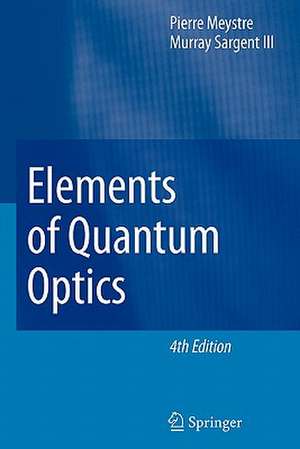
Elements of Quantum Optics
Autor Pierre Meystre, Murray Sargenten Limba Engleză Paperback – 19 oct 2010
Preț: 481.50 lei
Puncte Express: 722
Carte tipărită la comandă
Livrare economică 13-27 iulie
Livrare prin curier în România Termenul estimat este afișat lângă disponibilitate.
Transport gratuit pentru acest produs Plată online sau ramburs, în funcție de opțiunile comenzii.
Retur gratuit în 14 zile Comandă securizată și suport în română.
Specificații
ISBN-13: 9783642093524
ISBN-10: 3642093523
Pagini: 520
Ilustrații: XII, 507 p.
Dimensiuni: 155 x 235 x 27 mm
Greutate: 0.72 kg
Ediția:4th ed. 2007
Editura: Springer Berlin, Heidelberg
Colecția Springer
Locul publicării:Berlin, Heidelberg, Germany
ISBN-10: 3642093523
Pagini: 520
Ilustrații: XII, 507 p.
Dimensiuni: 155 x 235 x 27 mm
Greutate: 0.72 kg
Ediția:4th ed. 2007
Editura: Springer Berlin, Heidelberg
Colecția Springer
Locul publicării:Berlin, Heidelberg, Germany
V-ar putea interesa
-
 Polymers and Neutron ScatteringJulia S. Higgins-34%Preț: 693.42 lei1053.78 lei
 -
 Dynamical Theory of Crystal LatticesMax Born-11%Preț: 371.26 lei417.15 lei
 -
 Introductory Statistical MechanicsRoger Bowley-22%Preț: 391.53 lei502.05 lei
 -
 The Friction and Lubrication of SolidsF. P Bowden-37%Preț: 670.64 lei1064.08 lei
 -
 -37%Preț: 692.14 lei1092.64 lei
 -
 Introduction to the Theory of FerromagnetismAmikam Aharoni-34%Preț: 606.18 lei912.53 lei
 -
 Statistical Physics of Spin Glasses and Information Processing: An IntroductionHidetoshi Nishimori-30%Preț: 682.14 lei971.41 lei
 -
 The Physics of FoamsDenis Weaire-34%Preț: 523.71 lei788.31 lei
 -
 -35%Preț: 479.73 lei732.74 lei
 -
 -34%Preț: 733.94 lei1114.73 lei
 -
 Liquid Crystal ElastomersMark Warner-20%Preț: 535.23 lei666.74 lei
 -
 -27%Preț: 815.00 lei1109.35 lei
 -
 Optical Processes in SolidsYutaka Toyozawa-14%Preț: 780.96 lei908.09 lei
 -
 Bose-Einstein Condensation in Dilute GasesC. J. Pethick-14%Preț: 703.04 lei817.49 lei
 -
 Transport in NanostructuresDavid K. Ferry-14%Preț: 710.97 lei826.71 lei
 -
 Core Level Spectroscopy of SolidsFrank de Groot-18%Preț: 1566.47 lei1910.32 lei
 -
 Physics of Surfaces and InterfacesHarald Ibach-15%Preț: 691.59 lei813.63 lei
 -
 -18%Preț: 966.51 lei1178.66 lei
 -
 Solid-State PhysicsHarald Ibach-17%Preț: 396.60 lei477.83 lei
Public țintă
GraduateCuprins
Classical Electromagnetic Fields.- Classical Nonlinear Optics.- Quantum Mechanical Background.- Mixtures and the Density Operator.- CW Field Interactions.- Mechanical Effects of Light.- to Laser Theory.- Optical Bistability.- Saturation Spectroscopy.- Three and Four Wave Mixing.- Time-Varying Phenomena in Cavities.- Coherent Transients.- Field Quantization.- Interaction Between Atoms and Quantized Fields.- System-Reservoir Interactions.- Resonance Fluorescence.- Squeezed States of Light.- Cavity Quantum Electrodynamics.- Quantum Theory of a Laser.- Entanglement, Bell Inequalities and Quantum Information.
Textul de pe ultima copertă
Elements of Quantum Optics gives a self-contained and broad coverage of the basic elements necessary to understand and carry out research in laser physics and quantum optics, including a review of basic quantum mechanics and pedagogical introductions to system-reservoir interactions and to second quantization. The text reveals the close connection between many seemingly unrelated topics, such as probe absorption, four-wave mixing, optical instabilities, resonance fluorescence and squeezing. It also comprises discussions of cavity quantum electrodynamics and atom optics. The 4th edition includes a new chapter on quantum entanglement and quantum information, as well as added discussions of the quantum beam splitter, electromagnetically induced transparency, slow light, and the input-output formalism needed to understand many problems in quantum optics. It also provides an expanded treatment of the minimum-coupling Hamiltonian and a simple derivation of theGross-Pitaevskii equation, an important gateway to research in ultracold atoms and molecules.