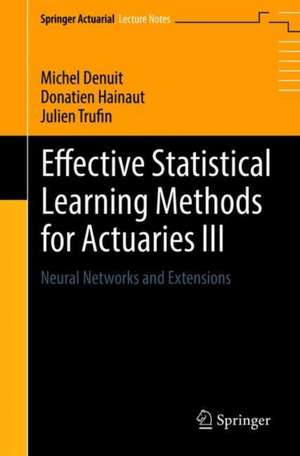
Effective Statistical Learning Methods for Actuaries III: Springer Actuarial
Autor Michel Denuit, Donatien Hainaut, Julien Trufinen Limba Engleză Paperback – 13 noi 2019
Găsim în Effective Statistical Learning Methods for Actuaries III o resursă esențială care pune accent pe componenta practică prin aplicații directe pe datele de daune, mortalitate și prognoze de serii temporale. Subliniem faptul că, deși rețelele neuronale sunt adesea privite ca o „cutie neagră”, autorii reușesc să introducă instrumentele necesare pentru dezvoltarea și analizarea acestora într-un stil riguros matematic, dar perfect adaptat nevoilor profesioniștilor din asigurări și finanțe. Structura volumului este una progresivă, ghidând cititorul de la fundamentele rețelelor feed-forward către concepte complexe precum Deep Learning, Bayesian learning, metode de boosting și modele Long Short Term Memory (LSTM). Această a treia parte a seriei Springer Actuarial dedică spații ample unor tehnici precum hărțile auto-organizate (Self-organizing Maps) și clustering-ul k-means în asigurările generale (non-life), oferind o alternativă solidă la metodele statistice tradiționale. Considerăm această lucrare o excelentă alternativă la Statistical Foundations of Actuarial Learning and its Applications pentru cursurile de analiză a datelor în asigurări, cu avantajul unei specializări stricte pe rețele neuronale și a unei integrări native a metodelor de tip ensemble. Față de lucrările anterioare ale lui Michel Denuit, precum Actuarial Theory for Dependent Risks, unde accentul era pus pe modelarea riscurilor dependente, prezentul volum marchează tranziția autorului către machine learning aplicat, completând viziunea începută în primele două volume ale seriei despre modele liniare generalizate și metode bazate pe arbori de decizie.






Preț: 435.30 lei
Carte tipărită la comandă
Livrare economică 07-21 decembrie
Specificații
ISBN-10: 3030258262
Pagini: 264
Ilustrații: XIII, 250 p. 78 illus., 75 illus. in color.
Dimensiuni: 155 x 235 x 15 mm
Greutate: 0.38 kg
Ediția:1st ed. 2019
Editura: Springer
Colecția Springer Actuarial
Seria Springer Actuarial
Locul publicării:Cham, Switzerland
V-ar putea interesa
-
 Learning Deep LearningMagnus Ekman-20%Preț: 414.01 lei517.52 lei
 -
 Just Enough Data Science and Machine LearningMark LevenePreț: 352.28 lei
 -
 Deep LearningIan Goodfellow-21%Preț: 684.46 lei865.01 lei
 -
 Probabilistic Machine LearningKevin P. Murphy-20%Preț: 862.38 lei1080.57 lei
 -
 Understanding Deep LearningSimon J. D. Prince-20%Preț: 636.22 lei795.27 lei
 -
 -27%Preț: 510.48 lei699.00 lei
 -
 Pattern Recognition and Machine LearningChristopher M Bishop-20%Preț: 646.10 lei807.62 lei
 -
 The Elements of Statistical LearningTrevor Hastie-20%Preț: 582.77 lei728.46 lei
 -
 -39%Preț: 394.79 lei646.62 lei
 -
 -31%Preț: 607.05 lei885.58 lei
 -
 Complex, Hypercomplex and Fuzzy-Valued Neural Networks: New Perspectives and ApplicationsAgnieszka Niemczynowicz-20%Preț: 411.99 lei514.98 lei
 -
 -20%Preț: 457.81 lei572.26 lei
 -
 Programming Neural Networks with PythonJoachim Steinwendner-20%Preț: 302.99 lei378.73 lei
 -
 -20%Preț: 249.08 lei311.36 lei
 -
 Deep Learning Crash CourseGiovanni Volpe-35%Preț: 290.92 lei445.81 lei
 -
 Practical Deep Learning, 2nd Edition: A Python-Based IntroductionRonald T. Kneusel-35%Preț: 333.73 lei515.68 lei
 -
 Actuarial Aspects of Long Term CareEtienne Dupourqué-18%Preț: 933.17 lei1138.01 lei
 -
 Deep Learning ArchitecturesOvidiu Calin-15%Preț: 498.66 lei586.66 lei
 -
 Neural Networks and Deep LearningCharu C. AggarwalPreț: 440.74 lei
 -
 Materials Data ScienceStefan Sandfeld-19%Preț: 624.52 lei771.02 lei
De ce să citești această carte
Această carte este ideală pentru studenții la master în științe actuariale și pentru actuarii care doresc să își actualizeze competențele în machine learning. Cititorul câștigă o înțelegere profundă a modului în care inteligența artificială poate înlocui sau completa metodele statistice clasice în prognoza mortalității și a daunelor, beneficiind de un fundament teoretic unitar și studii de caz concrete, adaptate industriei asigurărilor.
Despre autor
Michel Denuit este profesor de statistică și științe actuariale la Universitatea Catolică din Louvain, Belgia, fiind un cercetător recunoscut în teoria riscului și inegalități stochastice. Expertiza sa este confirmată de numeroasele articole publicate în jurnale de profil și de rolul de editor pentru enciclopedia Wiley de științe actuariale. În seria Effective Statistical Learning Methods for Actuaries, acesta colaborează cu Donatien Hainaut și Julien Trufin pentru a transpune progresele din inteligența artificială în contextul specific al pieței de asigurări.
Descriere scurtă
Artificial intelligence and neural networks offer a powerful alternative to statistical methods for analyzing data. Various topics are covered from feed-forward networks to deep learning, such as Bayesian learning, boosting methods and Long Short Term Memory models. All methods are applied to claims, mortality or time-series forecasting.
Requiring only a basic knowledge of statistics, this book is written for masters students in the actuarial sciences and for actuaries wishing to update their skills in machine learning. This is the third of three volumes entitled Effective Statistical Learning Methods for Actuaries. Written by actuaries for actuaries, this series offers a comprehensive overview of insurance data analytics with applications to P&C, life and health insurance. Although closely related to the other two volumes, this volume can be read independently.
Cuprins
Recenzii
Notă biografică
Michel Denuit holds masters degrees in mathematics and actuarial science as well as a PhD in statistics from ULB (Brussels). Since 1999, he has been professor of actuarial mathematics at UCLouvain (Louvain-la-Neuve, Belgium), where he serves as Director of the masters program in Actuarial Science. He has also held several visiting appointments, including at Lausanne (Switzerland) and Lyon (France). He has published extensively and has conducted many R&D projects with major (re)insurance companies over the past 20 years.
Donatien Hainaut is a civil engineer in applied mathematics and an actuary. He also holds a masters in financial risk management and a PhD in actuarial science from UCLouvain (Louvain-La-Neuve, Belgium). After a few years in the financial industry, he joined Rennes School of Business (France) and was visiting lecturer at ENSAE (Paris, France). Since 2016, he has been professor at UCLouvain, in the Institute of Statistics, Biostatistics and Actuarial Science. He serves as Director of the UCLouvain Masters in Data Science.
Julien Trufin holds masters degrees in physics and actuarial science as well as a PhD in actuarial science from UCLouvain (Louvain-la-Neuve, Belgium). After a few years in the insurance industry, he joined the actuarial school at Laval University (Quebec, Canada). Since 2014, he has been professor in actuarial science at the department of mathematics, ULB (Brussels, Belgium). He also holds visiting appointments in Lausanne (Switzerland) and in Louvain-la-Neuve (Belgium). He is associate editor for the Journals “Astin Bulletin” and “Methodology and Computing in Applied Probability” and qualified actuary of the Institute of Actuaries in Belgium (IA|BE).