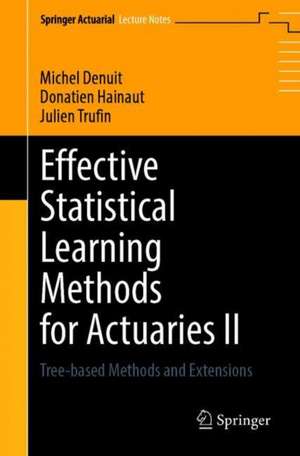
Effective Statistical Learning Methods for Actuaries II: Springer Actuarial
Autor Michel Denuit, Donatien Hainaut, Julien Trufinen Limba Engleză Paperback – 17 noi 2020
Descoperim în acest al doilea volum al seriei Springer Actuarial o resursă esențială pentru transpunerea seturilor masive de date în avantaje competitive pentru asigurări. Aplicabilitatea practică este punctul central al lucrării: autorii nu se limitează la teorie, ci alternează rigoarea metodologică cu studii de caz și implementări numerice folosind software-ul R. Într-o eră a volumelor mari de date, capacitatea actuarului de a utiliza algoritmi de învățare automată devine o competență de bază, iar această lucrare oferă instrumentele necesare pentru evaluarea performanței predictive a modelelor. Notăm cu interes structura progresivă a volumului. Primele capitole pun bazele evaluării performanței, urmate de o analiză detaliată a arborilor de regresie (Chapter 3) și a metodelor de tip ansamblu, precum Bagging și Random Forests (Chapter 4). Extinzând cadrul propus de Statistical Foundations of Actuarial Learning and its Applications cu date noi și o focalizare specifică pe algoritmii de tip boosting, volumul de față oferă o profunzime tehnică superioară în ceea ce privește modelele non-liniare. Față de abordările mai generale din Computational Actuarial Science with R, aici accentul cade strict pe ierarhia și optimizarea metodelor bazate pe arbori. Această lucrare completează viziunea autorilor începută în Effective Statistical Learning Methods for Actuaries I, unde s-au explorat modelele liniare generalizate. Dacă volumul anterior se concentra pe fundamentele statistice clasice, Effective Statistical Learning Methods for Actuaries II face tranziția către tehnicile moderne de „machine learning”, pregătind terenul pentru studiul rețelelor neuronale ce va fi abordat în cel de-al treilea volum al seriei.








Preț: 433.30 lei
Carte tipărită la comandă
Livrare economică 08-22 decembrie
Specificații
ISBN-10: 3030575551
Pagini: 240
Ilustrații: X, 228 p. 68 illus., 6 illus. in color.
Dimensiuni: 155 x 235 x 14 mm
Greutate: 0.37 kg
Ediția:1st edition 2020
Editura: Springer
Colecția Springer Actuarial
Seria Springer Actuarial
Locul publicării:Cham, Switzerland
V-ar putea interesa
-
 Just Enough Data Science and Machine LearningMark LevenePreț: 352.28 lei
 -
 SimulationSheldon M. Ross-31%Preț: 515.83 lei749.22 lei
 -
 -27%Preț: 510.48 lei699.00 lei
 -
 Machine Learning for Factor Investing: Python VersionGuillaume Coqueret-15%Preț: 569.15 lei669.60 lei
 -
 The Elements of Statistical LearningTrevor Hastie-20%Preț: 546.54 lei683.17 lei
 -
 -38%Preț: 398.93 lei646.62 lei
 -
 -18%Preț: 744.18 lei907.54 lei
 -
 -9%Preț: 1388.37 lei1525.67 lei
 -
 An Introduction to Statistical LearningGareth James-15%Preț: 416.05 lei489.47 lei
 -
 Practical Machine Learning in RFred Nwanganga-20%Preț: 222.19 lei277.73 lei
 -
 R-ticulateMartin Bader-23%Preț: 653.46 lei848.65 lei
 -
 -4%Preț: 390.49 lei406.76 lei
 -
 -23%Preț: 799.73 lei1038.62 lei
 -
 -20%Preț: 250.26 lei312.82 lei
 -
 An Introduction to Statistical LearningGareth James-15%Preț: 529.55 lei623.00 lei
 -
 Materials Data ScienceStefan Sandfeld-19%Preț: 624.52 lei771.02 lei
 -
 Statistics for ScientistsUmberto Michelucci-20%Preț: 279.62 lei349.53 lei
 -
 Business Analytics with R and PythonDavid L. Olson-20%Preț: 433.90 lei542.38 lei
De ce să citești această carte
Recomandăm această carte studenților la masterat și actuarilor care doresc să își actualizeze competențele tehnice. Cititorul câștigă o înțelegere aplicată a celor mai puternice metode de învățare automată utilizate astăzi în asigurări (P&C, viață și sănătate). Este un ghid practic care transformă conceptele complexe de boosting și random forests în instrumente de lucru imediate, facilitate de utilizarea codului R.
Despre autor
Michel Denuit este profesor de statistică și științe actuariale la Universitatea Catolică din Louvain, Belgia. Cercetările sale se concentrează pe teoria riscului și inegalități stocastice, fiind un autor prolific în jurnale de specialitate precum Insurance: Mathematics and Economics. Alături de Donatien Hainaut și Julien Trufin, Denuit contribuie la definirea standardelor moderne în analiza datelor de asigurări, fiind și editor al Enciclopediei Wiley de Științe Actuariale. Experiența sa academică și editorială garantează o abordare care îmbină precizia matematică cu relevanța practică pentru industrie.
Cuprins
Notă biografică
Textul de pe ultima copertă
The exposition alternates between methodological aspects and numerical illustrations or case studies. All numerical illustrations are performed with the R statistical software. The technical prerequisites are kept at a reasonable level in order to reach a broad readership. In particular, masters students in actuarial sciences and actuaries wishing to update their skills in machine learning will find the book useful.
This is the second of three volumes entitled Effective Statistical Learning Methods for Actuaries. Written by actuaries for actuaries, this series offers a comprehensive overview of insurance data analytics with applications to P&C, life and health insurance.