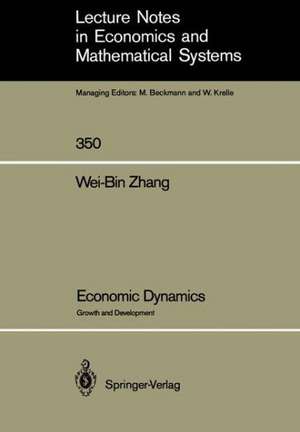
Economic Dynamics: Growth and Development: Lecture Notes in Economics and Mathematical Systems, cartea 350
Autor Wei-Bin Zhangen Limba Engleză Paperback – 14 noi 1990
Din seria Lecture Notes in Economics and Mathematical Systems
-
 Preț: 368.38 lei
 -
 Preț: 365.65 lei
 -
 Preț: 428.35 lei
 -
 Preț: 478.67 lei
 -
 Preț: 365.90 lei
 -
 Preț: 398.93 lei
 -
 Preț: 384.48 lei
 - 15%
 Preț: 646.64 lei
 -
 Preț: 364.71 lei
 -
 Preț: 437.64 lei
 -
 Preț: 370.76 lei
 - 15%
 Preț: 618.65 lei
 -
 Preț: 363.99 lei
 -
 Preț: 331.98 lei
 -
 Preț: 409.58 lei
 -
 Preț: 363.18 lei
 - 18%
 Preț: 778.82 lei
 -
 Preț: 377.68 lei
 -
 Preț: 405.53 lei
 - 15%
 Preț: 620.72 lei
 -
 Preț: 367.23 lei
 -
 Preț: 363.18 lei
 - 15%
 Preț: 611.54 lei
 - 15%
 Preț: 621.61 lei
 -
 Preț: 363.41 lei
 -
 Preț: 430.76 lei
 - 15%
 Preț: 618.65 lei
 -
 Preț: 371.37 lei
 - 15%
 Preț: 629.18 lei
 -
 Preț: 399.23 lei
 -
 Preț: 395.12 lei
 -
 Preț: 383.75 lei
 -
 Preț: 383.75 lei
 -
 Preț: 377.40 lei
 - 15%
 Preț: 610.96 lei
 - 20%
 Preț: 628.32 lei
 -
 Preț: 365.45 lei
 -
 Preț: 476.60 lei
 -
 Preț: 363.14 lei
 - 15%
 Preț: 611.04 lei
 -
 Preț: 371.20 lei
 -
 Preț: 364.19 lei
 - 15%
 Preț: 640.81 lei
 -
 Preț: 364.48 lei
 - 15%
 Preț: 611.19 lei
 -
 Preț: 365.09 lei
 - 15%
 Preț: 613.62 lei
 - 15%
 Preț: 612.55 lei
 -
 Preț: 432.70 lei
Preț: 615.35 lei
Preț vechi: 723.94 lei
-15%
Puncte Express: 923
Carte tipărită la comandă
Livrare economică 30 noiembrie-14 decembrie
Livrare prin curier în România Termenul estimat este afișat lângă disponibilitate.
Transport gratuit pentru acest produs Plată online sau ramburs, în funcție de opțiunile comenzii.
Retur gratuit în 14 zile Comandă securizată și suport în română.
Specificații
ISBN-13: 9783540532170
ISBN-10: 354053217X
Pagini: 252
Ilustrații: X, 232 p. 2 illus.
Dimensiuni: 170 x 244 x 13 mm
Greutate: 0.41 kg
Ediția:Softcover reprint of the original 1st ed. 1990
Editura: Springer Berlin, Heidelberg
Colecția Springer
Seria Lecture Notes in Economics and Mathematical Systems
Locul publicării:Berlin, Heidelberg, Germany
ISBN-10: 354053217X
Pagini: 252
Ilustrații: X, 232 p. 2 illus.
Dimensiuni: 170 x 244 x 13 mm
Greutate: 0.41 kg
Ediția:Softcover reprint of the original 1st ed. 1990
Editura: Springer Berlin, Heidelberg
Colecția Springer
Seria Lecture Notes in Economics and Mathematical Systems
Locul publicării:Berlin, Heidelberg, Germany
V-ar putea interesa
-
 Econometric Methods for Labour EconomicsStephen Bazen-31%Preț: 536.71 lei773.65 lei
 -
 The Index Number Problem: Construction TheoremsSydney Afriat-31%Preț: 898.74 lei1307.94 lei
 -
 Essays in Nonlinear Time Series EconometricsNiels Haldrup-33%Preț: 795.91 lei1192.47 lei
 -
 The Oxford Handbook of Bayesian EconometricsJohn Geweke-18%Preț: 344.41 lei422.29 lei
 -
 Applied Statistics for EconomistsMargaret Lewis-15%Preț: 613.49 lei721.74 lei
 -
 Introduction to Estimating Economic ModelsAtsushi Maki-18%Preț: 709.86 lei865.68 lei
 -
 Fundamentals of Applied Econometrics WSER A Ashley-27%Preț: 1541.48 lei2111.61 lei
 -
 Analysis of Economic DataG KoopPreț: 462.02 lei
 -
 -19%Preț: 435.95 lei538.22 lei
 -
 Business Analytics for ManagersWolfgang Jank-15%Preț: 525.61 lei618.36 lei
 -
 Spatial Statistics and ModelingCarlo Gaetan-18%Preț: 1114.35 lei1358.96 lei
 -
 Preț: 223.65 lei
 -
 New Introduction to Multiple Time Series AnalysisHelmut Lütkepohl-18%Preț: 878.32 lei1071.12 lei
 -
 EconometricsBadi H. BaltagiPreț: 510.27 lei
Public țintă
ResearchCuprins
I. The Economic Development Problem.- 1. Economic Development.- 2. A General Historical Sketch of Growth Theory.- 3. Development Indicators.- 4. Short Term versus Long Term.- 5. Fast Variable versus Slow Variable.- 6. Equilibrium versus Non-equilibrium.- 7. Stability versus Instability.- II. Growth Theory Revised — From Quantitative Aspect.- 1. The Neoclassical Approach to Growth.- 2. The One Sector Model of Technological Changes Within the Framework of the Neoclassical Approach.- 3. A Growth Model With Exhaustible Resources and Endogenous Population.- 4. Distribution of Income and Wealth in the Neoclassical One Sector Growth Model.- 5. The Two Sector Models.- 6. Multiple Sector Models — The extended neoclassical model.- 7. Production Functions in Growth Models.- III. A Revision of Real and Monetary Dynamic Models.- 1. Money in Economic Theory.- 2. The One Sector Model With Money Within the Framework of the Neoclassical Approach.- 3. On the Generalized Tobin Model.- IV. Prices, Growth Rates and Interest Rates in the Dynamic Context of Multisector Models.- 1. Introduction.- 2. The Input-Output System With Neoclassical Production Functions.- 3. The Existence of Short-Run Equilibria With Endogenous Interest Rate.- 4. The Existence of Equilibrium for a Fixed Interest Rate.- 5. The Interest Rate and Investment Coefficient Matrix.- 6. The Relations Between Growth, Interest and Inflation Rates in the von Neumann Dynamic Model — An extended concept of balanced growth.- V. Growth Rate Controlled and Economic Dynamics in a Multisector Model.- 1. Introduction.- 2. Economic Dynamics With Maximization of Welfare.- 3. Economic Cycles in the Case of One Sector.- 4. Properties of the Multiple Sector Model.- 5. Stabilization With Growth Rate Adjustment.- 6. Further Interpretationsof the Dynamic System.- 7. Conclusions.- VI. The Choice of Techniques.- 1. The Choice of Techniques in a Simple Growth Model.- 2. The Basic Model of Leontief Technology and Some of Its Fundamental Properties With One Technique.- 3. The Model of Leontief Technology With Many Alternative Techniques.- 4. Dynamic Behavior of the Model With Many Alternative Techniques.- 5. The Impossibility of Reswitching in the Continuous Substitution Model.- VII. Technological Policy and Economic Development — A Neoclassical Approach.- 1. Technological Change in Economic Development.- 2. The Model.- 3. Equilibrium and Stability.- 4. The Effects of Changes in Some Parameters.- 5. Effects of Changes in the Population Growth Rate in the Case of Instability.- 6. Conclusions.- VIII. Technological Policy and Economic Development — Multisector Approach.- 1. The Basic Model.- 2. Some Properties of the Basic System.- 3. Technological Change of “Learning by Doing”.- 4. Technological Change due to Investment in Training.- 5. A Growth Model of “Hybrid” Technological Change.- 6. Some Comments.- IX. Conclusion and Prospects for Further Research.- 1. Summary.- 2. How To Close Dynamic Models — The neoclassical, neo-Marxian and neo-Keynesian approaches.- Appendix. Nonlinear Dynamic System Theory.- A.1. Ordinary Differential Equations and Existence of Solutions.- A.2. Stability.- A.3. Linearization Principle and Its Valid Domain.- A.4. Limit Cycles in Two Dimension — The Poincaré-Bendixson theory.- A.5. Bifurcations.- A.6. Limit Cycles — The Hopf bifurcation theorem.- A.7. Maps.- A.8. Chaos.- A.9. The Logistic Map — An example of chaos.- References.