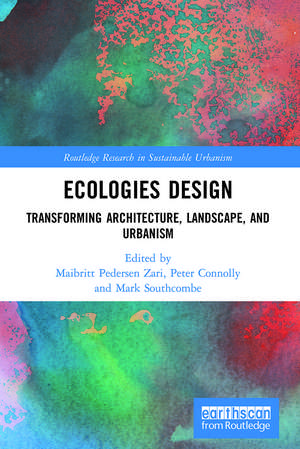
Ecologies Design: Transforming Architecture, Landscape, and Urbanism: Routledge Research in Sustainable Urbanism
Editat de Maibritt Pedersen Zari, Peter Connolly, Mark Southcombeen Limba Engleză Paperback – 29 apr 2022
The use of the term ‘ecology’ with design tends to refer to how to integrate ecologies into design and cities and be understood in a biologically-scientific and technical sense. In practice, this scientific-technical knowledge tends to be only loosely employed. The notion of ecology is also often used metaphorically in relation to the social use of space and cities. This book argues that what it calls the ‘biological’ and ‘social’ senses of ecology are both important and require distinctly different types of knowledge and practice. It proposes that science needs to be taken much more seriously in ‘biological ecologies’, and that ‘social ecologies’ can now be understood non-metaphorically as assemblages. Furthermore, this book argues that design practice itself can be understood much more rigorously, productively and relevantly if understood ecologically. The plural term ‘ecologies design’ refers to these three types of ecological design. This book is unique in bringing these three perspectives on ecological design together in one place. It is significant in proposing that a strong sense of ecologies design practice will only follow from the interconnection of these three types of practice.
Ecologies Design brings together leading international experts and relevant case studies in the form of edited research essays, case studies and project work. It provides an overarching critique of current ecologically-oriented approaches and offers evidence and exploration of emerging and effective methods, techniques and concepts. It will be of great interest to academics, professionals and students in the built environment disciplines.





Preț: 413.60 lei
Puncte Express: 620
Carte disponibilă
Livrare economică 30 octombrie-13 noiembrie
Livrare express 15-21 octombrie pentru 35.38 lei
Livrare prin curier în România Termenul estimat este afișat lângă disponibilitate.
Transport gratuit pentru acest produs Plată online sau ramburs, în funcție de opțiunile comenzii.
Retur gratuit în 14 zile Comandă securizată și suport în română.
Specificații
ISBN-13: 9780367491055
ISBN-10: 0367491052
Pagini: 320
Ilustrații: 118
Dimensiuni: 156 x 234 x 22 mm
Greutate: 0.45 kg
Ediția:1
Editura: Taylor & Francis
Colecția Routledge
Seria Routledge Research in Sustainable Urbanism
Locul publicării:Oxford, United Kingdom
ISBN-10: 0367491052
Pagini: 320
Ilustrații: 118
Dimensiuni: 156 x 234 x 22 mm
Greutate: 0.45 kg
Ediția:1
Editura: Taylor & Francis
Colecția Routledge
Seria Routledge Research in Sustainable Urbanism
Locul publicării:Oxford, United Kingdom
V-ar putea interesa
-
 Wild CitiesChris FitchPreț: 143.05 lei
 -
 The Nature of Our CitiesNadina GallePreț: 162.85 lei
 -
 Viable EcologiesPaolo BocciPreț: 247.54 lei
 -
 Preț: 383.89 leiRecomandat
 -
 New Directions in Sustainable DesignAdrian Parr-8%Preț: 491.73 lei534.49 lei
 -
 Preț: 328.72 lei
 -
 -19%Preț: 595.81 lei735.57 lei
 -
 Preț: 393.50 lei
 -
 Design-Tech: Building Science for ArchitectsJason Alread-8%Preț: 465.32 lei505.78 leiRecomandat
 -
 Regreening the Built Environment: Nature, Green Space, and SustainabilityMichael A. RichardsPreț: 384.44 lei
 -
 Preț: 386.48 lei
 -
 -19%Preț: 487.62 lei602.00 lei
 -
 -14%Preț: 210.80 lei244.24 lei
 -
 -15%Preț: 220.83 lei258.82 lei
 -
 Principles of Ecological Landscape DesignTravis BeckPreț: 315.97 lei
 -
 The Homegrown CityMatias EchanovePreț: 152.61 lei
 -
 We Must Begin with the LandStephen E. HuntPreț: 117.68 lei
 -
 Designing Regenerative CulturesDaniel Christian WahlPreț: 202.90 lei
Public țintă
PostgraduateCuprins
1. Introduction: Towards an ecologies design practice
Section 1: Biological Ecologies Design and Regeneration
2. Introduction: a shifting paradigm in ecologically focused design
3. Engaging with life: the developmental practice of regenerative development and design
4. Designing for living environments using regenerative development: a case study of The Paddock
5. The paradox of metrics: setting goals for regenerative design and development
6. Ecological design as the biointegration of a set of ‘infrastructures’: the ‘quatrobrid’ constructed ecosystem
7. Creating and restoring urban ecologies: case studies in China
8. Towards wildlife-supportive green space design in metropolitan areas: lessons from an experimental study
9. The new design with nature
10. Biomimicry: an opportunity for buildings to relate to place
11. The emergence of biophilic design and planning: re-envisioning cities and city life
Section 2: Documenting Social Ecologies
12. Introduction: How to Document Urban / Landscape Assemblages
13. City boids: diagramming molecular urbanism
14. Why would we spend time drawing people doing their washing in a Chinese village?
15. Object-led interview: documenting geographical ideas
16. Mapping informal settlements: a process for action
17. Ethnographic drawings and the benefits of using a sketchbook for fieldwork
18. A landscape architectural anthropology of green: Bahrain
19. Valparaiso Publico: graphic inventory of urban spaces in a Chilean city
20. Being with Hellersdorf: performative counter-mapping as a reflexive practice between architecture and anthropology
21. The happy city. An actor-network-theory manifesto
22. The aesthetics of documenting urban and landscape assemblages
Section 3: Ecologies Design Practices
23. Introduction: on the need for and potentials of ecological design practice
24. Indigenous ecological design
25. Ngāi Tūhoe’s Te Kura Whare: our living building
26. Design in relationship with an ecological entity: case study design with Te Awa Te Puna
27. On the Rise: case study of a hybrid coastal adaptation strategy
28. There are no sustainable buildings without sustainable people
29. Labour ecology and architecture
30. Integrating design teaching and practices
31. Stranded assets
32. (Hybrid) architecture in and over time
Conclusion
33. A call to ecologies design action
Section 1: Biological Ecologies Design and Regeneration
2. Introduction: a shifting paradigm in ecologically focused design
3. Engaging with life: the developmental practice of regenerative development and design
4. Designing for living environments using regenerative development: a case study of The Paddock
5. The paradox of metrics: setting goals for regenerative design and development
6. Ecological design as the biointegration of a set of ‘infrastructures’: the ‘quatrobrid’ constructed ecosystem
7. Creating and restoring urban ecologies: case studies in China
8. Towards wildlife-supportive green space design in metropolitan areas: lessons from an experimental study
9. The new design with nature
10. Biomimicry: an opportunity for buildings to relate to place
11. The emergence of biophilic design and planning: re-envisioning cities and city life
Section 2: Documenting Social Ecologies
12. Introduction: How to Document Urban / Landscape Assemblages
13. City boids: diagramming molecular urbanism
14. Why would we spend time drawing people doing their washing in a Chinese village?
15. Object-led interview: documenting geographical ideas
16. Mapping informal settlements: a process for action
17. Ethnographic drawings and the benefits of using a sketchbook for fieldwork
18. A landscape architectural anthropology of green: Bahrain
19. Valparaiso Publico: graphic inventory of urban spaces in a Chilean city
20. Being with Hellersdorf: performative counter-mapping as a reflexive practice between architecture and anthropology
21. The happy city. An actor-network-theory manifesto
22. The aesthetics of documenting urban and landscape assemblages
Section 3: Ecologies Design Practices
23. Introduction: on the need for and potentials of ecological design practice
24. Indigenous ecological design
25. Ngāi Tūhoe’s Te Kura Whare: our living building
26. Design in relationship with an ecological entity: case study design with Te Awa Te Puna
27. On the Rise: case study of a hybrid coastal adaptation strategy
28. There are no sustainable buildings without sustainable people
29. Labour ecology and architecture
30. Integrating design teaching and practices
31. Stranded assets
32. (Hybrid) architecture in and over time
Conclusion
33. A call to ecologies design action
Notă biografică
Maibritt Pedersen Zari is a Senior Lecturer in Sustainable Architecture and Interior Architecture in the School of Architecture at Victoria University, New Zealand.Peter Connolly is an Associate Professor of Landscape Architecture in the School of Architecture at Victoria University, New Zealand.Mark Southcombe is the Associate Dean of Postgraduate Research and a Senior Lecturer in the School of Architecture at Victoria University, New Zealand.
Descriere
Ecologies Design challenges professionals and academics to expand the concept of applying and understanding ecologies, both biological and social, in multi-disciplinary spatial design contexts.
This book will be of great interest to academics and professionals within ecology and design.
This book will be of great interest to academics and professionals within ecology and design.