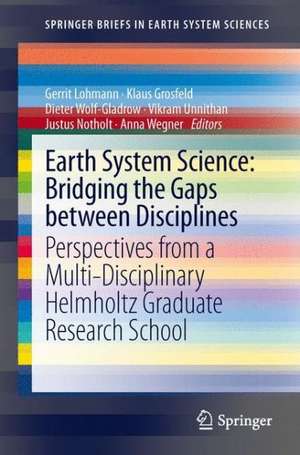
Earth System Science: Bridging the Gaps between Disciplines
Editat de Gerrit Lohmann, Klaus Grosfeld, Dieter Wolf-Gladrow, Vikram Unnithan, Justus Notholt, Anna Wegneren Limba Engleză Paperback – 6 noi 2012
Preț: 366.02 lei
Nou
Puncte Express: 549
Preț estimativ în valută:
64.76€ • 76.13$ • 56.72£
64.76€ • 76.13$ • 56.72£
Carte tipărită la comandă
Livrare economică 28 ianuarie-11 februarie 26
Preluare comenzi: 021 569.72.76
Specificații
ISBN-13: 9783642322341
ISBN-10: 3642322344
Pagini: 148
Ilustrații: XI, 134 p. 61 illus., 52 illus. in color.
Dimensiuni: 155 x 235 x 9 mm
Greutate: 0.24 kg
Ediția:2013
Editura: Springer
Locul publicării:Berlin, Heidelberg, Germany
ISBN-10: 3642322344
Pagini: 148
Ilustrații: XI, 134 p. 61 illus., 52 illus. in color.
Dimensiuni: 155 x 235 x 9 mm
Greutate: 0.24 kg
Ediția:2013
Editura: Springer
Locul publicării:Berlin, Heidelberg, Germany
V-ar putea interesa
-
 The Heart of the DalesGervase Phinn-32%Preț: 60.92 lei89.19 lei
 -
 -30%Preț: 161.74 lei231.96 lei
 -
 Preț: 240.90 lei
 -
 -31%Preț: 218.34 lei314.80 lei
 -
 -22%Preț: 221.64 lei282.96 lei
 -
 Introduction to American Higher EducationShaun R. Harper-15%Preț: 549.73 lei646.74 lei
 -
 Preț: 352.24 lei
 -
 Distributed Leadership According to the EvidenceKenneth Leithwood-15%Preț: 409.27 lei481.50 lei
 -
 Preparing Principals for a Changing WorldLinda Darling-HammondPreț: 265.80 lei
 -
 The Shaping School Culture FieldbookKent D PetersonPreț: 215.07 lei
 -
 The Student's Guide to Successful Project TeamsWilliam A KahnPreț: 414.92 lei
 -
 -42%Preț: 86.74 lei150.48 lei
 -
 Preț: 277.38 lei
 -
 -42%Preț: 97.75 lei168.04 lei
 -
 Restorative Justice PocketbookMargaret Thorsborne & David VinegradPreț: 93.21 lei
Public țintă
ResearchCuprins
1. Introduction.- 2. Remote Sensing and Modelling of Atmospheric Chemistry.- 3. Earth System Modelling and Data Analysis.- 4. Geotectonics.- 5. Climate Archives.- 6. Ecosystems and Climate Change.- 7. Geoinformatics.- 8. Geoengeneering.
Textul de pe ultima copertă
Earth system science is traditionally split into various disciplines (Geology, Physics, Meteorology, Oceanography, Biology etc.) and several sub-disciplines. Overall, the diversity of expertise provides a solid base for interdisciplinary research. However, gaining holistic insights into the Earth system requires the integration of observations, paleoclimate data, analysis tools and modeling. These different approaches of Earth system science are rooted in various disciplines that cut across a broad range of timescales. It is, therefore, necessary to link these disciplines at a relatively early stage in PhD programs. The linking of ‘data and modeling’, as it is the special emphasis in our graduate school, enables graduate students from a variety of disciplines to cooperate and exchange views on the common theme of Earth system science, which leads to a better understanding of processes within a global context.
Caracteristici
Shows the spectrum of Earth system science: Remote sensing, data exploration, process understanding, modelling, informatics Gives examples of how to link the different disciplines as a key concept of future PhD education in Earth system science Linking ‘data and modeling’ enables graduate students from a variety of disciplines to cooperate and exchange views on the common theme of global environmental change Includes supplementary material: sn.pub/extras