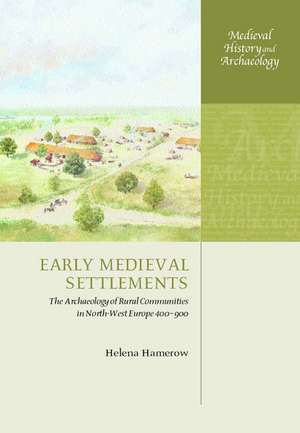
Early Medieval Settlements: The Archaeology of Rural Communities in North-West Europe 400-900: Medieval History and Archaeology
Autor Helena Hamerowen Limba Engleză Hardback – 5 dec 2002
Din seria Medieval History and Archaeology
- 16%
 Preț: 346.58 lei
 - 23%
 Preț: 793.99 lei
 - 17%
 Preț: 353.27 lei
 - 32%
 Preț: 625.84 lei
 - 28%
 Preț: 425.16 lei
 - 28%
 Preț: 434.52 lei
 - 29%
 Preț: 503.15 lei
 - 32%
 Preț: 424.35 lei
 - 25%
 Preț: 349.93 lei
 - 21%
 Preț: 356.98 lei
 - 26%
 Preț: 361.78 lei
 - 31%
 Preț: 726.20 lei
 - 27%
 Preț: 354.15 lei
 - 26%
 Preț: 359.24 lei
 - 18%
 Preț: 369.57 lei
 - 18%
 Preț: 366.47 lei
 - 15%
 Preț: 359.44 lei
 - 31%
 Preț: 861.06 lei
 - 29%
 Preț: 856.10 lei
 - 31%
 Preț: 777.12 lei
 - 30%
 Preț: 738.27 lei
 - 30%
 Preț: 742.66 lei
Preț: 572.04 lei
Preț vechi: 845.94 lei
-32%
Puncte Express: 858
Carte tipărită la comandă
Livrare economică 27 noiembrie-02 decembrie
Livrare prin curier în România Termenul estimat este afișat lângă disponibilitate.
Transport gratuit pentru acest produs Plată online sau ramburs, în funcție de opțiunile comenzii.
Retur gratuit în 14 zile Comandă securizată și suport în română.
Specificații
ISBN-13: 9780199246977
ISBN-10: 0199246971
Pagini: 240
Ilustrații: numerous figures, maps and halftones
Dimensiuni: 176 x 254 x 18 mm
Greutate: 0.6 kg
Editura: OUP OXFORD
Colecția OUP Oxford
Seria Medieval History and Archaeology
Locul publicării:Oxford, United Kingdom
ISBN-10: 0199246971
Pagini: 240
Ilustrații: numerous figures, maps and halftones
Dimensiuni: 176 x 254 x 18 mm
Greutate: 0.6 kg
Editura: OUP OXFORD
Colecția OUP Oxford
Seria Medieval History and Archaeology
Locul publicării:Oxford, United Kingdom
V-ar putea interesa
-
 The Crucible of Creation: The Burgess Shale and the Rise of AnimalsSimon Conway Morris-14%Preț: 252.90 lei295.68 lei
 -
 Scotland: An Oxford Archaeological GuideAnna Ritchie-19%Preț: 283.12 lei350.07 lei
 -
 The Oxford Handbook of the Archaeology of the Levant: c. 8000-332 BCEMargreet L. Steiner-32%Preț: 1084.56 lei1591.09 lei
 -
 -31%Preț: 826.23 lei1196.11 lei
 -
 The Birth of Neolithic Britain: An Interpretive AccountJulian Thomas-31%Preț: 907.18 lei1313.04 lei
 -
 Death and Dying in the Neolithic Near EastKarina Croucher-31%Preț: 1091.64 lei1587.83 lei
 -
 How To Think Like a NeandertalThomas Wynn-25%Preț: 170.98 lei227.37 lei
 -
 The Archaeology of the Arabian GulfMichael Rice-15%Preț: 472.21 lei555.53 lei
 -
 An Archaeology of the Cosmos: Rethinking Agency and Religion in Ancient AmericaTimothy R. PauketatPreț: 451.67 lei
 -
 Preț: 384.23 lei
 -
 Burren ArchaeologyHugh CarthyPreț: 112.68 lei
 -
 Ancient nets and fishing gear : a first approach : proceedings of the International Workshop on Nets and Fishing Gear in Classical Antiquity, Cádiz, November 15-17, 2007International Workshop on Nets and Fishing Gear in Classical AntiquityPreț: 363.39 lei
Recenzii
The concept behind this book is excellent and the content sorely needed ... The importance of this book is that it has helped by filling a significant gap in a way that will be extremely useful to undergraduates, postgraduates and early medievalists. Sites are clearly described, well-referenced, and fully discussed within their social and territorial context.
Without doubt, this is one of the most important books currently available on the early medieval economy and its effect upon the developing landscape.
... scholarly and elegantly presented ... The survey is wide-ranging, lucid, and thought-provoking as well as precisely exemplified.
... provides a fine example of what this relatively new discipline can bring to our understanding of the immediate post-Roman period.
Hamerow's arguments are clearly put accross and based upon a sound, reliable and detailed knowledge of the evidence, which makes them profitable to read and rewarding to engage with.
Hamerow is the leading British student of post-Roman rural settlement and, as one would expect, this long-awaited synthesis presents a wealth of extremely useful information, accompanied by clear and consistent plans and diagrams.
While certainly accessible to historians, this book also deserves a substantial readership among archaelogists, not least because it thoughtfully presents a great deal of material that would otherwise be inaccessible to the increasingly 'Anglolexic' world of British archaeology.
... attractively produced and interesting new book.
Hamerow's book is well produced. It should be read and consulted by all students of early medieval archaeology, both on the British and on the continental side of the North Sea.
... the author has made a large body of archaeological information from the continent accessible to British students.
Hamerow has produced a fundamentally important comparison of the rural settlement and social history of Early Medieval communities around the North Sea, which demonstrates beyond doubt the value of studying Britain within the context of mainland Europe.
... especially strong in its social analysis of buildings and settlement morphology, reflecting the author's long-standing research in this field.
... this book should provide a most helpful resource for students and reference book for a wide range of specialists with interests in the economic and social history of Early-medieval Europe.
It is much to be welcomed that a publishing house of the weight of the Oxford University Press is willing to launch a series of monographs in Medieval History and Archaeology, and the series is off to a fine start with this volume.
Without doubt, this is one of the most important books currently available on the early medieval economy and its effect upon the developing landscape.
... scholarly and elegantly presented ... The survey is wide-ranging, lucid, and thought-provoking as well as precisely exemplified.
... provides a fine example of what this relatively new discipline can bring to our understanding of the immediate post-Roman period.
Hamerow's arguments are clearly put accross and based upon a sound, reliable and detailed knowledge of the evidence, which makes them profitable to read and rewarding to engage with.
Hamerow is the leading British student of post-Roman rural settlement and, as one would expect, this long-awaited synthesis presents a wealth of extremely useful information, accompanied by clear and consistent plans and diagrams.
While certainly accessible to historians, this book also deserves a substantial readership among archaelogists, not least because it thoughtfully presents a great deal of material that would otherwise be inaccessible to the increasingly 'Anglolexic' world of British archaeology.
... attractively produced and interesting new book.
Hamerow's book is well produced. It should be read and consulted by all students of early medieval archaeology, both on the British and on the continental side of the North Sea.
... the author has made a large body of archaeological information from the continent accessible to British students.
Hamerow has produced a fundamentally important comparison of the rural settlement and social history of Early Medieval communities around the North Sea, which demonstrates beyond doubt the value of studying Britain within the context of mainland Europe.
... especially strong in its social analysis of buildings and settlement morphology, reflecting the author's long-standing research in this field.
... this book should provide a most helpful resource for students and reference book for a wide range of specialists with interests in the economic and social history of Early-medieval Europe.
It is much to be welcomed that a publishing house of the weight of the Oxford University Press is willing to launch a series of monographs in Medieval History and Archaeology, and the series is off to a fine start with this volume.