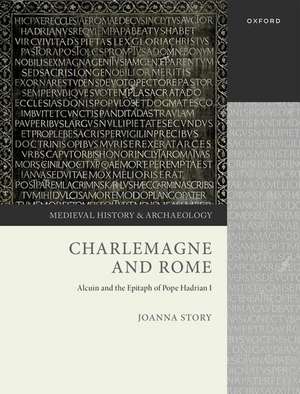
Charlemagne and Rome: Alcuin and the Epitaph of Pope Hadrian I: Medieval History and Archaeology
Autor Joanna Storyen Limba Engleză Hardback – iun 2023
Publicul format din studenți la istorie medievală, cercetători în domeniul epigrafiei și practicieni ai arheologiei creștine va găsi în Charlemagne and Rome o analiză exhaustivă a politicii culturale din epoca carolingiană. Lucrarea semnată de Joanna Story depășește granițele unei simple descrieri de monument, oferind o „biografie de obiect” riguroasă, centrată pe epitaful Papei Adrian I. Putem afirma că această inscripție, realizată din piatră neagră de Aachen și amplasată în Bazilica Sfântul Petru, nu este doar un omagiu funerar, ci un veritabil manifest imperial care proclamă autoritatea francă asupra Romei.
Merită menționat modul în care autoarea integrează date tehnice din geologie și paleografie cu analiza literară a versurilor compuse de Alcuin din York. Găsim în această carte o documentare metodică a modului în care arta carolingiană a reciclat simbolismul imperial roman pentru a legitima o nouă putere politică. Comparabil cu Rome in the Ninth Century de John Osborne în ceea ce privește rigoarea analizei culturii materiale, volumul de față este însă mult mai focalizat pe tranziția dintre antichitatea târzie și Renașterea carolingiană, oferind o perspectivă unică asupra supraviețuirii obiectelor de cult în timpul reconstrucțiilor masive ale bazilicii sub Bramante sau Michelangelo.
Această monografie se înscrie natural în opera autoarei, continuând temele explorate în Carolingian Connections sau Old Saint Peter's, Rome. Dacă lucrările anterioare stabileau contextul general al legăturilor anglo-saxone și carolingiene, Charlemagne and Rome rafinează aceste concepte printr-un studiu de caz aplicat, demonstrând cum un singur obiect poate sintetiza ambițiile unui imperiu aflat în plină ascensiune.
Din seria Medieval History and Archaeology
- 21%
 Preț: 312.10 lei
 - 23%
 Preț: 738.66 lei
 - 21%
 Preț: 328.75 lei
 - 33%
 Preț: 664.10 lei
 - 33%
 Preț: 555.27 lei
 - 31%
 Preț: 388.53 lei
 - 30%
 Preț: 397.49 lei
 - 31%
 Preț: 454.27 lei
 - 20%
 Preț: 404.14 lei
 - 22%
 Preț: 359.06 lei
 - 12%
 Preț: 363.14 lei
 - 21%
 Preț: 370.21 lei
 - 24%
 Preț: 662.46 lei
 - 22%
 Preț: 364.97 lei
 - 21%
 Preț: 370.51 lei
 - 21%
 Preț: 331.88 lei
 - 13%
 Preț: 331.46 lei
 - 21%
 Preț: 330.14 lei
 - 14%
 Preț: 779.33 lei
 - 33%
 Preț: 774.56 lei
 - 33%
 Preț: 714.06 lei
Preț: 742.31 lei
Preț vechi: 964.04 lei
-23%
Carte disponibilă
Livrare economică 18 mai-01 iunie
Specificații
ISBN-10: 0199206341
Pagini: 428
Ilustrații: numerous colour and black and white figures/illustrations
Dimensiuni: 195 x 252 x 25 mm
Greutate: 1.12 kg
Editura: OUP OXFORD
Colecția OUP Oxford
Seria Medieval History and Archaeology
Locul publicării:Oxford, United Kingdom
De ce să citești această carte
Cititorul va câștiga o înțelegere profundă a modului în care Carol cel Mare a utilizat arta și scrierea pentru a-și consolida statutul imperial. Este o recomandare esențială pentru cei interesați de istoria Romei și a papalității, oferind dovezi concrete despre cum un obiect de artă supraviețuiește timp de un mileniu, devenind un martor tăcut al transformărilor arhitecturale și politice ale Europei, de la Aachen până la inima Vaticanului.
Despre autor
Joanna Story este profesor de istorie medievală timpurie la Universitatea din Leicester, fiind recunoscută pentru abordările sale interdisciplinare care îmbină istoria cu arheologia. Specialistă în epoca lui Carol cel Mare, cercetările sale se concentrează pe contactele culturale dintre Anglia anglo-saxonă și Europa continentală, cu un interes deosebit pentru manuscrise și inscripții. Expertiza sa în studiul legăturilor dintre Anglia și Roma este reflectată în numeroasele sale publicații, printre care se numără și studii fundamentale despre Bazilica Sfântul Petru și influența anglo-saxonă asupra lumii carolingiene.
Descriere
Recenzii
This is an impressive work that serves as an important contribution to our knowledge of Carolingian culture and politics. This work will interest Carolingian specialists and those seeking to learn about the history of Saint Peter's Basilica and the papacy. It shows the value of considering both the physical form and content of texts, and it can serve as a model for other object biographies by demonstrating the wealth of insights that can stem from the focus on a single artifact.
Joanna Story's investigation is much more than a simple biography of a funerary inscription. [...] From an academic and methodological perspective, this multi-and even transdisciplinary investigation demonstrates the various ways in which a single object can be examined. It not only sheds new light on the relationship between the Franks and Rome, demonstrating the multidimensional nature of these ties, but also immerses the reader in the broader cultural history of Frankish society at the end of the 8th century.
Story has meticulously set the epitaph of Pope Hadrian I in its historical, textual, paleographic, and cultural context. The volume is richly illustrated with numerous color figures that enhance the arguments presented. Oxford UniversityPress deserves commendation for its exceptional production of this volume. Scholars interested in Charlemagne's reign, Carolingian culture, and palaeography will find this text an invaluable resource.
Charlemagne and Rome's examination of the epitaph of Hadrian shows just what rich possibilities lie in taking a medieval object and carefully, patiently, diligently working through the context in which that object was designed, seen, and used. When done well, as is emphatically the case here, it is remarkable just how gracefully such an approach can open new vistas on a familiar historical moment.
In any case, the next time you are going to the Vatican in Rome, look up this book before you cross the threshold of St. Peter's Basilica. You will learn that the epitaph in the portico is such an amazing nexus of geological, ancient, medieval, and early modern history that you might linger, not bothering to enter the basilica at all.
Story' book provides a significant example of an interdisciplinary methodological approach applied to a quite problematic object: only an extensive use of all available sources allowed her to highlight the cultural context in which the epitaph was conceived, created, and then displayed.