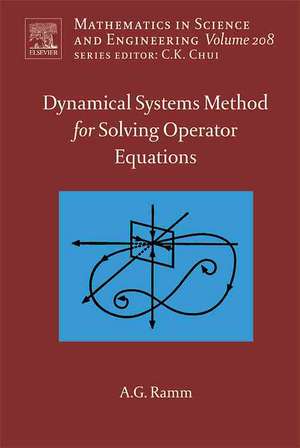
Dynamical Systems Method for Solving Nonlinear Operator Equations: Mathematics in Science and Engineering, cartea 208
Autor Alexander G. Rammen Limba Engleză Hardback – 25 sep 2006
- Contains a systematic development of a novel general method, the dynamical systems method, DSM for solving operator equations, especially nonlinear and ill-posed
- Self-contained, suitable for wide audience
- Can be used for various courses for graduate students and partly for undergraduates (especially for RUE classes)
Din seria Mathematics in Science and Engineering
- 26%
 Preț: 746.10 lei
 - 31%
 Preț: 722.09 lei
 - 40%
 Preț: 591.67 lei
 - 24%
 Preț: 742.83 lei
 - 30%
 Preț: 866.20 lei
 - 31%
 Preț: 993.87 lei
 - 30%
 Preț: 520.30 lei
 - 31%
 Preț: 862.06 lei
 - 27%
 Preț: 1119.12 lei
 - 27%
 Preț: 713.30 lei
 - 46%
 Preț: 700.50 lei
 - 30%
 Preț: 638.74 lei
 - 27%
 Preț: 1369.53 lei
 - 27%
 Preț: 1343.62 lei
 - 27%
 Preț: 1226.65 lei
 - 27%
 Preț: 1232.18 lei
 - 27%
 Preț: 1199.00 lei
 - 27%
 Preț: 831.20 lei
 - 9%
 Preț: 717.99 lei
Preț: 973.93 lei
Preț vechi: 1334.14 lei
-27%
Puncte Express: 1461
Carte tipărită la comandă
Livrare economică 30 noiembrie-14 decembrie
Livrare prin curier în România Termenul estimat este afișat lângă disponibilitate.
Transport gratuit pentru acest produs Plată online sau ramburs, în funcție de opțiunile comenzii.
Retur gratuit în 14 zile Comandă securizată și suport în română.
Specificații
ISBN-13: 9780444527950
ISBN-10: 0444527958
Pagini: 304
Dimensiuni: 152 x 229 x 17 mm
Greutate: 0.63 kg
Editura: ELSEVIER SCIENCE
Seria Mathematics in Science and Engineering
ISBN-10: 0444527958
Pagini: 304
Dimensiuni: 152 x 229 x 17 mm
Greutate: 0.63 kg
Editura: ELSEVIER SCIENCE
Seria Mathematics in Science and Engineering
V-ar putea interesa
-
 Spectral and Scattering TheoryAlexander G. Ramm-15%Preț: 666.07 lei783.60 lei
 -
 Theory and Applications of Some New Classes of Integral EquationsAlexander G. RammPreț: 393.95 lei
 -
 Functional Data AnalysisHsing-19%Preț: 502.40 lei620.25 lei
 -
 The Radon Transform and Local TomographyAlexander G. Ramm-20%Preț: 1998.07 lei2497.59 lei
 -
 -23%Preț: 627.24 lei814.60 lei
 -
 Hypergeometric SummationWolfram Koepf-15%Preț: 502.35 lei591.01 lei
 -
 Decay of the Fourier TransformAlex Iosevich-15%Preț: 724.89 lei852.80 lei
 -
 -15%Preț: 606.90 lei714.01 lei
 -
 -18%Preț: 830.45 lei1012.74 lei
 -
 Geometric Aspects of Functional AnalysisBo'az KlartagPreț: 383.37 lei
 -
 Dynamic Inequalities On Time ScalesRavi AgarwalPreț: 407.16 lei
 -
 A Topological Introduction to Nonlinear AnalysisRobert F. BrownPreț: 488.13 lei
 -
 Stochastic Processes - Inference TheoryMalempati M. Rao-15%Preț: 691.09 lei813.04 lei
 -
 -48%Preț: 505.49 lei980.06 lei
 -
 Semigroups, Boundary Value Problems and Markov ProcessesKazuaki Taira-18%Preț: 838.70 lei1022.81 lei
 -
 Scattering by ObstaclesAlexander G. Ramm-15%Preț: 677.73 lei797.34 lei
 -
 HILBERT-HUANG TRANSFORM AND ITS APPLICATIONS (2ND ED)Huang Norden E-18%Preț: 849.16 lei1035.56 lei
 -
 Hilbert Space and Quantum MechanicsFranco Gallone-18%Preț: 799.24 lei974.69 lei
Public țintă
Mathematicians, numerical analysists, specialists in scientific computing, engineers and others interested in solving operator equations, ill-posed and inverse problems.Cuprins
1. Introduction2. Ill-posed problems3. DSM for well-posed problems4. DSM and linear ill-posed problems5. Some inequalities6. DSM for monotone operators7. DSM for general nonlinear operator equations8 DSM for operators satisfying a spectral assumption9. DSM in Banach spaces10. DSM and Newton-type methods without inversion of the derivative11. DSM and unbounded operators12. DSM and nonsmooth operators13. DSM as a theoretical tool14. DSM and iterative methods15. Numerical problems arising in applications16. Auxiliary results from analysis