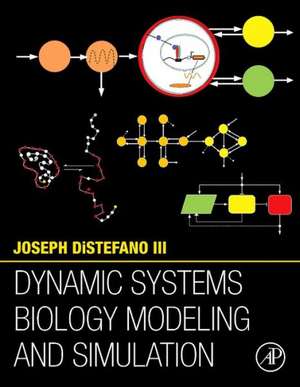
Dynamic Systems Biology Modeling and Simulation
Autor Joseph DiStefano IIIen Limba Engleză Hardback – 10 ian 2015
Evoluția biologiei sistemelor în ultimele decenii a transformat disciplina dintr-o știință descriptivă într-una riguros cantitativă, o tranziție pe care Dynamic Systems Biology Modeling and Simulation o documentează și o facilitează magistral. Observăm cum autorul Joseph DiStefano III reușește să sintetizeze jumătate de secol de cercetare la UCLA într-un manual care unifică metodologiile clasice cu cele contemporane. Lucrarea nu se rezumă la teorie, ci ancorează modelarea matematică în realitatea datelor experimentale, oferind claritate unor concepte adesea ambigue în literatura de specialitate.
Structura volumului este una progresivă, de tip tutorial sistematic. Primele capitole pun bazele nomenclaturii și ale modelării compartimentale, trecând ulterior prin cinetica biochimică și sisteme celulare, pentru ca în final să abordeze subiecte avansate de analiză de senzitivitate și optimizarea designului experimental. Această organizare reflectă o viziune didactică maturizată, unde matematica (ecuații diferențiale, algebră liniară) este prezentată mereu în dialog cu biologia sau farmacologia pertinentă. Subliniem relevanța practică a capitolelor dedicate identifiabilității și estimării parametrilor, esențiale pentru validarea oricărui model în contextul cercetării aplicate.
În peisajul editorial actual, această lucrare completează perspectiva oferită de A Guide to Numerical Modelling in Systems Biology de Peter Deuflhard. În timp ce textul lui Deuflhard se concentrează strict pe metode numerice și algoritmi pentru cei cu background matematic limitat, volumul de față oferă o viziune mult mai integrată, legând strâns execuția computațională de interpretarea biologică multiscală. De asemenea, spre deosebire de A First Course in Systems Biology, care servește ca o introducere generală, manualul lui DiStefano oferă instrumente software concrete (Matlab, Simulink, SAAMII) și un suport pedagogic extins, fiind o resursă superioară pentru nivelul graduate și cercetare.
Preț: 569.21 lei
Preț vechi: 618.70 lei
-8%
Carte tipărită la comandă
Livrare economică 30 noiembrie-14 decembrie
Specificații
ISBN-10: 0124104118
Pagini: 884
Dimensiuni: 210 x 279 x 48 mm
Greutate: 2.79 kg
Editura: ELSEVIER SCIENCE
V-ar putea interesa
-
 An Introduction to Human Evolutionary AnatomyLeslie Aiello-21%Preț: 380.01 lei480.61 lei
 -
 Bird Census TechniquesColin J. Bibby-29%Preț: 468.31 lei664.11 lei
 -
 Phylogenetics and EcologyPaul Eggleton-14%Preț: 1302.52 lei1514.56 lei
 -
 Signal Transductionljsbrand M. Kramer-24%Preț: 577.28 lei761.25 lei
 -
 Moonwalking with EinsteinJoshua Foer-30%Preț: 65.47 lei93.26 lei
 -
 The Future of the MindMichio KakuPreț: 80.05 lei
 -
 Consciousness and the BrainStanislas DehaenePreț: 106.53 lei
 -
 Preț: 282.00 lei
 -
 Atlas of Human Brain ConnectionsMarco Catani-30%Preț: 823.41 lei1180.80 lei
 -
 -19%Preț: 364.93 lei448.61 lei
 -
 Brain and MusicStefan KoelschPreț: 369.66 lei
 -
 The Power of HabitCharles DuhiggPreț: 86.85 lei
Public țintă
upper-division undergraduate, graduate level, and research level students systems biology, computational biology, biomathematics, biomedical engineering (bioengineering), pharmacology and areas using contemporary dynamical biosystem modeling and simulation methodology.De ce să citești această carte
Este resursa definitivă pentru studenții de la bioinginerești și cercetătorii care doresc să stăpânească modelarea sistemelor dinamice. Cititorul câștigă nu doar rigoare matematică, ci și competențe practice de simulare pe calculator, susținute de resurse digitale și cod sursă. Este o investiție pe termen lung pentru oricine lucrează cu date biologice complexe și are nevoie de modele computaționale valide și testabile.
Descriere scurtă
- Introductory coverage of core mathematical concepts such as linear and nonlinear differential and difference equations, Laplace transforms, linear algebra, probability, statistics and stochastics topics
- The pertinent biology, biochemistry, biophysics or pharmacology for modeling are provided, to support understanding the amalgam of “math modeling with life sciences
- Strong emphasis on quantifying as well as building and analyzing biomodels: includes methodology and computational tools for parameter identifiability and sensitivity analysis; parameter estimation from real data; model distinguishability and simplification; and practical bioexperiment design and optimization
- Companion website provides solutions and program code for examples and exercises using Matlab, Simulink, VisSim, SimBiology, SAAMII, AMIGO, Copasi and SBML-coded models
- A full set of PowerPoint slides are available from the author for teaching from his textbook. He uses them to teach a 10 week quarter upper division course at UCLA, which meets twice a week, so there are 20 lectures. They can easily be augmented or stretched for a 15 week semester course
- Importantly, the slides are editable, so they can be readily adapted to a lecturer’s personal style and course content needs. The lectures are based on excerpts from 12 of the first 13 chapters of DSBMS. They are designed to highlight the key course material, as a study guide and structure for students following the full text content
- The complete PowerPoint slide package (~25 MB) can be obtained by instructors (or prospective instructors) by emailing the author directly, at: joed@cs.ucla.edu
Cuprins
Recenzii
"This book provides a systematic review of the concepts of mathematical modeling in various fields. With its simple language, varied practical examples, quick references, appendixes, and clear basic concepts, it provides a thorough explanation of the subject. The well-organized chapters, along with the use of different notations and typescripts, make it a user-friendly book." Rating: 5 Stars--Doody.com, March 7, 2014
"DiStefano presents this interdisciplinary text merging mathematics, modeling, systems science, and biology. The first chapter introduces the philosophy and nomenclature of modeling and simulation. Chapter two covers mathematics including algebraic models, differential equations, linear and nonlinear modeling, and chapter three describes the use of Taylor series and algorithmic treatment of differential equations in computer simulation methods."--ProtoView.com, February 2014
“I am just in awe of your ability to start with simple ideas and use them to explain sophisticated concepts and methodologies in modeling biochemical and cellular systems (Chapters 6 and 7). This is a great new contribution to the textbook offerings in systems biology.”--Alex Hoffmann, Director of the San Diego Center for Systems Biology and the UCSD Graduate Program in Bioinformatics and Systems Biology
"I found Chapter 1 to be a marvel of heavy-lifting, done so smoothly there was no detectable sweat. Heavy-lifting because you laid out the big load of essential vocabulary and concepts a reader has to have to enter the world of biomodeling confidently. In that chapter you generously acknowledge some us who tried to accomplish this earlier but, compared to your Chapter 1, we were clumsy and boring. For me, now, Chapter 1 was a "page-turner" to be enjoyed straight through. You have the gift of a master athlete who does impossible performances and makes them seem easy.
Your Chapter 9 – on oscillations and stability – is a true jewel. I have a shelf full of books etc on nonlinear mechanics and system analyses and modeling, but nothing to match the clarity and deep understanding you offer the reader. You are a great explainer and teacher." --F. Eugene Yates, Emeritus Professor of Medicine, Chemical Engineering and Ralph and Marjorie Crump Professor of Biomedical Engineering, UCLA