
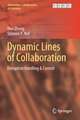
Dynamic Lines of Collaboration: Disruption Handling & Control: Automation, Collaboration, & E-Services, cartea 6
Autor Hao Zhong, Shimon Y. Nofen Limba Engleză Hardback – 11 ian 2020
In this book, we are chiefly interested in how effectively these collaborations can be supported and how we canfurther optimize such support. Solution guidelines for optimizing collaborations are illustrated with examples in various application domains: agricultural robotics, civil cyber-physical infrastructure, visual analytics, manufacturing automation, and supply chains. Open-source simulation tools are also provided to supplement the main content.
| Toate formatele și edițiile | Preț | Express |
|---|---|---|
| Paperback (1) | 612.94 lei 6-8 săpt. | |
| Springer International Publishing – 11 ian 2021 | 612.94 lei 6-8 săpt. | |
| Hardback (1) | 618.96 lei 6-8 săpt. | |
| Springer International Publishing – 11 ian 2020 | 618.96 lei 6-8 săpt. |






Preț: 618.96 lei
Preț vechi: 773.69 lei
-20% Nou
Puncte Express: 928
Preț estimativ în valută:
109.56€ • 128.21$ • 95.85£
109.56€ • 128.21$ • 95.85£
Carte tipărită la comandă
Livrare economică 24 ianuarie-07 februarie 26
Preluare comenzi: 021 569.72.76
Specificații
ISBN-13: 9783030344627
ISBN-10: 3030344622
Pagini: 115
Ilustrații: XVII, 115 p. 24 illus., 23 illus. in color.
Dimensiuni: 155 x 235 mm
Greutate: 0.37 kg
Ediția:1st ed. 2020
Editura: Springer International Publishing
Colecția Springer
Seria Automation, Collaboration, & E-Services
Locul publicării:Cham, Switzerland
ISBN-10: 3030344622
Pagini: 115
Ilustrații: XVII, 115 p. 24 illus., 23 illus. in color.
Dimensiuni: 155 x 235 mm
Greutate: 0.37 kg
Ediția:1st ed. 2020
Editura: Springer International Publishing
Colecția Springer
Seria Automation, Collaboration, & E-Services
Locul publicării:Cham, Switzerland
Cuprins
Introduction.- Collaborative e-Work and Collaborative Control Theory for Disruption Handling and Control.- The DLOC Model.- Protocols for The Dynamic Lines of Collaboration.- The TIE/DLOC Tool.- Applications and Experiments.- Evolving DLOC Theory and Emerging Applications.
Textul de pe ultima copertă
This book focuses on the systematic modeling of complex situations characterized by escalating disruptions, and on cycles of dynamic collaboration for the best handling of disruptions. What can we do about disruptive events and their cascading effects? Thanks to the evolution of intelligent technologies for interaction, communication, sharing, and collaboration, cyberspace is a rapidly expanding world. Our systems of machines, software services, and human organizations have become increasingly interdependent, in other words – networked. As a result, disruptions that initially affect only a small part of any network tend to escalate. At the same time, cyber solutions can support first responders and emergency handlers, enhancing their responsiveness and ability to collaborate with one another in controlling disruptions and preventing their escalation.
In this book, we are chiefly interested in how effectively these collaborations can be supported and how we canfurther optimize such support. Solution guidelines for optimizing collaborations are illustrated with examples in various application domains: agricultural robotics, civil cyber-physical infrastructure, visual analytics, manufacturing automation, and supply chains. Open-source simulation tools are also provided to supplement the main content.
Caracteristici
Explains, illustrates and evaluates the theory and application of Dynamic Lines of Collaboration (DLOC) in detail Describes applications and experiments with DLOC in several types of cyber physical systems Discusses other potential applications including: collaborative visual analytics, heterogeneous robotic material handling, and quality assurance planning in manufacturing