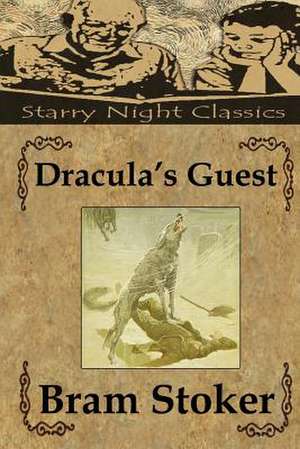
Dracula's Guest
Autor Bram Stoker Editat de Richard S. Hartmetzen Limba Engleză Paperback
Preț: 55.66 lei
Puncte Express: 83
Carte disponibilă
Livrare economică 13-27 noiembrie
Livrare prin curier în România Termenul estimat este afișat lângă disponibilitate.
Transport gratuit de la 400.00 lei Plată online sau ramburs, în funcție de opțiunile comenzii.
Retur gratuit în 14 zile Comandă securizată și suport în română.
Specificații
ISBN-13: 9781484956700
ISBN-10: 1484956702
Pagini: 168
Dimensiuni: 152 x 229 x 9 mm
Greutate: 0.23 kg
Editura: CREATESPACE
ISBN-10: 1484956702
Pagini: 168
Dimensiuni: 152 x 229 x 9 mm
Greutate: 0.23 kg
Editura: CREATESPACE
V-ar putea interesa
-
 DraculaBram StokerPreț: 28.01 lei
 -
 CLASSIC RETELLINGS_DRACULATanya LandmanPreț: 58.00 lei
 -
 Dracula's Guest and Other Weird TalesBram Stoker-24%Preț: 60.96 lei80.33 lei
 -
 Preț: 146.26 lei
 -
 DraculaBram StokerPreț: 44.23 lei
 -
 Haunted LibraryTanya KirkPreț: 76.32 lei
 -
 Tales of the SupernaturalAlgernon BlackwoodPreț: 149.68 lei
 -
 Preț: 145.85 lei
 -
 Dracula and Other Horror ClassicsBram Stoker-30%Preț: 208.67 lei299.61 lei
 -
 Dracula (Graphic Art Collector's Edition)Bram Stoker-30%Preț: 93.28 lei132.84 lei
 -
 -18%Preț: 168.62 lei205.95 leiRecomandat
 -
 Bram Stoker Horror StoriesBram Stoker-9%Preț: 135.80 lei148.56 lei
 -
 Carmilla (Gift Edition)Sheridan Le FanuPreț: 64.37 lei
 -
 Dr Jekyll and Mr Hyde & Other TalesRobert Louis Stevenson-31%Preț: 49.62 lei72.05 lei
 -
 Dracula & Dracula''s GuestBram StokerPreț: 33.94 lei
 -
 DraculaBram StokerPreț: 62.28 lei
 -
 Preț: 32.05 lei
 -
 DraculaBram StokerPreț: 31.55 lei
 -
 CarmillaJoseph Sheridan Le FanuPreț: 92.17 lei
 -
 #DRCL midnight children, Vol. 5Shin'ichi Sakamoto-18%Preț: 128.66 lei157.81 leiRecomandat
Descriere
Descriere de la o altă ediție sau format:
Dracula needs no introduction, but few of its fans have heard of Dracula's Guest, a short story following Jonathan Harker as he makes his way to Transylvania and falls prey to Walpurgis Nacht terrors when he stops off in Munich. Dracula's Guest is the missing chapter that will captivate all fans of Stoker's 'dangers from snow and wolves and night'.
Dracula needs no introduction, but few of its fans have heard of Dracula's Guest, a short story following Jonathan Harker as he makes his way to Transylvania and falls prey to Walpurgis Nacht terrors when he stops off in Munich. Dracula's Guest is the missing chapter that will captivate all fans of Stoker's 'dangers from snow and wolves and night'.
Notă biografică
"Bram Stoker, born in Dublin in 1847, overcame a childhood illness to become an accomplished athlete and scholar at Trinity College. His career took a pivotal turn when he became the personal assistant to the famous actor Sir Henry Irving and managed London's Lyceum Theatre for 27 years, immersing himself in high society. While best known for his 1897 novel Dracula, Stoker wrote several other works of gothic fiction. Dracula, in particular, drew on his fascination with folklore and became an iconic influence in vampire literature and popular culture.Stoker's life was shaped by his wide range of interests, including literature, theatre, and travel. His time managing the Lyceum Theatre gave him access to London's literary and artistic circles, where he met figures like Sir Arthur Conan Doyle and Walt Whitman. His travels to places like Whitby, England, and Cruden Bay, Scotland, helped inspire the eerie settings in Dracula. Although he never visited Eastern Europe, Stoker's extensive research into its folklore gave his most famous work a haunting authenticity.In his later years, Stoker faced declining health and financial struggles, yet he remained productive until his death in 1912. Dracula was not initially recognized as a literary masterpiece but has since become one of the most influential horror novels ever written, cementing Stoker's place in literary history. His unique blend of gothic horror, folklore, and Victorian anxieties continues to captivate readers and inspire adaptations across all forms of media."