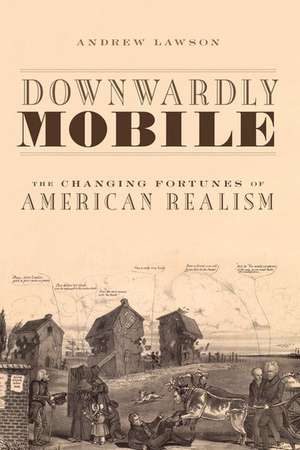
Downwardly Mobile: The Changing Fortunes of American Realism
Autor Andrew Lawsonen Limba Engleză Paperback – 22 mai 2014
În volumul Downwardly Mobile, Andrew Lawson propune o perspectivă nouă asupra genezei realismului american, ancorând estetica literară în realitățile brutale ale fluctuațiilor economice din secolul al XIX-lea. Observăm cum autorul mută accentul de la simplele convenții stilistice către o „structură a simțirii” generată de precaritate. Această ediție publicată de Oxford University Press demonstrează că realismul nu a fost doar o alegere artistică, ci un mecanism de supraviețuire psihologică și socială pentru o clasă de mijloc amenințată de insolvență și devalorizarea monedei de hârtie.
Analiza extinde cadrul propus de The Cambridge Introduction to American Literary Realism de Phillip J. Barrish prin corelarea directă a biografiilor autorilor cu traumele financiare colective. Dacă Barrish se concentrează pe contextul istoric general, Lawson aprofundează modul în care eșecurile financiare personale ale unor scriitori precum Susan Warner sau experiența frontierei pentru William Dean Howells au cristalizat nevoia de a capta realitatea cu o precizie chirurgicală. De asemenea, lucrarea completează viziunea din Vital Contact de Patrick Chura; în timp ce Chura analizează „coborârea” voluntară în rândul claselor sărace, Lawson investighează teroarea mobilității descendente involuntare.
Apreciem rigoarea cu care sunt examinate figurile marginale — muncitori, sclavi și persoane cu dizabilități — care devin vizibile în textul realist ca urmare a pieței nereglementate. În contextul operei sale, Downwardly Mobile continuă direcția teoretică stabilită în Class and the Making of American Literature, rafinând argumentul că literatura americană este indisolubil legată de conștiința de clasă și de anxietatea statutului social.
Preț: 241.56 lei
Preț vechi: 299.71 lei
-19%
Carte tipărită la comandă
Livrare economică 27 noiembrie-02 decembrie
Specificații
ISBN-10: 019937502X
Pagini: 208
Dimensiuni: 234 x 155 x 15 mm
Greutate: 0.3 kg
Editura: Oxford University Press
Colecția OUP USA
Locul publicării:New York, United States
V-ar putea interesa
-
 -12%Preț: 365.51 lei413.51 lei
 -
 Victoria's Year: English Literature and Culture 1837-1838Richard L. Stein-31%Preț: 1279.01 lei1864.36 lei
 -
 Emerson and the Art of the DiaryLawrence Rosenwald-29%Preț: 496.09 lei695.20 lei
 -
 -31%Preț: 777.62 lei1125.88 lei
 -
 Shelley's Goddess: Maternity, Language, SubjectivityBarbara Charlesworth Gelpi-13%Preț: 274.53 lei313.87 lei
 -
 High and Low Moderns: Literature and Culture, 1889-1939Maria DiBattista-31%Preț: 915.56 lei1331.74 lei
 -
 Was Huck Black?: Mark Twain and African-American VoicesShelley Fisher Fishkin-16%Preț: 207.64 lei248.54 lei
 -
 -13%Preț: 294.78 lei338.21 lei
 -
 -31%Preț: 603.52 lei873.65 lei
 -
 Oxford Reader's Companion to ConradOwen Knowles-16%Preț: 198.09 lei234.93 lei
 -
 -31%Preț: 802.24 lei1167.94 lei
 -
 Algernon Charles SwinburneCatherine MaxwellPreț: 222.22 lei
 -
 The Edinburgh Companion to Nineteenth-Century American Letters and Letter-WritingCeleste-Marie Bernier-26%Preț: 1331.21 lei1792.63 lei
 -
 Preț: 469.90 lei
 -
 Laon and CythnaPercy Bysshe Shelley-20%Preț: 222.67 lei277.64 lei
De ce să citești această carte
Recomandăm această lucrare cercetătorilor și studenților la filologie sau istorie care doresc să înțeleagă rădăcinile economice ale literaturii. Cititorul va câștiga o perspectivă critică asupra modului în care crizele financiare modelează formele narative. Este un studiu esențial despre cum frica de declasare a creat unul dintre cele mai importante curente literare americane, oferind instrumente de analiză pentru operele lui Henry James sau Hamlin Garland.
Despre autor
Andrew Lawson este un cercetător respectat în domeniul studiilor americane, cu un interes academic profund pentru intersecția dintre clasă, economie și producție literară. Deși numele său coincide cu cel al unui cunoscut fotograf de grădini, Lawson se distinge în mediul universitar prin analizele sale pătrunzătoare asupra structurilor sociale din Statele Unite ale secolului al XIX-lea. Printre contribuțiile sale notabile se numără volumul Class and the Making of American Literature, unde a pus bazele unei noi metodologii de interpretare a canonului literar prin prisma inegalității și a controlului social, teme pe care le rafinează și în prezenta lucrare.
Descriere
Recenzii
Downwardly Mobile is innovative in its approach, clearly and pleasingly written, and it will be of great interest not only to scholars of realism but, more generally, to those active in American literary and cultural studies.
Downwardly Mobile is a strikingly original and erudite study: a significant accomplishment. Lawson's work represents one of the best instances I've seen of an emerging formation of scholarship that combines a variety of intellectual commitments that used to be thought incompatible: careful historicism (including local storytelling and big-picture analyses), loving attention to writerly style, respect for a greatly expanded canon, and easy interweaving of several strands of critical theory (Marxism/materialism, psychoanalysis, queer theory) without any intrusive terminology or apparatus.
Thoughtfully combines biography, economic history, and literary analysis to explore realism as a genre emerging from marketplace dislocations...Highly recommended.
Lawson's book reminds us of the crucial and fundamental questions that must be asked whenever we talk about realism.
[Lawson's] advanced argument is solidly supported, innovative, and valuable to those interested not only in American realism but in cultural materialism, history, and social and economic movements.
Just as realist writers clarified the real, Lawson clarifies why realism emerged when it did. Like the IMF and its flowchart, or the realist novels themselves, Lawson helps us trace something - the origins of literary realism - that would otherwise remain obscure.