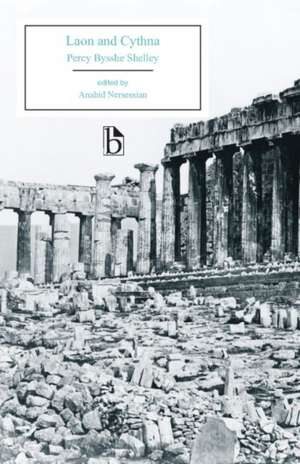
Laon and Cythna
Autor Percy Bysshe Shelley Editat de Anahid Nersessianen Limba Engleză Paperback – 18 apr 2016
Historical appendices provide context for Shelley’s political and philosophical ideas, contemporary feminism, and the treatment of Asia and the Middle East in Romantic literature.
Preț: 222.79 lei
Preț vechi: 277.64 lei
-20%
Puncte Express: 334
Carte disponibilă
Livrare economică 10-24 noiembrie
Livrare prin curier în România Termenul estimat este afișat lângă disponibilitate.
Transport gratuit de la 400.00 lei Plată online sau ramburs, în funcție de opțiunile comenzii.
Retur gratuit în 14 zile Comandă securizată și suport în română.
Specificații
ISBN-13: 9781554811946
ISBN-10: 1554811945
Pagini: 304
Dimensiuni: 140 x 216 x 14 mm
Greutate: 0.41 kg
Editura: BROADVIEW PR
Colecția Broadview Press
Locul publicării:Peterborough, Canada
ISBN-10: 1554811945
Pagini: 304
Dimensiuni: 140 x 216 x 14 mm
Greutate: 0.41 kg
Editura: BROADVIEW PR
Colecția Broadview Press
Locul publicării:Peterborough, Canada
V-ar putea interesa
-
 The Soviet Novel, Third EditionKaterina ClarkPreț: 173.86 lei
 -
 -15%Preț: 661.92 lei778.72 lei
 -
 Shelley's Poetry and ProsePercy Bysshe ShelleyPreț: 168.13 lei
 -
 The Masochistic Pleasures of Sentimental LiteratureMarianne NoblePreț: 467.12 lei
 -
 Preț: 142.47 lei
 -
 Stories with a MoralMichael E PricePreț: 443.13 lei
 -
 Preț: 186.37 lei
 -
 Photography and Literature: Volume 2Eric Lambrechts-39%Preț: 1520.33 lei2496.77 lei
 -
 The Poems of Herman MelvilleRobillardPreț: 161.27 lei
 -
 Adonais - An Elegy on the Death of John KeatsPercy Bysshe ShelleyPreț: 115.77 lei
 -
 LodoreMary Shelley-21%Preț: 241.39 lei306.26 lei
 -
 -24%Preț: 336.60 lei442.91 lei
 -
 Frankenstein - Third EditionMary Shelley-15%Preț: 112.70 lei133.37 lei
 -
 -18%Preț: 132.79 lei162.85 lei
 -
 -8%Preț: 477.92 lei519.48 lei
 -
 The Poetry of RimbaudRobert Greer CohnPreț: 242.85 lei
 -
 Der entfesselte PrometheusPercy Bysshe ShelleyPreț: 91.35 lei
Recenzii
Laon and Cythna is one of Percy Bysshe Shelley’s most celebrated, and most controversial, literary works. At once philosophical treatise and love story, it follows the adventures of a pair of siblings who lead a political uprising based on socialist, feminist, and ecological ideals, only to be executed for treason. In its own time Shelley’s poem was condemned by some for promoting sedition, atheism, promiscuity, and incest, while others praised its beauty and radical vision. Although it inspired a generation of writers and activists, today Laon and Cythna is hardly read except by scholars. This edition seeks to correct that oversight and to introduce new audiences to this important and powerful text.
Historical appendices provide context for Shelley’s political and philosophical ideas, contemporary feminism, and the treatment of Asia and the Middle East in Romantic literature.
“With its illuminating appendices and compellingly argued introduction, Anahid Nersessian’s edition of Laon and Cythna; Or, the Revolution of the Golden City richly contextualizes and enlivens one of Percy Bysshe Shelley’s most understudied poems. This edition will become essential reading for students, scholars, or anyone studying Romantic literature’s engagement with the French Revolution and its aftermath, orientalist aesthetics, feminist thought, and utopian philosophy. Indispensable for those working with the poem’s later incarnation—the revised and retitled The Revolt of Islam—Nersessian’s edition also makes the original censored poem and its literary and historical contexts easily accessible for the first time.” — Michele Speitz, Furman University
“This new edition of Laon and Cythna makes Shelley’s epic revolutionary romance widely available in a scholarly yet accessible form for the first time. Anahid Nersessian’s highly engaging and wide-ranging introduction makes a compelling case for the centrality of the text’s preoccupations to Shelley’s work and thought more widely, in particular, how Shelley’s reflection on the nature and means of sociopolitical reform shapes the trajectory of the poem. The introduction and supplementary material provide a rich range of historical, political, and literary contexts for the poem. Nersessian demonstrates how the poem participates in contemporary debates about women’s rights, the possibilities of non-violent revolution, and the desirability of vegetarianism, and discusses the poem’s contribution to ideas of Romantic orientalism. This superb new edition is an invaluable resource for new readers and experienced scholars alike and is a timely contribution to Shelley studies more broadly.” — Sally West, University of Chester
Historical appendices provide context for Shelley’s political and philosophical ideas, contemporary feminism, and the treatment of Asia and the Middle East in Romantic literature.
“With its illuminating appendices and compellingly argued introduction, Anahid Nersessian’s edition of Laon and Cythna; Or, the Revolution of the Golden City richly contextualizes and enlivens one of Percy Bysshe Shelley’s most understudied poems. This edition will become essential reading for students, scholars, or anyone studying Romantic literature’s engagement with the French Revolution and its aftermath, orientalist aesthetics, feminist thought, and utopian philosophy. Indispensable for those working with the poem’s later incarnation—the revised and retitled The Revolt of Islam—Nersessian’s edition also makes the original censored poem and its literary and historical contexts easily accessible for the first time.” — Michele Speitz, Furman University
“This new edition of Laon and Cythna makes Shelley’s epic revolutionary romance widely available in a scholarly yet accessible form for the first time. Anahid Nersessian’s highly engaging and wide-ranging introduction makes a compelling case for the centrality of the text’s preoccupations to Shelley’s work and thought more widely, in particular, how Shelley’s reflection on the nature and means of sociopolitical reform shapes the trajectory of the poem. The introduction and supplementary material provide a rich range of historical, political, and literary contexts for the poem. Nersessian demonstrates how the poem participates in contemporary debates about women’s rights, the possibilities of non-violent revolution, and the desirability of vegetarianism, and discusses the poem’s contribution to ideas of Romantic orientalism. This superb new edition is an invaluable resource for new readers and experienced scholars alike and is a timely contribution to Shelley studies more broadly.” — Sally West, University of Chester
Cuprins
Acknowledgements
Introduction
Percy Bysshe Shelley: A Brief Chronology
A Note on the Text
Laon and Cythna; or, The Revolution of the Golden City
Appendix A: Shelley’s Political and Philosophical Prose
Introduction
Percy Bysshe Shelley: A Brief Chronology
A Note on the Text
Laon and Cythna; or, The Revolution of the Golden City
Appendix A: Shelley’s Political and Philosophical Prose
- From A Vindication of Natural Diet (1813)
- From “On Love” (1818)
- From “A Philosophical View of Reform” (1819–20)
- Shelley to an unknown publisher (13 October 1817)
- From Shelley to Charles Ollier (3 December 1817)
- From Shelley to William Godwin (11 December 1817)
- Shelley to Charles Ollier (11 December 1817)
- From Shelley to Thomas Moore (16 December 1817)
- From Shelley to Charles Ollier (22 January 1818)
- From Leigh Hunt, “Literary Notices, No. 39,” The Examiner (1 February 1818)
- From Leigh Hunt, “Literary Notices, No. 41,” The Examiner (1 March 1818)
- From [John Gibson Lockhart,] “Observations on the Revolt of Islam,” Blackwood’s Edinburgh Magazine (January 1819)
- From [John Taylor Coleridge,] “Shelley’s Revolt of Islam,” Quarterly Review (April 1819)
- From Leigh Hunt, “The Quarterly Review and the Revolt of Islam,” The Examiner (10 October 1819)
- From Richard Hurd, Letters on Chivalry and Romance (1762)
- From Edmund Burke, Reflections on the Revolution in France (1790)
- From Helen Maria Williams, Letters from France (1792)
- From William Wordsworth, “The Female Vagrant” (1798)
- From Lord Byron, Canto II of Childe Harold’s Pilgrimage (1812)
- From Mary Wollstonecraft, A Vindication of the Rights of Woman (1792)
- From William Godwin, Enquiry Concerning Political Justice, 3rd ed. (1798)
- From James Lawrence, The Empire of the Nairs (1811)
- From Charles Louis de Secondat, Baron de Montesquieu, Persian Letters (1721)
- From Constantin-François Chasseboeuf, Comte de Volney, The Ruins: or a Survey of the Revolutions of Empires (1791)
- From Robert Southey, Thalaba the Destroyer (1801)
- From Sydney Owenson (Lady Morgan), The Missionary (1811)
- From Lord Byron, The Giaour, a Fragment of a Turkish Tale (1813)
- From Thomas Love Peacock, Ahrimanes (c. 1815)
- From Mary Wollstonecraft Shelley, “Note on The Revolt of Islam” (1839)