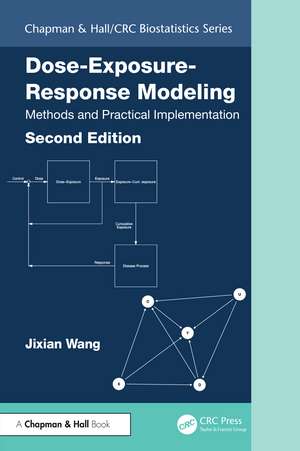
Dose-Exposure-Response Modeling: Methods and Practical Implementation: Chapman & Hall/CRC Biostatistics Series
Autor Jixian Wangen Limba Engleză Hardback – 19 feb 2026
Applied statisticians and modelers can find details on how to implement new approaches, while researchers can find topics for or applications of their work. In addition, students can see how complicated methodology and models are applied to practical situations.
Key Features:
- Provides SAS, R, and Stan codes that will enable readers to test the approaches in their own scenarios.
- Gives a systematic treatment of concepts and methodology.
- Helps with understanding concepts and evaluating the performance of new methods, particularly those in Chapters 7, 8, and 9.
- Includes a large amount of R codes for methods introduced in the new materials in chapters on Bayesian analyses, causal inference, and dose-adjustment.
- Includes a simulation to show how some complex methods such as generalized propensity score adjustment and adaptive dose adjustment can be implemented with simple codes.
Din seria Chapman & Hall/CRC Biostatistics Series
-
 Preț: 409.90 lei
 - 9%
 Preț: 1050.95 lei
 - 5%
 Preț: 710.24 lei
 -
 Preț: 384.53 lei
 - 9%
 Preț: 1092.40 lei
 -
 Preț: 387.05 lei
 -
 Preț: 361.15 lei
 - 8%
 Preț: 422.08 lei
 -
 Preț: 401.90 lei
 - 8%
 Preț: 430.65 lei
 - 9%
 Preț: 827.45 lei
 - 5%
 Preț: 365.52 lei
 - 5%
 Preț: 410.53 lei
 -
 Preț: 412.93 lei
 - 18%
 Preț: 705.39 lei
 - 18%
 Preț: 916.02 lei
 - 5%
 Preț: 1050.43 lei
 - 15%
 Preț: 679.06 lei
 - 15%
 Preț: 495.47 lei
 - 15%
 Preț: 481.33 lei
 - 5%
 Preț: 931.99 lei
 - 15%
 Preț: 502.01 lei
 -
 Preț: 466.91 lei
 - 5%
 Preț: 753.68 lei
 - 18%
 Preț: 812.82 lei
 -
 Preț: 441.95 lei
 -
 Preț: 425.90 lei
 -
 Preț: 446.99 lei
 - 18%
 Preț: 1034.96 lei
 - 18%
 Preț: 752.91 lei
 -
 Preț: 435.70 lei
 - 18%
 Preț: 807.50 lei
 - 15%
 Preț: 481.33 lei
 -
 Preț: 432.28 lei
 - 18%
 Preț: 1133.53 lei
 - 5%
 Preț: 417.43 lei
 - 18%
 Preț: 766.55 lei
 - 18%
 Preț: 1132.63 lei
 - 5%
 Preț: 941.57 lei
 - 18%
 Preț: 811.27 lei
 -
 Preț: 437.33 lei
 - 18%
 Preț: 1037.81 lei
 - 5%
 Preț: 2077.95 lei
 - 5%
 Preț: 779.58 lei
 - 18%
 Preț: 808.24 lei
Preț: 856.78 lei
Preț vechi: 1044.85 lei
-18% Precomandă
Puncte Express: 1285
Preț estimativ în valută:
151.68€ • 176.62$ • 131.77£
151.68€ • 176.62$ • 131.77£
Carte nepublicată încă
Doresc să fiu notificat când acest titlu va fi disponibil:
Se trimite...
Preluare comenzi: 021 569.72.76
Specificații
ISBN-13: 9781032596259
ISBN-10: 1032596252
Pagini: 362
Ilustrații: 74
Dimensiuni: 156 x 234 mm
Greutate: 0.45 kg
Ediția:2. Auflage
Editura: CRC Press
Colecția Chapman and Hall/CRC
Seria Chapman & Hall/CRC Biostatistics Series
ISBN-10: 1032596252
Pagini: 362
Ilustrații: 74
Dimensiuni: 156 x 234 mm
Greutate: 0.45 kg
Ediția:2. Auflage
Editura: CRC Press
Colecția Chapman and Hall/CRC
Seria Chapman & Hall/CRC Biostatistics Series
Public țintă
Professional Practice & Development, Professional Reference, and Professional TrainingCuprins
1 Introduction 2 Basic exposure and exposure-response models 3 Dose-exposure and exposure-response models for longitudinal data 4 Sequential and simultaneous dose-exposure-response modeling 5 Exposure-risk modeling for time-to-event data 6 Modeling dynamic dose-exposure-response relationship 7 Bayesian dose-exposure-response modeling 8 Causal dose-exposure-response analysis 9 Learning dose-exposure-response relationships: dose allocation and optimization 10 Appendices Index
Notă biografică
Jixian Wang is a statistical methodologist in Bristol Myers Squibb, Switzerland. He has worked on drug development for over twenty years and was an academic researcher before joining the pharmaceutical industry. His research interests include statistical methodology and its applications to real problems in pharmaceuticals, including exposure-safety, PKPD modeling, treatment/dose selection, health economics, benefit-risk and health technology assessments, and optimal trial design with 60+ publications on peer-reviewed journals.
Descriere
This thoroughly revised and updated new edition reflects the progress that has been made in dose-exposure-response (DER) modelling. As the title suggests, the new edition covers more topics on dose and dose adjustment. A large part of the book has been rewritten.