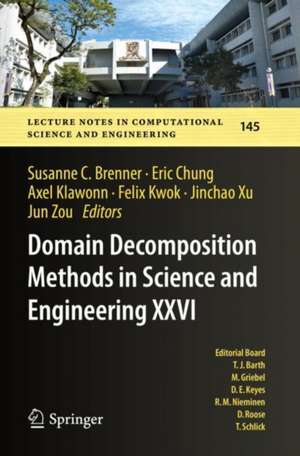
Domain Decomposition Methods in Science and Engineering XXVI: Lecture Notes in Computational Science and Engineering, cartea 145
Editat de Susanne C. Brenner, Eric Chung, Axel Klawonn, Felix Kwok, Jinchao Xu, Jun Zouen Limba Engleză Paperback – 16 mar 2024
Domain decomposition methods are iterative methods for solving the often very large systems of equations that arise when engineering problems are discretized, frequently using finite elements or other modern techniques. These methods are specifically designed to make effective use of massively parallel, high-performance computing systems.
The book presents both theoretical and computational advances in this domain, reflecting the state of art in 2020.
Din seria Lecture Notes in Computational Science and Engineering
- 18%
 Preț: 2157.09 lei
 - 18%
 Preț: 1431.86 lei
 -
 Preț: 369.74 lei
 - 20%
 Preț: 952.45 lei
 - 15%
 Preț: 671.56 lei
 - 15%
 Preț: 676.61 lei
 -
 Preț: 419.51 lei
 - 18%
 Preț: 1012.97 lei
 - 18%
 Preț: 1004.97 lei
 -
 Preț: 411.51 lei
 - 18%
 Preț: 997.97 lei
 - 15%
 Preț: 670.03 lei
 - 15%
 Preț: 671.56 lei
 - 15%
 Preț: 672.68 lei
 - 18%
 Preț: 1390.01 lei
 -
 Preț: 442.87 lei
 -
 Preț: 442.87 lei
 - 18%
 Preț: 1286.95 lei
 - 20%
 Preț: 690.84 lei
 - 15%
 Preț: 678.14 lei
 - 15%
 Preț: 666.97 lei
 - 18%
 Preț: 992.70 lei
 - 18%
 Preț: 1268.76 lei
 - 18%
 Preț: 937.27 lei
 - 18%
 Preț: 1289.25 lei
 - 24%
 Preț: 1215.39 lei
 - 20%
 Preț: 945.72 lei
 - 15%
 Preț: 665.43 lei
 - 18%
 Preț: 989.09 lei
Preț: 1203.66 lei
Preț vechi: 1583.77 lei
-24%
Puncte Express: 1805
Carte tipărită la comandă
Livrare economică 03-09 decembrie
Livrare prin curier în România Termenul estimat este afișat lângă disponibilitate.
Transport gratuit pentru acest produs Plată online sau ramburs, în funcție de opțiunile comenzii.
Retur gratuit în 14 zile Comandă securizată și suport în română.
Specificații
ISBN-13: 9783030950279
ISBN-10: 3030950271
Pagini: 780
Ilustrații: XXXIII, 780 p.
Dimensiuni: 155 x 235 mm
Ediția:2022
Editura: Springer International Publishing
Colecția Springer
Seria Lecture Notes in Computational Science and Engineering
Locul publicării:Cham, Switzerland
ISBN-10: 3030950271
Pagini: 780
Ilustrații: XXXIII, 780 p.
Dimensiuni: 155 x 235 mm
Ediția:2022
Editura: Springer International Publishing
Colecția Springer
Seria Lecture Notes in Computational Science and Engineering
Locul publicării:Cham, Switzerland
Textul de pe ultima copertă
These are the proceedings of the 26th International Conference on Domain Decomposition Methods in Science and Engineering, which was hosted by the Chinese University of Hong Kong and held online in December 2020.
Domain decomposition methods are iterative methods for solving the often very large systems of equations that arise when engineering problems are discretized, frequently using finite elements or other modern techniques. These methods are specifically designed to make effective use of massively parallel, high-performance computing systems.
The book presents both theoretical and computational advances in this domain, reflecting the state of art in 2020.
Domain decomposition methods are iterative methods for solving the often very large systems of equations that arise when engineering problems are discretized, frequently using finite elements or other modern techniques. These methods are specifically designed to make effective use of massively parallel, high-performance computing systems.
The book presents both theoretical and computational advances in this domain, reflecting the state of art in 2020.