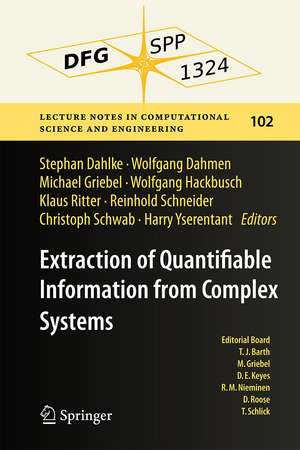
Extraction of Quantifiable Information from Complex Systems: Lecture Notes in Computational Science and Engineering, cartea 102
Editat de Stephan Dahlke, Wolfgang Dahmen, Michael Griebel, Wolfgang Hackbusch, Klaus Ritter, Reinhold Schneider, Christoph Schwab, Harry Yserentanten Limba Engleză Hardback – dec 2014
Aplicabilitatea practică a acestui volum rezidă în capacitatea sa de a oferi soluții numerice riguroase pentru modele care, deși devin tot mai realiste datorită puterii de calcul sporite, suferă de „blestemul dimensionalității”. Apreciem modul în care Extraction of Quantifiable Information from Complex Systems reușește să transforme fundamentul teoretic al Programului de Prioritate 1324 (DFG) într-un set de instrumente esențiale pentru tehnologia modernă, inginerie și finanțe. Descoperim aici o abordare sinergică, unde cercetarea teoretică și aplicațiile industriale sunt dezvoltate simultan, facilitând un transfer tehnologic real între matematică și practică. Suntem de părere că volumul se distinge prin rigoarea cu care tratează interconexiunile dintre discipline aparent divergente. Structura sa este organizată tematic, pornind de la rezolvarea programelor dinamice stocastice prin optimizare convexă și simulare, avansând spre rezoluția structurilor anizotropice și regularitatea hărților parametru-stare în ecuații diferențiale parabolice. Un accent deosebit este pus pe metodele wavelet adaptive și algoritmii de cuantizare constructivă, oferind o progresie logică de la baze teoretice la implementări algoritmice complexe. Comparabil cu Foundations of Computational Mathematics, Budapest 2011 în ceea ce privește rigurozitatea și platforma de fertilizare încrucișată a ideilor, acest volum este însă actualizat pentru provocările specifice ale sistemelor de înaltă dimensionalitate și integrarea stocasticii în analiza numerică. În contextul operei editorilor, lucrarea extinde temele explorate în Harmonic and Applied Analysis, trecând de la construcția reprezentărilor multiscală în procesarea semnalelor către o viziune mai largă asupra sistemelor complexe și a cuantificării incertitudinii prin filtre Kalman și probleme inverse bayesiene.
Din seria Lecture Notes in Computational Science and Engineering
- 18%
 Preț: 2157.09 lei
 - 18%
 Preț: 1431.86 lei
 -
 Preț: 369.74 lei
 - 20%
 Preț: 952.45 lei
 - 15%
 Preț: 671.56 lei
 - 15%
 Preț: 676.61 lei
 - 18%
 Preț: 1012.97 lei
 - 18%
 Preț: 1004.97 lei
 -
 Preț: 411.51 lei
 - 18%
 Preț: 997.97 lei
 - 15%
 Preț: 670.03 lei
 - 15%
 Preț: 671.56 lei
 - 15%
 Preț: 672.68 lei
 - 18%
 Preț: 1390.01 lei
 -
 Preț: 442.87 lei
 -
 Preț: 442.87 lei
 - 18%
 Preț: 1286.95 lei
 - 20%
 Preț: 690.84 lei
 - 15%
 Preț: 678.14 lei
 - 15%
 Preț: 666.97 lei
 - 18%
 Preț: 992.70 lei
 - 18%
 Preț: 1268.76 lei
 - 18%
 Preț: 937.27 lei
 - 18%
 Preț: 1289.25 lei
 - 24%
 Preț: 1215.39 lei
 - 20%
 Preț: 945.72 lei
 - 15%
 Preț: 665.43 lei
 - 18%
 Preț: 989.09 lei
Preț: 419.51 lei
Carte tipărită la comandă
Livrare economică 08-22 decembrie
Specificații
ISBN-10: 3319081586
Pagini: 460
Ilustrații: XIX, 432 p. 49 illus., 22 illus. in color.
Dimensiuni: 160 x 241 x 31 mm
Greutate: 0.8 kg
Ediția:2014
Editura: Springer
Colecția Lecture Notes in Computational Science and Engineering
Seria Lecture Notes in Computational Science and Engineering
Locul publicării:Cham, Switzerland
V-ar putea interesa
-
 Hyperbolic Partial Differential EquationsSerge AlinhacPreț: 464.32 lei
 -
 Control Theory for Partial Differential EquationsIrena Lasiecka-11%Preț: 573.16 lei644.00 lei
 -
 Advanced Mathematics for ApplicationsAndrea Prosperetti-11%Preț: 543.09 lei610.21 lei
 -
 Chaos and Coarse Graining in Statistical MechanicsPatrizia Castiglione-14%Preț: 948.67 lei1103.11 lei
 -
 An Introduction to Difference EquationsSaber Elaydi-15%Preț: 513.85 lei604.53 lei
 -
 Direct Methods in the Calculus of VariationsBernard Dacorogna-18%Preț: 1129.72 lei1377.71 lei
 -
 -18%Preț: 1167.21 lei1423.42 lei
 -
 Random Dynamical SystemsLudwig Arnold-18%Preț: 819.91 lei999.90 lei
 -
 The Concept of Stability in Numerical MathematicsWolfgang HackbuschPreț: 403.03 lei
 -
 Tensor Spaces and Numerical Tensor CalculusWolfgang Hackbusch-24%Preț: 759.08 lei998.80 lei
Public țintă
ResearchDe ce să citești această carte
Această lucrare este esențială pentru cercetătorii care lucrează la intersecția dintre analiza numerică și modelarea stocastică. Cititorul câștigă acces la rezultatele de vârf ale unui program de cercetare german de anvergură, beneficiind de algoritmi eficienți pentru sisteme complexe. Este o resursă rară care reușește să unifice limbajul matematicii pure cu cerințele de performanță ale calculului științific modern.
Despre autor
Colectivul de editori, condus de Stephan Dahlke, Wolfgang Dahmen și Michael Griebel, reunește unii dintre cei mai respectați specialiști în matematică aplicată și analiză numerică din spațiul academic european. Aceștia au coordonat proiecte ample de cercetare sub egida Deutsche Forschungsgemeinschaft (DFG), concentrându-se pe dezvoltarea de noi algoritmi și pe înțelegerea fundamentelor matematice ale sistemelor de înaltă dimensionalitate. Expertiza lor combinată acoperă domenii vaste, de la teoria wavelet și analiză armonică, până la finanțe computaționale și stocastică, reflectând spiritul interdisciplinar al seriei Lecture Notes in Computational Science and Engineering.
Cuprins
Textul de pe ultima copertă
Mathematical models of complex systems provide the foundation for further technological developments in science, engineering and computational finance. Motivated by the trend toward steadily increasing computer power, ever more realistic models have been developed in recent years. These models have also become increasingly complex, and their numerical treatment poses serious challenges.
Recent developments in mathematics suggest that, in the long run, much more powerful numerical solution strategies could be derived if the interconnections between the different fields of research were systematically exploited at a conceptual level. Accordingly, a deeper understanding of the mathematical foundations as well as the development of new and efficient numerical algorithms were among the main goals of this Priority Program.
The treatment of high-dimensional systems is clearly one of the most challenging tasks in applied mathematics today. Since the problem of high-dimensionality appears in many fields of application, the above-mentioned synergy and cross-fertilization effects were expected to make a great impact. To be truly successful, the following issues had to be kept in mind: theoretical research and practical applications had to be developed hand in hand; moreover, it has proven necessary to combinedifferent fields of mathematics, such as numerical analysis and computational stochastics. To keep the whole program sufficiently focused, we concentrated on specific but related fields of application that share common characteristics and, as such, they allowed us to use closely related approaches.