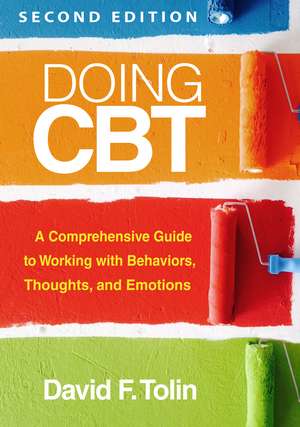
Doing CBT, Second Edition: A Comprehensive Guide to Working with Behaviors, Thoughts, and Emotions
Autor David F. Tolinen Limba Engleză Paperback – 3 mai 2024
Observăm în ultimii ani o tranziție clară a psihoterapiei către modele transdiagnostice și integrarea unor tehnici din „al treilea val”, precum mindfulness-ul, în structura clasică a terapiei cognitiv-comportamentale (CBT). În acest context, cea de-a doua ediție a lucrării Doing CBT de David F. Tolin se impune ca un ghid clinic riguros, dar remarcabil de accesibil. Considerăm că forța acestui manual rezidă în capacitatea de a demitiza procesul terapeutic, oferind răspunsuri clare la întrebările „ce”, „de ce” și „cum” în abordarea elementelor cognitive și emoționale ale pacienților.
Structura volumului este logică și progresivă, pornind de la fundamentele suferinței umane — analizate prin prismele sistemelor comportamentale, cognitive și emoționale — și avansând către conceptualizarea de caz și intervenții specifice. Notăm cu interes secțiunile dedicate finesei terapeutice și gestionării barierelor în tratament, elemente care lipsesc adesea din manualele pur teoretice. Pe linia clinică a lucrării Cognitive Behavior Therapy, Third Edition de Judith S. Beck, dar cu un accent pronunțat pe aplicabilitatea imediată și pe utilizarea materialelor grafice, textul lui Tolin funcționează ca un mentor la îndemâna clinicianului.
În comparație cu alte opere ale autorului, precum Science-Based Therapy, unde accentul cade pe analiza criteriilor APA pentru tratamente susținute empiric, Doing CBT este o lucrare mult mai aplicată. Autorul reușește să integreze 39 de fișe de lucru descărcabile și studii de caz extinse (precum cele ale lui William și Anna), oferind un parcurs complet de la evaluare la finalizarea terapiei. Este, în esență, un instrument de lucru care prioritizează competența culturală și adaptabilitatea intervenției la nevoile specifice ale individului.
Preț: 560.35 lei
Preț vechi: 589.84 lei
-5%
Carte disponibilă
Livrare economică 16-30 noiembrie
Livrare express 31 octombrie-06 noiembrie pentru 51.05 lei
Specificații
ISBN-10: 1462554121
Pagini: 659
Dimensiuni: 178 x 254 x 33 mm
Greutate: 1.18 kg
Ediția:2nd edition
Editura: Guilford Publications
Colecția Guilford Press
V-ar putea interesa
-
 Oxford Guide to Behavioural Experiments in Cognitive TherapyJames Bennett-Levy-20%Preț: 436.26 lei545.60 lei
 -
 Clinical Case FormulationsBarbara Lichner Ingram-5%Preț: 627.66 lei660.69 lei
 -
 The Wiley Handbook of Cognitive Behavioral Therapy, 3 Volume SetStefan G. Hofmann-25%Preț: 2572.75 lei3423.42 lei
 -
 Think Good, Feel GoodPaul StallardPreț: 276.26 lei
 -
 CBT For Dummies, 4th EditionRhena Branch-5%Preț: 132.51 lei139.48 lei
 -
 Preț: 286.58 lei
 -
 -5%Preț: 344.64 lei362.78 lei
 -
 Preț: 162.53 lei
 -
 -5%Preț: 530.66 lei558.59 lei
 -
 -5%Preț: 245.78 lei258.71 lei
 -
 -5%Preț: 313.59 lei330.09 lei
 -
 -5%Preț: 316.06 lei332.70 lei
 -
 Emotional Schema TherapyRobert L. Leahy-5%Preț: 316.18 lei332.82 lei
 -
 Cognitive Behavior Therapy, Third Edition: Basics and BeyondJudith S. Beck-5%Preț: 498.29 lei524.52 lei
 -
 Handbook of Cognitive-Behavioral Therapies, Fourth EditionKeith S. Dobson-5%Preț: 420.27 lei442.39 lei
 -
 DBT Skills Training Manual, Revised EditionMarsha M. Linehan-5%Preț: 505.87 lei532.50 lei
 -
 An Introduction to Cognitive Behaviour TherapyHelen Kennerley-5%Preț: 345.51 lei363.69 lei
 -
 Cognitive-Behavioral Therapy for Bipolar Disorder, Second EditionMonica Ramirez Basco-5%Preț: 346.65 lei364.90 lei
 -
 A Practical Guide to CBTElaine Iljon Foreman-5%Preț: 67.32 lei70.86 lei
De ce să citești această carte
Această carte este ideală pentru studenții la psihologie clinică și practicienii aflați la început de drum care doresc o structură clară pentru ședințele lor. Cititorul câștigă acces la un set complet de instrumente practice (fișe, dialoguri-mostră, protocoale de expunere) și învață cum să aplice tehnici complexe de restructurare cognitivă și reglare emoțională într-un mod empatic și fundamentat științific.
Despre autor
David F. Tolin este un expert recunoscut în domeniul psihologiei clinice, activitatea sa fiind strâns legată de promovarea tratamentelor bazate pe dovezi. Deși datele biografice furnizate îl menționează pe Martin E. Franklin ca figură centrală în cercetarea tulburărilor anxioase la Universitatea din Pennsylvania, David F. Tolin s-a remarcat prin lucrări fundamentale care analizează eficacitatea terapiilor moderne. Opera sa, care include titluri precum Science-Based Therapy și The Oxford Handbook of Obsessive-Compulsive and Related Disorders, reflectă o preocupare constantă pentru rigurozitatea metodologică și pentru traducerea cercetării științifice în protocoale clinice accesibile, fiind un reper în literatura de specialitate dedicată CBT.
Cuprins
I. Why Do People Suffer?
2. The Behavioral System and How It Can Go Wrong
3. The Cognitive System and How It Can Go Wrong
4. The Emotional System and How It Can Go Wrong
5. Creating Solid Case Conceptualizations
II. How Do We Help?
- Section A. How We Engage the Client
6. Therapy Assessment and Case Formulation
7. CBT Finesse
- Section B. Behavior‑Level Interventions
8. Situation Selection and Stimulus Control
9. Contingency Management in Therapy
10. Direct Behavioral Prescriptions and Graded Task Assignment
11. Exposure
12. Behavioral Skill Training
- Section C. Cognitive‑Level Interventions
13. What’s the Client Thinking?
14. Restructuring Thoughts
15. Leaving Thoughts Alone
16. Going Deeper with Intermediate and Core Beliefs
- Section D. Emotion‑Level Interventions
17. Modulating Emotion
18. Distress Tolerance
III. Putting It All Together
19. Putting It All Together: William’s CBT
20. Putting It All Together: Anna’s CBT
21. Putting It All Together: Elizabeth’s CBT
22. Putting It All Together: Bethany’s CBT
Appendix A. Further Reading
Appendix B. Tools for the Clinician
References
Index
Notă biografică
Descriere scurtă
New to This Edition
*New or expanded discussions of case formulation, transdiagnostic interventions, therapeutic strategies like mindfulness and acceptance, and more.
*Increased attention to cultural competence, intermediate beliefs, and linking conceptualization to intervention.
*Additional chapter-length case example.
Pedagogical Features
*Numerous engaging boxes, including "Try This," "The Science Behind It," "Things that Might Bug You about This,” and more.
*New in the second edition--chapter-opening "Essential Points," "CBT Spotlight" boxes on popular variants of CBT, and end-of-chapter discussion questions.
*Learning worksheets for self-practice of core CBT skills.
*End-of-chapter key terms with definitions.
See also Experiencing CBT from the Inside Out, by James Bennett-Levy, Richard Thwaites, Beverly Haarhoff, and Helen Perry, a unique self-practice/self-reflection workbook, and The Therapeutic Relationship in Cognitive-Behavioral Therapy, by Nikolaos Kazantzis, Frank M. Dattilio, and Keith S. Dobson, which provides key recommendations for optimizing outcomes.
Recenzii
"I was looking for a text that comprehensively taught and illustrated the full toolbox of CBT techniques and the theories behind them, and I was very glad to find this one. Like the first edition, the excellent second edition will be perfect for my graduate-level CBT course. It is focused broadly on the principles of change and is a great primer for anyone interested in learning how to apply CBT flexibly and effectively."--Michelle G. Newman, PhD, Department of Psychology, The Pennsylvania State University
"Few if any texts discuss and demonstrate the breadth of CBT interventions that this one does. This book covers a wide range of techniques, provides specific details on implementation, and includes an impressive array of client handouts, which my students and I use often. This is a 'must read' for experienced and novice practitioners, including graduate students or interns learning psychotherapy. The writing is clear, and it is a pleasure to read. I have used the first edition in my practicum courses, and it provides my students with both theoretical and practical knowledge. After reading a chapter on intervention, they are ready to try it!"--Raymond DiGiuseppe, PhD, ABPP, Department of Psychology, St John’s University
"This is my all-time favorite resource for CBT case conceptualization and treatment planning! Experienced clinicians and trainees alike will find this book to be a highly engaging (and often funny) treasure trove of information and practical clinical strategies. I have been using the first edition in my graduate seminars, in clinical supervision, and with my own clients for years. The welcome second edition provides the best from the original work along with new case examples and additional resources. Every CBT therapist, trainer, and supervisor should have and use Doing CBT as part of their professional toolbox."--Ann M. Steffen, PhD, ABPP, Department of Psychological Sciences, University of Missouri–St. Louis-The book does a masterful job of integrating the cognitive, behavioral, and emotional aspects of CBT into a balanced treatment that maximizes client outcome….The book's straightforward style with refreshingly open opinions about the author's approach to CBT and user friendly, step-by-step structure makes it an essential training tool for graduate students. This theoretically grounded, research informed, comprehensive text makes a good reference book for scientists. Finally, its vivid instructive case examples make it a valuable resource for practitioners and instructors. In summary, Doing CBT is an excellent 'go-to' resource for professional practice, consultation, and graduate level training. (on the first edition)--Journal of Contemporary Psychotherapy, 6/1/2018ƒƒThose new to CBT or just beginning their psychological training will find the material, structure, and case examples provide a foundation to build upon. Practitioners who are looking to gather an understanding of CBT that they can integrate into their current practices will find a clear clinical description accompanied by a plethora of exercises and tests for immediate use. Seasoned clinicians who are well versed in CBT logic and practice will find a resource that they can rely upon to refresh their thinking as well as an introductory guide into third-wave thinking. (on the first edition)--PsycCRITIQUES, 5/1/2017ƒƒThe emphasis on theory-driven techniques and science-based conceptualizations is maintained without jargon, making the text easily digestible for clinicians of all backgrounds and experience levels….The strength of the book is its attempt to be comprehensive and integrative in introducing the reader to the varieties of modern CBT interventions….It is a perfect textbook for courses introducing evidence-based CBT techniques to new therapists, and an excellent resource for professionals who want a resource for broadening and honing their skills. (on the first edition)--The Behavior Therapist, 6/1/2017ƒƒThis book is excellent….It is very practical and easy to read. The case studies are excellent because they walk through the process from beginning to end. *****--Doody's Review Service, 6/14/2024