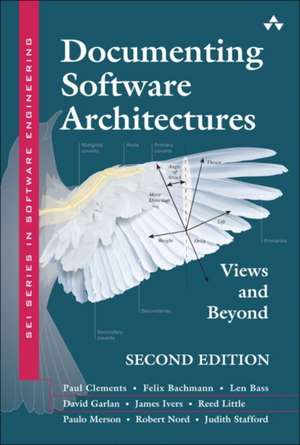
Documenting Software Architectures: Views and Beyond
Autor Paul Clements, Felix Bachmann, Len Bass, David Garlan, James Ivers, Reed Little, Paulo Merson, Robert Nord, Judith Stafforden Limba Engleză Hardback – 5 oct 2010
Prin parcurgerea acestui volum, cititorul va reuși să implementeze un pachet complet de documentație tehnică, capabil să transforme viziunea abstractă a unui sistem software într-un set de instrucțiuni pragmatice pentru toți stakeholderii implicați. Notăm cu interes faptul că Documenting Software Architectures nu se limitează la teorie, ci oferă reguli stricte și strategii de documentare care servesc drept „adeziv conceptual” pe tot parcursul ciclului de viață al unui proiect. Ne-a atras atenția structura riguroasă a cărții, organizată în trei părți esențiale: explorarea stilurilor arhitecturale (module, componente și conectori), completarea documentației prin descrierea comportamentului și a interfețelor, și, în final, procesul de revizuire și asamblare a pachetului final. Abordarea autorilor diferă de cea din Software Systems Architecture: Working With Stakeholders Using Viewpoints and Perspectives prin accentul pus pe execuția documentației și pe utilizarea unor șabloane gata de utilizat, fiind mai puțin axată pe managementul stakeholderilor și mai mult pe livrabilul tehnic propriu-zis. Față de Software Architecture in Practice, lucrare de referință a acelorași autori care se concentrează pe designul și analiza atributelor de calitate, acest volum acționează ca un manual de aplicare, detaliind cum trebuie comunicate deciziile luate. Putem afirma că ediția a doua rafinează semnificativ procesul de documentare pentru erele moderne, introducând suport pentru arhitecturi orientate spre servicii (SOA) și oferind soluții pentru echipele care adoptă metodologii Agile, unde documentația trebuie să fie concisă și utilă, nu doar exhaustivă.
Preț: 464.54 lei
Preț vechi: 580.67 lei
-20%
Carte tipărită la comandă
Livrare economică 26 noiembrie-10 decembrie
Specificații
ISBN-10: 0321552687
Pagini: 592
Dimensiuni: 164 x 241 x 36 mm
Greutate: 1.07 kg
Ediția:Nouă
Editura: Pearson International
Locul publicării:Upper Saddle River, NJ, United States
V-ar putea interesa
-
 Applying UML and PatternsCraig Larman-15%Preț: 605.79 lei712.70 lei
 -
 Designing Software ArchitecturesHumberto Cervantes-20%Preț: 313.58 lei391.97 lei
 -
 Clean ArchitectureRobert C. Martin-20%Preț: 236.92 lei296.15 lei
 -
 -20%Preț: 641.11 lei801.39 lei
 -
 Preț: 291.45 lei
 -
 Software Architecture in PracticeLen Bass-20%Preț: 394.59 lei493.24 lei
 -
 Software Design DecodedAndre van der Hoek-20%Preț: 85.23 lei106.54 lei
 -
 Patterns of Enterprise Application ArchitectureMartin Fowler-20%Preț: 396.95 lei496.18 lei
 -
 Enterprise Integration PatternsGregor Hohpe-20%Preț: 398.67 lei498.33 lei
 -
 Computer Architecture: A Quantitative ApproachJohn L. Hennessy-39%Preț: 534.37 lei882.55 lei
 -
 Code Complete: A practical handbook of software constructionSteve McConnell-20%Preț: 285.38 lei356.73 lei
 -
 Software ArchitectMichael BellPreț: 240.36 lei
 -
 -20%Preț: 627.14 lei783.93 lei
 -
 Software Architecture FundamentalsMahbouba Gharbi-20%Preț: 245.98 lei307.47 lei
 -
 Preț: 425.77 lei
 -
 Introduction to Software ArchitectureKevin Lano-20%Preț: 415.26 lei519.08 lei
 -
 Software Architecture in ActionFlavio Oquendo-20%Preț: 305.83 lei382.28 lei
 -
 -20%Preț: 620.33 lei775.42 lei
 -
 -20%Preț: 373.26 lei466.58 lei
De ce să citești această carte
Recomandăm această carte arhitecților software și liderilor tehnici care au nevoie de o metodologie clară pentru a comunica structura sistemelor complexe. Cititorul câștigă acces la șabloane industriale testate și învață cum să documenteze eficient interfețele și comportamentul sistemului, asigurând o mentenanță facilă și o scalabilitate reală a proiectului. Este un ghid esențial pentru a evita eșecul proiectelor cauzat de lipsa unei comunicări tehnice riguroase.
Despre autor
Paul Clements este un membru senior al personalului tehnic de la Software Engineering Institute (SEI), fiind recunoscut la nivel mondial pentru expertiza sa în arhitectura software și ingineria liniilor de produse. Co-autor al unor lucrări fundamentale precum Software Architecture in Practice, acesta a publicat peste treizeci de lucrări de cercetare care au definit standardele industriei. Alături de o echipă de experți de la SEI, Clements aduce în acest volum decenii de experiență practică în consultanță pentru proiecte software de anvergură, oferind soluții validate prin utilizarea intensă în sectorul industrial.
Notă biografică
Descriere scurtă
-From the Foreword by Grady Booch, IBM Fellow
Software architecture-the conceptual glue that holds every phase of a project together for its many stakeholders-is widely recognized as a critical element in modern software development. Practitioners have increasingly discovered that close attention to a software system's architecture pays valuable dividends. Without an architecture that is appropriate for the problem being solved, a project will stumble along or, most likely, fail. Even with a superb architecture, if that architecture is not well understood or well communicated-in other words, is not well documented-the project cannot be deemed a complete success.
This revision of Documenting Software Architectures provides the most complete and current guidance, independent of language or notation, on how to capture an architecture in a commonly understandable form. Drawing on their extensive experience, the authors first help you decide what information to document, and then, with guidelines and examples (in various notations, including UML), show you how to express an architecture so that others can successfully use, maintain, and build a system from it. The book features rules for sound documentation, the goals and strategies of documentation, architectural views and styles, documentation for software interfaces and software behavior, and templates for capturing and organizing information to generate a coherent package.
New and improved in this second edition:
- Coverage of documentation for new architectural styles, such as service-oriented architectures, multi-tier architectures, and architectures for aspect-oriented systems
- Guidance oriented to documentation in an Agile development environment
- Deeper treatment of the systematic rationale, reflecting best industrial practices
- Improved templates, reflecting years of use and feedback, and more documentation layout options
- A new, comprehensive example (available online), featuring documentation of a Web-based service-oriented system
Cuprins
- Prologue: Software Architectures and Documentation
- Part I: A Collection of Software Architecture Styles
- Chapter 1: Module Views
- Chapter 2: A Tour of Some Module Styles
- Chapter 3: Component-and-Connector Views
- Chapter 4: A Tour of Some Component-and-Connector Styles
- Chapter 5: Allocation Views and a Tour of Some Allocation Styles
- Part II: Beyond Structure: Completing the Documentation
- Chapter 6: Beyond the Basics
- Chapter 7: Documenting Software Interfaces
- Chapter 8: Documenting Behavior
- Part III: Building the Architecture Documentation
- Chapter 9: Choosing the Views
- Chapter 10: Building the Documentation Package
- Chapter 11: Reviewing an Architecture Document
- Epilogue: Using Views and Beyond with Other Approaches
- Appendix A: UML-Unified Modeling Language
- Appendix B: SysML-Systems Modeling Language
- Appendix C: AADL-The SAE Architecture Analysis and Design Language