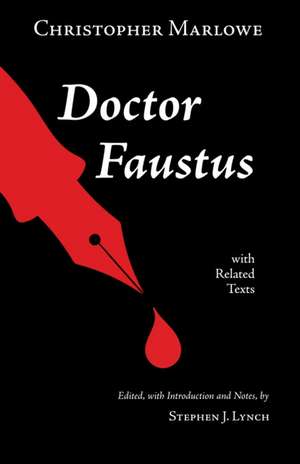
Doctor Faustus: With Related Texts
Autor Christopher Marlowe Editat de Stephen J. Lynchen Limba Engleză Paperback – 21 iul 2023
Christopher Marlowe, figura centrală a teatrului elisabetan înainte de ascensiunea lui Shakespeare, a oferit prin Dr. Faustus una dintre cele mai profunde explorări ale condiției umane și ale limitelor ambiției. Găsim în această lucrare tranziția de la mitul popular german la tragedia clasică, unde doctorul învățat nu mai este doar un personaj de farsă, ci un simbol al omului modern sfâșiat între aspirația spre divin și tentațiile materiale. Considerăm că forța acestui text rezidă în echilibrul dintre elementele fantastice — viziunile cu Lucifer, îngerii în duel sau Cele Șapte Păcate Capitale — și monologurile interioare încărcate de o intensitate tragică autentică. Stilul lui Marlowe se remarcă prin utilizarea magistrală a versului alb, o inovație tehnică ce a oferit textului o cadență solemnă, potrivită pentru gravitatea temei pactului diavolesc. Spre deosebire de alte lucrări incluse în antologii precum Christopher Marlowe: Four Plays sau The Complete Plays, unde explorarea puterii politice este centrală (ca în 'Tamburlaine' sau 'Edward II'), Dr. Faustus se concentrează pe o bătălie metafizică, individuală. Ca alternativă la ediția Doctor Faustus and Other Plays din seria Oxford World's Classics, acest volum de la Dover Publications oferă un format esențializat, ideal pentru studiu aprofundat sau pentru cei care doresc să descopere piesa într-o formă accesibilă, fără aparatul critic extins al volumelor colective, dar păstrând întreaga bogăție a limbajului original.
Preț: 100.38 lei
Preț vechi: 121.81 lei
-18%
Carte disponibilă
Livrare economică 16-30 noiembrie
Specificații
ISBN-10: 1647921279
Pagini: 208
Ilustrații: none
Dimensiuni: 140 x 216 x 12 mm
Greutate: 0.24 kg
Editura: Hackett Publishing Company,Inc
Colecția Hackett Publishing Company, Inc.
Locul publicării:United States
V-ar putea interesa
-
 Brave New WorldAldous HuxleyPreț: 64.37 lei
 -
 Brave New WorldAldous HuxleyPreț: 58.71 lei
 -
 The Complete PlaysChristopher Marlowe-26%Preț: 82.24 lei110.60 lei
 -
 FaustGoethe-25%Preț: 59.03 lei78.82 lei
 -
 Oxford Playscripts: Doctor FaustusChristopher Marlowe-30%Preț: 85.86 lei121.94 lei
 -
 Oxford Student Texts: Christopher Marlowe: Doctor FaustusChristopher Marlowe-28%Preț: 82.06 lei114.37 lei
 -
 Doctor FaustusThomas MannPreț: 74.34 lei
 -
 Faust: Part OneJ. W. von GoethePreț: 58.09 lei
 -
 -15%Preț: 69.02 lei81.46 lei
 -
 The Lord of the Rings Box SetJ. R. R. Tolkien-8%Preț: 522.51 lei567.94 lei
 -
 The Metamorphosis and Other StoriesFranz Kafka-19%Preț: 23.12 lei28.58 lei
 -
 On the Origin of SpeciesCharles Darwin-18%Preț: 73.91 lei89.89 lei
 -
 The PoemsWilliam ShakespearePreț: 58.34 lei
 -
 Best Served ColdJoe Abercrombie-23%Preț: 73.79 lei96.33 lei
 -
 Dr Faustus: A Guide (B Text)Christopher MarlowePreț: 163.88 lei
 -
 Preț: 60.96 lei
 -
 Dr Faustus: A TextChristopher MarlowePreț: 158.32 lei
 -
 The Jew of Malta: with Related TextsChristopher Marlowe-17%Preț: 81.70 lei98.50 lei
 -
 -13%Preț: 82.21 lei94.96 lei
 -
 Preț: 62.48 lei
 -
 On the Origin of SpeciesCharles Darwin-32%Preț: 54.69 lei80.12 lei
 -
 The Merchant of VeniceWilliam ShakespearePreț: 37.28 lei
 -
 King JohnWilliam ShakespearePreț: 37.70 lei
 -
 Dr Faustus 1616Chiaki HanabusaPreț: 256.67 lei
 -
 Doctor Faustus - Second EditionChristopher Marlowe-17%Preț: 145.17 lei175.47 lei
 -
 FaustJohann Wolfgang von GoethePreț: 45.89 lei
 -
 Preț: 62.80 lei
 -
 The Maiden FaustConor FarringtonPreț: 26.21 lei
 -
 The Faust-Legend and Goethe's 'Faust'H. B. CotterillPreț: 83.45 lei
De ce să citești această carte
Recomandăm această ediție cititorilor pasionați de literatura elisabetană și de marile mituri ale culturii occidentale. Cititorul câștigă acces la textul fundamental care a definit tema pactului cu diavolul, beneficiind de un stil poetic rafinat. Este o lectură esențială pentru a înțelege rădăcinile tragediei moderne și influența masivă pe care Marlowe a exercitat-o asupra teatrului universal, totul într-un format portabil și clar.
Despre autor
Christopher Marlowe (1564–1593) a fost cel mai proeminent dramaturg, poet și traducător din Londra anilor premergători morții sale premature și misterioase. Contemporan cu William Shakespeare, Marlowe a revoluționat teatrul englez prin introducerea versului alb și prin crearea unor protagoniști dominanți, ale căror pasiuni extreme depășesc limitele morale ale epocii. Viața sa, marcată de acuzații de spionaj și violență, s-a încheiat tragic la doar 29 de ani, însă opera sa a rămas un pilon al literaturii engleze, influențând generații de scriitori prin amestecul său unic de umanism, realism emoțional și spectacol grandios.
Descriere
Recenzii
—Robert A. Logan, Emeritus Professor of English, University of Hartford
Textul de pe ultima copertă
In his epic treatment of the Faust legend, Marlowe retains much of the rich phantasmagoria of its origins. There are florid visions of an enraged Lucifer, dueling angels, the Seven Deadly Sins, Faustus tormenting the Pope, and his summoning of the spirit of Alexander the Great. But the playwright created equally powerful scenes that invest the work with tragic dignity, among them the doomed man's calling upon Christ to save him and his ultimate rejection of salvation for the embrace of Helen of Troy.
With immense poetic skill, and psychological insight that foreshadowed the later work of Shakespeare and the Jacobean playwrights, Marlowe created in Dr. Faustus one of the first true tragedies in English. Vividly dramatic, rich in poetic grandeur, this classic play remains a robust and lively exemplar of the glories of Elizabethan drama."
Notă biografică
Cuprins
Introduction
Christopher Marlowe: A Brief Chronology of His Life and Times
A Note on the Text
The Tragical History of the Life and Death of Doctor Faustus
Appendix A: Variant Passages from the 1604 and 1663 Quartos
- From the 1604 Quarto
- Scene 4
- Chorus 3
- Scene 7
- Scene 8
- Scene 9
- Act 3 Scene 1 from the 1663 Quarto (B7)
- Of his parentage and birth
- How Doctor Faustus began to practice his devilish art and how he conjured the devil, making him to appear and meet him on the morrow at his own house
- The conference of Doctor Faustus with the spirit Mephostophiles the morning following at his own house
- The second time of the spirit’s appearing to Faustus in his house and of their parley
- The third parley between Doctor Faustus and Mephostophiles about a conclusion
- How Doctor Faustus set his blood in a saucer on warm ashes and writ as followeth
- Questions put forth by Doctor Faustus unto his spirit Mephostophiles
- How Doctor Faustus dreamed that he had seen hell in his sleep and how he questioned with his spirit of matters as concerning hell, with the spirit’s answer
- Another question put forth by Doctor Faustus to his spirit concerning his lord Lucifer, with the sorrow that Faustus fell afterwards into
- Another disputation betwixt Doctor Faustus and his spirit, of the power of the devil and of his envy to mankind
- How Doctor Faustus desired again of his spirit to know the secrets and pains of hell and whether those damned devilsand their company might ever come into the favour of God again or not
- Another question put forth by Doctor Faustus to his spirit Mephostophiles of his own estate
- How Doctor Faustus fell into despair with himself, for, having put forth a question unto his spirit, they fell at variance, whereupon the whole rout of devils appeared unto him, threatening him sharply
- How Doctor Faustus desired to see hell and of the manner how he was used therein
- How Doctor Faustus was carried though the air up to the heavens to see the world and how the sky and planets ruled, after the which he wrote one letter to his friend of the same to Leipzig, how he went about the world in eight days
- How Doctor Faustus made his journey through the principal and most famous lands in the world
- How the Emperor Carolus Quintus requested of Faustus to see some of his cunning, whereunto he agreed
- How Doctor Faustus in the sight of the Emperor conjured a pair of hart’s horns upon a knight’s head that slept out of a casement
- How the above-mentioned knight went about to be revenged of Doctor Faustus
- How Doctor Faustus deceived a horse-courser
- How Doctor Faustus ate a load of hay
- How Faustus served the drunken clowns
- How Doctor Faustus played a merry jest with the Duke of Anholt in his court
- How Doctor Faustus through his charms made a great castle in presence of the Duke of Anholt
- How Doctor Faustus showed the fair Helena unto the students upon the Sunday following
- How four jugglers cut one another’s head off and set them on again and how Doctor Faustus deceived them
- How an old man and neighbour of Faustus sought to persuade him to amend his evil life and to fall unto repentance
- How Doctor Faustus wrote the second time with his own blood and gave it to the devil
- How Doctor Faustus made the spirit of fair Helena of Greece his own paramour and bedfellow in his twentythird year
- An oration of Faustus to the students
- From Jean Calvin, The Institution of Christian Religion (1578), translated by Thomas North
- Book 3 Chapter 21, “Of the eternal election whereby God hath predestinate some to salvation and other some to destruction”
- Book 3 Chapter 23, “A confutation of the slanders wherewith this doctrine hath always been wrongfully burdened”
- Book 3 Chapter 24, “That election is established by the calling of God but that the reprobate do bring upon themselves the just destruction whereunto they are appointed”
- From the Geneva Bible, “Certain questions and answers touching the doctrine of predestination, the use of God’s word, and sacraments” (1599)
- From Articles whereupon it was agreed by the archbishops and bishops of both provinces and the whole clergy in the convocation holden at London in the year of our Lord God 1562 according to the computation of the Church of England, for the avoiding of the diversities of opinions and for the establishing of consent touching true religion (1593)
- Article 9, “Of original birth or sin”
- Article 10, “Of free will”
- Article 11, “Of the justification of man”
- Article 12, “Of good works”
- Article 13, “Of works before justification”
- Article 14, “Of the works of supererogation”
- Article 15, “Of Christ alone without sin”
- Article 16, “Of sin after baptism”
- Article 17, “Of predestination and election”
- Article 18, “Of obtaining eternal salvation only by the name of Christ”
- From William Perkins, A Golden Chain or The Description of Theology Containing the Order of the Causes of Salvation and Damnation According to God’s Word (1592)
- “To the Christian Reader”
- Chapter 53, “Concerning the execution of the decree of reprobation”
- From Reginald Scot, The Discovery of Witchcraft (1584)
- From Book 1 Chapter 3, “Who they be that are called witches, with a manifest declaration of the cause that moveth men so commonly to think, and witches themselves to believe, that they can hurt children, cattle, etc. with words and imaginations; and of cozening witches”
- From Book 3 Chapter 1, “The witch’s bargain with the devil, according to M. Mal. Bodin, Nider, Danaeus, Pseellus, Erastus, Hemingius, Cumanus, Aquinas, Bartholomaeus Spineus, &c.”
- From Book 13 Chapter 3, “What secrets do lie hidden, and what is taught in natural magic, how God’s glory is magnified therein, and that it is nothing but the work of nature”
- From Henry Cornelius Agrippa, Three Books of Occult Philosophy (1651), translated by J.F.
- From Book I Chapter I, “How magicians collect virtues from the three-fold world is declared in these three books”
- From Book I Chapter LXX, “Of the virtue of proper names”
- From Book III Chapter XX, “Of the annoyance of evil spirits and the preservation we have by good spirits”
- From “The censure or retraction of Henry Cornelius Agrippa concerning magic, after his declamation of thevanity of sciences and the excellency of the Word of God”
- From James VI and I, Daemonology (1603)
- Book 1 Chapter 2, “What kind of sin the practisers of these unlawful arts commits. The division of these arts. And what are the means that allures any to practise them”
- From Book 1 Chapter 3, “The signification and etymologies of the words of magic and necromancy. The difference betwixt necromancy and witchcraft. What are the entrances and beginnings that brings any to the knowledge thereof”
- From Book 1 Chapter 6, “The devil’s contract with the magicians. The division thereof into two parts. What is the difference betwixt God’s miracles and the devil’s”
- From Robert Greene, Perimedes the Blacksmith (1588) and A Groatsworth of Wit (1592)
- From Perimedes the Blacksmith (1588)
- From A Groatsworth of Wit (1592)
- Thomas Kyd’s letters to Sir John Puckering about Marlowe
- Richard Baines, “A note containing the opinion of Christopher Marlowe concerning his damnable Judgment of religionand scorn of God’s word”
- From Thomas Beard, The Theatre of God’s Judgements (1597)