
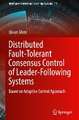
Distributed Fault-Tolerant Consensus Control of Leader-Following Systems: Intelligent Control and Learning Systems
Autor Qikun Shenen Limba Engleză Paperback – 3 noi 2024
| Toate formatele și edițiile | Preț | Express |
|---|---|---|
| Paperback (1) | 733.65 lei 38-44 zile | |
| Springer – 3 noi 2024 | 733.65 lei 38-44 zile | |
| Hardback (1) | 752.42 lei 6-8 săpt. | |
| Springer Nature Singapore – 3 noi 2023 | 752.42 lei 6-8 săpt. |

Preț: 733.65 lei
Preț vechi: 965.33 lei
-24% Nou
Puncte Express: 1100
Preț estimativ în valută:
129.84€ • 152.27$ • 113.84£
129.84€ • 152.27$ • 113.84£
Carte tipărită la comandă
Livrare economică 20-26 ianuarie 26
Preluare comenzi: 021 569.72.76
Specificații
ISBN-13: 9789819974283
ISBN-10: 9819974283
Pagini: 204
Dimensiuni: 155 x 235 x 12 mm
Greutate: 0.32 kg
Editura: Springer
Seria Intelligent Control and Learning Systems
ISBN-10: 9819974283
Pagini: 204
Dimensiuni: 155 x 235 x 12 mm
Greutate: 0.32 kg
Editura: Springer
Seria Intelligent Control and Learning Systems
Cuprins
Chapter 1 Introduction.- Chapter 2 Distributed Cooperative Neural Fault-Tolerant Sliding Mode Control against Actuator Faults.- Chapter 3 Distributed Cooperative Fuzzy Fault-Tolerant Backstepping Control Against Dead-Zone and Saturation.- Chapter 4 Distributed Neural Fault-Tolerant Supervisory Control AgainstBacklash-Like Hysteresis.- Chapter 5 Distributed Fuzzy Fault-Tolerant Output Consensus Control Against Unknown Nonlinear Dead-Zone.- Chapter 6 Adaptive Fault-Tolerant Consensus Control Against Transmission Faults.- Chapter 7 Cooperative Fault-tolerant Neural Control Against Signal Transmission Faults.- Chapter 8 Distributed Fault-tolerant Output-Feedback Control Against Sensor Faults.- Chapter 9 Conclusion and Future Research Directions
Notă biografică
Dr. Qikun Shen received his B.Sc. degree in computer science and applications from the Chinese University of Mining and Technology, Xuzhou, China, in 1996, an M.Sc. degree in computer science and applications from Yangzhou University, Yangzhou, China, in 2007, and a Ph.D. degree in control theorem and control applications from the College of Automation Engineering, Nanjing University of Aeronautics and Astronautics, Nanjing, China, in 2015. He is currently a professor with the College of Information Engineering, Yangzhou University.
He focuses on the research of dynamical systems including multi-agent systems. His current research interests include distributed control, consensus control, fault-tolerant control, adaptive control, fuzzy control, neural networks-based control, and intelligent control. Since 2007, Dr. Shen has published 100 peer-reviewed technical papers in international journals and conferences. He was a recipient of the 2018 Wu Wenjun Science and Technology Award. Since 2020, he is also selected as Elsevier Most Cited Chinese Researchers.
Textul de pe ultima copertă
This book provides recent theoretical results and applications of the consensus control for nonlinear leader-following systems. Combining adaptive control technique, fuzzy logic systems, neural networks with the other control techniques or approaches, this book investigates the consensus control problem of leader-following systems and proposes the corresponding control scheme. This book intends to provide the readers a good understanding on consensus control based on adaptive control technology. This book can serve as a reference for the main research issues and results on nonlinear multi-agent systems including leader-following systems for researchers devoting to various areas of control theory, as well as a material for graduate and undergraduate students interested in nonlinear multi-agent systems including leader-following systems and their applications. Some prerequisites for reading this book include nonlinear system theory, matrix theory, mathematics, basic graph theory, and soon.
Caracteristici
Combines more practical scenarios toward the distributed control design of leader-following systems Studies the fault location and impact on system performance and divides the faults into local and global faults Proposes the corresponding fault-tolerant control schemes to compensate for the different faults