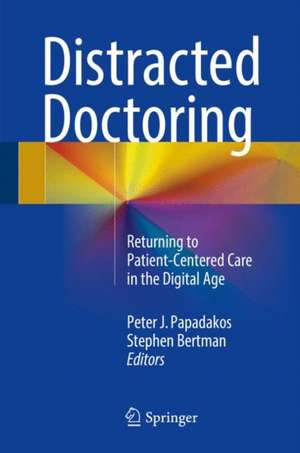
Distracted Doctoring: Returning to Patient-Centered Care in the Digital Age
Editat de Peter J. Papadakos, Stephen Bertmanen Limba Engleză Hardback – 14 aug 2017
Pregătirea pentru examenul de rezidențiat sau pentru certificările de specialitate pune adesea accent pe competențele tehnice, însă Distracted Doctoring evidențiază o lacună critică în formarea medicală contemporană: gestionarea atenției în era digitală. Remarcăm o analiză clinică riguroasă a modului în care computerele din sălile de consultație, deși esențiale pentru stocarea datelor, fragmentează timpul alocat anamnezei și ascultării active. Subliniem faptul că Peter J. Papadakos și Stephen Bertman nu resping tehnologia, ci investighează „doctoria distrasă” ca pe un factor de risc major pentru siguranța pacientului.
Structura volumului progresează de la istoricul digitalizării medicinei către implicațiile psihologice ale „adicției electronice”, culminând cu strategii practice de management al distragerilor. Manual de referință comparabil cu The Digital Doctor de Robert Wachter, dar axat mai specific pe impactul comportamental și pe riscurile imediate în anesteziologie și chirurgie, acest titlu oferă o perspectivă necesară asupra eticii profesionale în 2017. Merită menționat capitolul care face o analogie între cercetările privind condusul distras și practica medicală, oferind date concrete despre cum ecranele pot induce o debranșare periculoasă de la scopul fundamental al actului medical. Față de Digital Communication in Medical Practice, care se concentrează pe eficiența administrativă, volumul de față prioritizează restaurarea relației medic-pacient ca pilon central al îngrijirii de calitate.
Preț: 651.28 lei
Preț vechi: 685.56 lei
-5%
Carte tipărită la comandă
Livrare economică 05-11 august
Specificații
ISBN-10: 331948706X
Pagini: 260
Ilustrații: XIV, 260 p. 17 illus., 14 illus. in color.
Dimensiuni: 155 x 235 x 18 mm
Greutate: 0.61 kg
Ediția:1st ed. 2017
Editura: Springer International Publishing
Colecția Springer
Locul publicării:Cham, Switzerland
V-ar putea interesa
-
 Family Medicine Board Review: Pearls of Wisdom, Fourth EditionCynthia Waickus-33%Preț: 533.21 lei799.69 lei
 -
 Deja Review Physiology, Second EditionEdward Gould-35%Preț: 149.22 lei230.75 lei
 -
 Deja Review Neuroscience, Second EditionMatthew Tremblay-35%Preț: 149.36 lei230.86 lei
 -
 Handbook to Life in Ancient MesopotamiaStephen BertmanPreț: 178.09 lei
 -
 Hyperculture: The Human Cost of SpeedStephen Bertman-18%Preț: 331.19 lei402.53 lei
 -
 Cultural Amnesia: America's Future and the Crisis of MemoryStephen Bertman-28%Preț: 474.28 lei658.21 lei
 -
 Silicon Photonics for Telecommunications and BiomedicineSasan Fathpour-15%Preț: 519.71 lei611.43 lei
 -
 Healthcare Sensor Networks: Challenges Toward Practical ImplementationDaniel Tze Huei Lai-15%Preț: 526.17 lei619.02 lei
 -
 -15%Preț: 544.22 lei640.26 lei
 -
 Biomedical NanotechnologyNeelina H. Malsch-5%Preț: 615.65 lei648.05 lei
 -
 Carotenoids in Health and DiseaseNorman I. Krinsky-15%Preț: 522.94 lei615.23 lei
 -
 Reviews in Food and Nutrition Toxicity, Volume 2Victor R. Preedy-5%Preț: 584.47 lei615.23 lei
 -
 Genomics and Proteomics in NutritionCarolyn D. Berdanier-15%Preț: 522.94 lei615.23 lei
 -
 Nutrition and Alcohol: Linking Nutrient Interactions and Dietary IntakeRonald Ross Watson-15%Preț: 522.94 lei615.23 lei
 -
 Alcohol and Coffee Use in the AgingRonald Ross Watson-15%Preț: 522.94 lei615.23 lei
 -
 Vegetables, Fruits, and Herbs in Health PromotionRonald Ross Watson-15%Preț: 524.41 lei616.95 lei
 -
 -15%Preț: 543.80 lei639.77 lei
 -
 Knee ArthroscopyBrian P. McKeon-5%Preț: 737.88 lei776.72 lei
 -
 Atlas of Post-Mortem Techniques in NeuropathologyJ. Hume Adams-5%Preț: 348.21 lei366.53 lei
 -
 Differential Diagnosis in Primary CareNairah Rasul-5%Preț: 381.58 lei401.66 lei
 -
 Erotic Love Poems of Greece and RomeStephen BertmanPreț: 329.98 lei
 -
 Publizieren, Promovieren - leicht gemachtWolfgang Janni-5%Preț: 346.09 lei364.30 lei
De ce să citești această carte
Recomandăm această carte oricărui medic sau administrator de spital care dorește să navigheze echilibrat între eficiența EMR (Electronic Medical Records) și siguranța clinică. Cititorul câștigă o înțelegere profundă a factorilor umani care duc la erori medicale în mediul digitalizat. Este o lectură esențială pentru a învăța cum să utilizezi tehnologia fără a sacrifica empatia și atenția necesară diagnosticului corect.
Despre autor
Peter J. Papadakos este un reputat specialist în anestezie, chirurgie și neurologie la University of Rochester Medical Center, fiind recunoscut pentru cercetările sale asupra impactului tehnologiei în unitățile de terapie intensivă. Stephen Bertman este profesor și cercetător cu expertiză în studiile umaniste aplicate în context tehnologic, activând în cadrul University of Windsor. Împreună, cei doi editori reunesc perspectivele clinice cu cele sociologice pentru a aborda una dintre cele mai presante probleme ale sistemului de sănătate modern: erodarea atenției umane sub presiunea digitalizării.
Cuprins
Recenzii
“The book’s purpose is to help healthcare organizations achieve patient-centered care and eliminate digital distraction. … The book offers detailed insight into the problem of digital distraction in healthcare and offers readers techniques and strategies to help eliminate the issue.” (Brian Zimmerman, beckershospitalreview.com, January, 2018)
“This book is a must-read for anyone who wants to learn more about the negative effects of technology on the practice of medicine. Most important, it is an expert guide for any health care practitioner who wants to learn how to avoid distraction in her/his personal or professional life and instead use technology to improve patient-centered care.” (Shayna Friedman, American Journal of Medical Quality, 2018)
“‘Distracted Doctoring: Returning to Patient-Centered Care in the Digital Age’ (Springer, 2017) is what Dr. Papadakos ordered. The book is timely, pioneering, even riveting sometimes — and fearless. Most of its readers will probably be doctors and nurses, but its message transcends medicine.” (Huffington Post, huffingtonpost.com, November, 2017)
Notă biografică
Caracteristici
Descriere
Examining-room computers require doctors to record detailed data about their patients, yet reduce the time clinicians can spend listening attentively to the very people they are trying to help. This book presents original essays by distinguished experts in their fields, addressing this critical problem and making an urgent case for reform, because while electronic technology has revolutionized the practice of medicine, it also poses a unique challenge to health care. Smartphones in the hands of doctors and nurses have become dangerously seductive devices that can endanger their patients.
Distracted Doctoring is written for anesthesiologists and surgeons, as well as general practitioners, nurses, and health care administrators and students. Chapters include Electronic Challenges to Patient Safety and Care; Distraction, Disengagement, and the Purpose of Medicine; and Managing Distractions through Advocacy, Education, and Change.