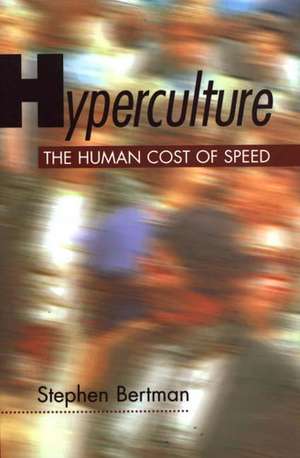
Hyperculture: The Human Cost of Speed
Autor Stephen Bertmanen Limba Engleză Hardback – 30 apr 1998
Notăm cu interes apariția volumului Hyperculture, o lucrare ce vine să completeze o lacună esențială în literatura academică dedicată sociologiei timpului: lipsa unui principiu unificator care să explice fenomene disparate precum dezintegrarea familiei și stresul cronic. În timp ce lucrări clasice s-au concentrat pe impactul schimbării tehnologice, Stephen Bertman pătrunde mai adânc, diagnosticând o afecțiune cronică a valorilor umane sub presiunea vitezei de procesare electronică.
Găsim în această carte o progresie logică riguroasă, organizată de la nivel micro la macro. După stabilirea premiselor în capitolele despre sursele puterii „prezentului”, Stephen Bertman analizează sistematic transformarea individului, a familiei și a democrației, culminând cu impactul asupra relațiilor internaționale. Această abordare amintește de temele explorate în Handbook to Life in Ancient Mesopotamia sau Genesis of Science, unde autorul analiza fundamentele civilizației; aici, el aplică aceeași rigoare istorică pentru a avertiza asupra erodării acestor fundamente în modernitate.
Acoperă aceeași arie tematică precum The Culture of Speed de John Tomlinson sau Future Shock de Alvin Toffler, dar cu o abordare mult mai critică la adresa costului uman spiritual. Dacă James Gleick în Faster descrie „boala grăbirii” ca pe un fenomen tehnologic, Stephen Bertman o tratează ca pe o criză morală. Stilul este unul academic, dar marcat de o urgență etică, invitând la o recalibrare a raportului nostru cu tehnologia pentru a asigura un viitor uman generațiilor următoare.
Preț: 331.19 lei
Preț vechi: 402.53 lei
-18%
Carte tipărită la comandă
Livrare economică 21 noiembrie-05 decembrie
Specificații
ISBN-10: 0275962059
Pagini: 288
Dimensiuni: 156 x 235 x 20 mm
Greutate: 0.63 kg
Editura: Bloomsbury Publishing
Colecția Praeger
Locul publicării:New York, United States
V-ar putea interesa
-
 Handbook to Life in Ancient MesopotamiaStephen Bertman-14%Preț: 180.41 lei210.46 lei
 -
 Cultural Amnesia: America's Future and the Crisis of MemoryStephen Bertman-27%Preț: 497.48 lei678.96 lei
 -
 Handicrafts in BangladeshMohammed Ali MiluPreț: 72.34 lei
 -
 Erotic Love Poems of Greece and RomeStephen BertmanPreț: 344.17 lei
 -
 Frauen und DepressionMelanie CremerPreț: 311.26 lei
 -
 Das Phänomen StudienabbruchAntje HeinrichPreț: 311.42 lei
 -
 Wandel der FamilienbildungRavenna EickhorstPreț: 375.44 lei
 -
 Mädchen in RisikosituationenBeate Hüttl-8%Preț: 398.47 lei433.12 lei
 -
 Framing DeathKyle J. HolodyPreț: 312.32 lei
 -
 Kulturelle Einflüsse auf Web Experience und User-VerhaltenAnna Karen SchmitzPreț: 313.25 lei
 -
 Systemisches CoachingClaudia KinzelPreț: 375.08 lei
 -
 Gender und KonfliktBettina EngelsPreț: 311.42 lei
 -
 Suizid und suizidale TendenzenJessica HamersPreț: 312.32 lei
 -
 Illegalisierte KinderflüchtlingeHelge Pfingsten-WismerPreț: 313.83 lei
 -
 GenfoodJuliane DuschlPreț: 377.28 lei
 -
 Das Geheimnis interkultureller VerhandlungenBjörn KempePreț: 266.68 lei
 -
 Körperkult und -inszenierungKarola WeberPreț: 316.97 lei
 -
 Jugendschutz im InternetJosefin SaegerPreț: 180.02 lei
De ce să citești această carte
Recomandăm această carte studenților și cercetătorilor din științele sociale care doresc să înțeleagă rădăcinile stresului sistemic modern. Hyperculture nu este doar o analiză a vitezei, ci un instrument critic pentru a evalua modul în care tehnologia reconfigurează etica personală și structurile democratice. Cititorul va câștiga o perspectivă unică asupra necesității „încetinirii” ca act de conservare a umanității într-o lume dominată de instantaneu.
Despre autor
Stephen Bertman este profesor emerit de limbi, literaturi și civilizații clasice și moderne la Universitatea din Windsor, Canada. Expertiză sa vastă în antichitate, demonstrată în lucrări precum Art and the Romans sau The Conflict of Generations in Ancient Greece and Rome, îi oferă o perspectivă istorică rară asupra problemelor contemporane. În Hyperculture, el îmbină rigoarea cercetătorului clasic cu observația sociologică, fiind un consultant educațional recunoscut la nivel național în Statele Unite.
Descriere
We live, according to Bertman, in a society ruled by the power of now, a power that gives us instant gratification even as it demands our instantaneous obedience. As a result, we have adapted our lives and values to match the speed-of-light electronic technologies that surround us. But, in so doing, we have paid a high price in spirit and mind. Cut off from the wisdom of the past and too rushed to consider the consequences of our actions, we are caught up in a culture of sensationalism and transience in which the very definitions of personal identity and democracy are being transformed. Hyperculture dares to suggest that the cure for our condition lies not in an information superhighway or third wave information revolution, but in the radical and painful process of decelerating our lives enough to reclaim them. It is a daunting challenge, to be sure, but one on which our happiness and even our survival depend.
Cuprins
Warp Speed
The Three Sources of Now's Power
The Transformation of the Individual
The Transformation of the Family
The Transformation of Society
The Transformation of Democracy
The Transformation of International Relations
The Transformation of the Environment
The Three Keys to Resisting Now's Power
Beyond Future Shock
Recommended Reading
Index
Recenzii
The book is easy to read and has a broad sweep. . . . Students and thoughful psychologists interested in communication, stresses related to time pressure, cultural change, and the effects of technology on human behavior and cognition should find useful ideas here.
Impressive in its command of details and description, this book accurately describes the revolutionary social changes wrought by modern culture, and especially the instantaneous culture of electonic communication.
Bertman weaves a critical, compelling, and most significant for the sociologist, multi-level analytic argument about the human dimensions of living an accelerated life. He offers insightful, thoughtful, and conservative strategies for restraining our technology, retaining our history, and regaining our senses. This book could be used as a supplemental reading in Introductory Sociology or Social Problems courses that have a social change orientation. This book could also be easily integrated into courses such as American Society, Social Movements, Technology and Society, Social Change, and Social Theory and portions could be integrated into Family or Social Psychology courses.