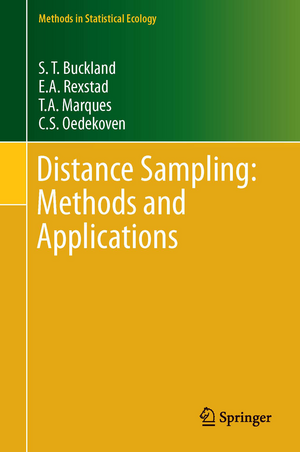
Distance Sampling: Methods and Applications: Methods in Statistical Ecology
Autor S. T. Buckland, E. A. Rexstad, T. A. Marques, C. S. Oedekovenen Limba Engleză Hardback – 24 aug 2015
În domeniul cercetării ecologice și al managementului biodiversității, Distance Sampling: Methods and Applications se impune ca o resursă clinică esențială pentru estimarea densității și abundenței populațiilor animale. Ne-a atras atenția rigoarea cu care autorul S. T. Buckland și echipa sa de la Universitatea St. Andrews sintetizează zece ani de progrese metodologice, oferind o lucrare de sine stătătoare care rafinează tehnicile de eșantionare prin transecte liniare și punctuale. Subliniem faptul că acest volum nu se limitează la teorie, ci este ancorat în practica de teren, abordând direct eșecurile ipotezelor cheie și oferind soluții prin cod R și software specializat. Structura editorială este organizată logic în trei secțiuni: prima parte stabilește fundamentele designului experimental și colectarea datelor, a doua dezvoltă modelele de detecție și estimare, iar a treia aplică aceste tehnici pe grupuri taxonomice specifice, de la fluturi la cetacee. Pe linia clinică a lucrării Measuring Abundance, dar cu un accent mult mai pronunțat pe modelarea funcțiilor de detecție și pe integrarea tehnologiei moderne în cercetare, volumul completează viziunea autorului expusă în Modelling Population Dynamics. Dacă în lucrările anterioare accentul cădea pe dinamica populațiilor închise, aici S. T. Buckland extinde analiza către aplicații practice complexe, oferind liste de verificare indispensabile pentru biologi și cercetători. Această ediție de la Springer reușește să transforme statistica abstractă într-un instrument de precizie pentru conservarea speciilor.
Preț: 1059.85 lei
Preț vechi: 1115.63 lei
-5%
Carte tipărită la comandă
Livrare economică 01-07 decembrie
Specificații
ISBN-10: 3319192183
Pagini: 300
Ilustrații: XV, 277 p. 80 illus.
Dimensiuni: 160 x 241 x 21 mm
Greutate: 0.62 kg
Ediția:1st edition 2015
Editura: Springer
Colecția Methods in Statistical Ecology
Seria Methods in Statistical Ecology
Locul publicării:Cham, Switzerland
V-ar putea interesa
-
 Epidemiology and Demography in Public HealthJaphet Killewo-25%Preț: 545.35 lei725.88 lei
 -
 -27%Preț: 486.42 lei670.87 lei
 -
 -18%Preț: 278.49 lei338.78 lei
 -
 -22%Preț: 370.66 lei474.33 lei
 -
 Epidemiology: A Very Short IntroductionRodolfo Saracci-23%Preț: 58.23 lei75.86 lei
 -
 Obesity Epidemiology: From Aetiology to Public HealthDavid Crawford-11%Preț: 688.14 lei774.58 lei
 -
 -27%Preț: 583.34 lei796.55 lei
 -
 -5%Preț: 1452.53 lei1528.98 lei
 -
 -5%Preț: 739.98 lei778.93 lei
 -
 Epidemiology of Obesity in Children and AdolescentsLuis A. Moreno-5%Preț: 770.18 lei810.72 lei
 -
 Epidemiology and the Delivery of Health Care ServicesDenise M. Oleske-5%Preț: 652.30 lei686.63 lei
 -
 Epidemiology of Human Congenital MalformationsBengt Källén-5%Preț: 751.13 lei790.65 lei
Public țintă
ResearchDe ce să citești această carte
Recomandăm această carte cercetătorilor și practicienilor din ecologie care au nevoie de o metodologie validată pentru monitorizarea faunei. Cititorul câștigă acces la tehnici avansate de modelare și, mai ales, la resurse practice (cod R și studii de caz) care permit implementarea imediată a sondajelor. Este un instrument indispensabil pentru a transforma datele brute de teren în estimări de populație riguroase din punct de vedere statistic.
Cuprins
Introduction.- The basic methods.- Designing surveys.- Designing distance sampling experiments.- Field methods and data checking.- Modelling detection functions.- Design-based estimation of animal density and abundance.- Model-based distance sampling: two-stage models.- Model-based distance sampling: full likelihood methods.- Variations on a theme.- Taxon-specific issues.- Exchanging assumptions for data.- Summary.
Recenzii
Textul de pe ultima copertă
In this book, the authors cover the basic methods and advances within distance sampling that are most valuable to practitioners and in ecology more broadly. This is the fourth book dedicated to distance sampling. In the decade since the last book published, there have been a number of new developments. The intervening years have also shown which advances are of most use. This self-contained book covers topics from the previous publications, while also including recent developments in method, software and application.
Distance sampling refers to a suite of methods, including line and point transect sampling, in which animal density or abundance is estimated from a sample of distances to detected individuals. The book illustrates these methods through case studies; data sets and computer code are supplied to readers through the book’s accompanying website. Some of the case studies use the software Distance, while others use R code. The book is in three parts. The first part addresses basic methods, the design of surveys, distance sampling experiments, field methods and data issues. The second part develops a range of modelling approaches for distance sampling data. The third part describes variations in the basic method; discusses special issues that arise when sampling different taxa (songbirds, seabirds, cetaceans, primates, ungulates, butterflies, and plants); considers advances to deal with failures of the key assumptions; and provides a check-list for those conducting surveys.
Caracteristici
Includes theory for designed experiments in distance sampling
Has examples using R in addition to the Distance software
Couples case studies with accessible datasets and software to allow readers to apply methods in a variety of contexts