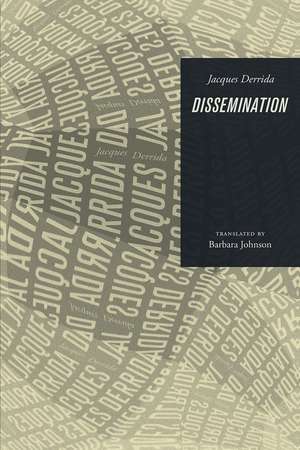
Dissemination
Autor Jacques Derrida Traducere de Barbara Johnsonen Limba Engleză Paperback – sep 2017
"The English version of Dissemination [is] an able translation by Barbara Johnson . . . . Derrida's central contention is that language is haunted by dispersal, absence, loss, the risk of unmeaning, a risk which is starkly embodied in all writing. The distinction between philosophy and literature therefore becomes of secondary importance. Philosophy vainly attempts to control the irrecoverable dissemination of its own meaning, it strives—against the grain of language—to offer a sober revelation of truth. Literature—on the other hand—flaunts its own meretriciousness, abandons itself to the Dionysiac play of language. In Dissemination—more than any previous work—Derrida joins in the revelry, weaving a complex pattern of puns, verbal echoes and allusions, intended to 'deconstruct' both the pretension of criticism to tell the truth about literature, and the pretension of philosophy to the literature of truth."—Peter Dews, New Statesman
| Toate formatele și edițiile | Preț | Express |
|---|---|---|
| Paperback (3) | 126.88 lei 43-57 zile | +46.31 lei 5-11 zile |
| Bloomsbury Publishing – 25 feb 2016 | 167.69 lei 22-36 zile | +46.31 lei 5-11 zile |
| Bloomsbury Publishing – 14 oct 2004 | 126.88 lei 43-57 zile | |
| University of Chicago Press – sep 2017 | 259.90 lei 43-57 zile |
Preț: 259.90 lei
Puncte Express: 390
Preț estimativ în valută:
46.01€ • 53.58$ • 39.97£
46.01€ • 53.58$ • 39.97£
Carte tipărită la comandă
Livrare economică 23 februarie-09 martie
Preluare comenzi: 021 569.72.76
Specificații
ISBN-13: 9780226503479
ISBN-10: 022650347X
Pagini: 400
Dimensiuni: 140 x 216 x 25 mm
Greutate: 0.46 kg
Editura: University of Chicago Press
Colecția University of Chicago Press
ISBN-10: 022650347X
Pagini: 400
Dimensiuni: 140 x 216 x 25 mm
Greutate: 0.46 kg
Editura: University of Chicago Press
Colecția University of Chicago Press
V-ar putea interesa
-
 NatureRalph Waldo EmersonPreț: 53.80 lei
 -
 Malignant: Medical Ethicists Confront CancerRebecca Dresser-20%Preț: 216.67 lei272.38 lei
 -
 Truth by Analysis: Games, Names, and PhilosophyColin McGinn-14%Preț: 564.02 lei655.84 lei
 -
 The Beast and the Sovereign, Volume IIJacques DerridaPreț: 216.76 lei
 -
 Writing and DifferenceJacques DerridaPreț: 146.05 lei
 -
 Preț: 194.64 lei
 -
 Preț: 128.32 lei
 -
 Adieu to Emmanuel LevinasJacques DerridaPreț: 122.28 lei
 -
 Sovereignties in QuestionJacques DerridaPreț: 277.64 lei
 -
 History of Philosophy Volume 11: Logical Postivism and ExistentialismFrederick Copleston-43%Preț: 119.34 lei207.79 lei
 -
 The Shorter Leibniz Texts: A Collection of New TranslationsDr Lloyd Strickland-19%Preț: 194.82 lei239.33 lei
 -
 R. G. Collingwood: A Research CompanionProfessor James Connelly-34%Preț: 975.35 lei1479.66 lei
 -
 Living CurrencyPierre Klossowski-43%Preț: 93.84 lei165.73 lei
 -
 Benjamin, Barthes and the Singularity of PhotographyDr. Kathrin Yacavone-27%Preț: 190.62 lei261.04 lei
 -
 Towards the Definition of PhilosophyMartin Heidegger-43%Preț: 113.00 lei198.09 lei
Notă biografică
Barbara Johnson is a professor of English and Comparative Literature at Harvard University.
Cuprins
Translator's Introduction
Outwork, prefacing
Plato's Pharmacy
I.
1. Pharmacia
2. The Father of Logos
3. The Filial Inscription: Theuth, Hermes, Thoth, Nabu, Nebo
4. The Pharmakon
5. The Pharmakeus
II.
6. The Pharmakos
7. The Ingredients: Phantasms, Festivals, and Paints
8. The Heritage of the Pharmakon: Family Scene
9. Play: From the Pharmakon to the Letter and from Blindness to the Supplement
The Double Session
I
II
Dissemination
I.
1. The Trigger
2. The Apparatus or Frame
3. The Scission
4. The Double Bottom of the Plupresent
5. wriTing, encAsIng, screeNing
6. The Attending Discourse
II.
7. The Time before First
8. The Column
9. The Crossroads of the "Est"
10. Grafts, a Return to Overcasting
XI. The Supernumerary
Outwork, prefacing
Plato's Pharmacy
I.
1. Pharmacia
2. The Father of Logos
3. The Filial Inscription: Theuth, Hermes, Thoth, Nabu, Nebo
4. The Pharmakon
5. The Pharmakeus
II.
6. The Pharmakos
7. The Ingredients: Phantasms, Festivals, and Paints
8. The Heritage of the Pharmakon: Family Scene
9. Play: From the Pharmakon to the Letter and from Blindness to the Supplement
The Double Session
I
II
Dissemination
I.
1. The Trigger
2. The Apparatus or Frame
3. The Scission
4. The Double Bottom of the Plupresent
5. wriTing, encAsIng, screeNing
6. The Attending Discourse
II.
7. The Time before First
8. The Column
9. The Crossroads of the "Est"
10. Grafts, a Return to Overcasting
XI. The Supernumerary
Descriere
Descriere de la o altă ediție sau format:
![]()
"In Dissemination - more than in any previous work - Derrida weav[es] a complex pattern of puns, verbal echoes and allusions, intended to 'deconstruct' both the pretension of criticism to tell the truth about literature, and the pretension of philosophy to be the literature of truth." New Statesman
Jacques Derrida (1930-) is Professor of Philosophy at École Normale Supérieure, Paris. Regarded as the founding father of Deconstruction, his influence on contemporary thought has been enormous. His impact on philosophy and literary criticism was assured by the publication of Speech and Phenomena, Writing and Difference and Of Grammatology.
First published in 1972, Dissemination contains three of Derrida's most central and seminal works: 'Plato's Pharmacy', 'The Double Session' and 'Dissemination'. The essays present a re-evaluation of the logic of meaning and the function of writing in Western discourse. This is a groundbreaking work on the relationship and interplay between language, literature and philosophy.
Translated, with an Introduction and Additional Notes by Barbara Johnson
"In Dissemination - more than in any previous work - Derrida weav[es] a complex pattern of puns, verbal echoes and allusions, intended to 'deconstruct' both the pretension of criticism to tell the truth about literature, and the pretension of philosophy to be the literature of truth." New Statesman
Jacques Derrida (1930-) is Professor of Philosophy at École Normale Supérieure, Paris. Regarded as the founding father of Deconstruction, his influence on contemporary thought has been enormous. His impact on philosophy and literary criticism was assured by the publication of Speech and Phenomena, Writing and Difference and Of Grammatology.
First published in 1972, Dissemination contains three of Derrida's most central and seminal works: 'Plato's Pharmacy', 'The Double Session' and 'Dissemination'. The essays present a re-evaluation of the logic of meaning and the function of writing in Western discourse. This is a groundbreaking work on the relationship and interplay between language, literature and philosophy.
Translated, with an Introduction and Additional Notes by Barbara Johnson
Recenzii
The English version of Dissemination [is] an able translation by Barbara Johnson . . . . Derrida's central contention is that language is haunted by dispersal, absence, loss, the risk of unmeaning, a risk which is starkly embodied in all writing. The distinction between philosophy and literature therefore becomes of secondary importance. Philosophy vainly attempts to control the irrecoverable dissemination of its own meaning, it strives-against the grain of language-to offer a sober revelation of truth. Literature-on the other hand-flaunts its own meretriciousness, abandons itself to the Dionysiac play of language. In Dissemination-more than any previous work-Derrida joins in the revelry, weaving a complex pattern of puns, verbal echoes and allusions, intended to 'deconstruct' both the pretension of criticism to tell the truth about literature, and the pretension of philosophy to the literature of truth.
The English version of Dissemination [is] an able translation by Barbara Johnson . . . . Derrida's central contention is that language is haunted by dispersal, absence, loss, the risk of unmeaning, a risk which is starkly embodied in all writing. The distinction between philosophy and literature therefore becomes of secondary importance. Philosophy vainly attempts to control the irrecoverable dissemination of its own meaning, it strives-against the grain of language-to offer a sober revelation of truth. Literature-on the other hand-flaunts its own meretriciousness, abandons itself to the Dionysiac play of language. In Dissemination-more than any previous work-Derrida joins in the revelry, weaving a complex pattern of puns, verbal echoes and allusions, intended to 'deconstruct' both the pretension of criticism to tell the truth about literature, and the pretension of philosophy to the literature of truth.
The English version of Dissemination [is] an able translation by Barbara Johnson . . . . Derrida's central contention is that language is haunted by dispersal, absence, loss, the risk of unmeaning, a risk which is starkly embodied in all writing. The distinction between philosophy and literature therefore becomes of secondary importance. Philosophy vainly attempts to control the irrecoverable dissemination of its own meaning, it strives-against the grain of language-to offer a sober revelation of truth. Literature-on the other hand-flaunts its own meretriciousness, abandons itself to the Dionysiac play of language. In Dissemination-more than any previous work-Derrida joins in the revelry, weaving a complex pattern of puns, verbal echoes and allusions, intended to 'deconstruct' both the pretension of criticism to tell the truth about literature, and the pretension of philosophy to the literature of truth.
Caracteristici
Includes a detailed introduction and additional notes on the text by Barbara Johnson