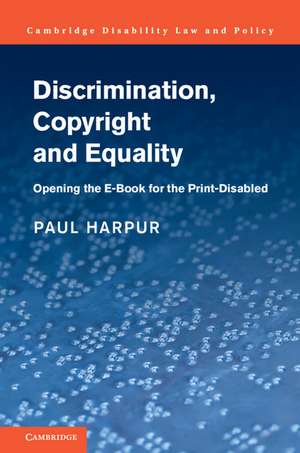
Discrimination, Copyright and Equality
Autor Paul Harpuren Limba Engleză Hardback – 3 apr 2017
Preț: 447.57 lei
Preț vechi: 559.64 lei
-20%
Puncte Express: 671
Carte indisponibilă temporar
Specificații
ISBN-13: 9781107119000
ISBN-10: 1107119006
Pagini: 359
Ilustrații: 1 table
Dimensiuni: 155 x 239 x 25 mm
Greutate: 0.64 kg
Editura: Cambridge University Press
Locul publicării:New York, United States
ISBN-10: 1107119006
Pagini: 359
Ilustrații: 1 table
Dimensiuni: 155 x 239 x 25 mm
Greutate: 0.64 kg
Editura: Cambridge University Press
Locul publicării:New York, United States
V-ar putea interesa
-
 Constituting Economic and Social RightsKatharine G. YoungPreț: 375.00 lei
 -
 Monaghan on Equality LawKaron Monaghan QC-35%Preț: 1746.68 lei2685.15 lei
 -
 Philosophical Foundations of Discrimination LawDeborah Hellman-8%Preț: 782.34 lei853.65 lei
 -
 Courts and Consociations: Human Rights versus Power-SharingChristopher McCrudden-24%Preț: 467.73 lei615.35 lei
 -
 Asian Data Privacy Laws: Trade & Human Rights PerspectivesGraham Greenleaf-33%Preț: 1010.37 lei1510.93 lei
 -
 Law and ReligionRussell SandbergPreț: 354.96 lei
 -
 The Lost Promise of Civil RightsRisa L GoluboffPreț: 248.13 lei
 -
 -11%Preț: 668.74 lei751.39 lei
 -
 Disability, Education and Employment in Developing CountriesKamal Lamichhane-23%Preț: 472.33 lei616.18 lei
 -
 -14%Preț: 738.04 lei858.19 lei
 -
 The Negotiable Constitution: On the Limitation of RightsGrégoire C. N. WebberPreț: 338.25 lei
 -
 Preț: 416.17 lei
 -
 Preț: 361.75 lei
 -
 Preț: 304.28 lei
 -
 Preț: 445.95 lei
 -
 Reasoning Rights: Comparative Judicial EngagementDr Liora Lazarus-25%Preț: 286.81 lei381.22 lei
 -
 -30%Preț: 917.10 lei1315.96 lei
 -
 Wiretaps & Electronic Eavesdropping: Federal Law & Legal EthicsLaurel Jennings-30%Preț: 816.29 lei1169.66 lei
 -
 -26%Preț: 1002.12 lei1347.81 lei
 -
 The Rule of Law, Freedom of Expression and Islamic LawProfessor Hossein Esmaeili-34%Preț: 587.69 lei884.41 lei
Cuprins
Foreword Gerard Goggin; Acknowledgements; Introduction; 1. How technology has created the possibility of opening the book: from hard copy to e-books; 2. Access to information communication technologies, universal design and the new disability human rights paradigm introduced by the Convention on the Rights of Persons with Disabilities; 3. The weakening of the exception paradigm: the World Intellectual Property Organization changes path with the Marrakesh Treaty to Facilitate Access to Published Works for Persons Who Are Blind, Visually Impaired, or Otherwise Print Disabled; 4. The role of copyright laws in restricting access to information and contributing to the book famine; 5. Exceptions to rights-holders' exclusivity provides limited relief from the disabling impact of copyright; 6. Anti-discrimination laws help protect persons with disabilities against digital disablement, but who qualifies for protection?; 7. Causing digital disablement is not a trigger for regulation by anti-discrimination laws: ignoring capacity in favour of prescribed relationships; 8. The prohibition against discrimination: regulating for equality through retrofitting inaccessible systems; 9. Introducing positive duties in promoting equality outcomes for persons with disabilities: the United Kingdom Public Sector Equality Duty reducing digital disablement; 10. The right to digital equality in action: protections under the Canadian Charter of Rights and Freedoms, and human rights acts; 11. United States regulatory interventions targeting disability inclusive digital environments; 12. The enforcement of legal duties: protecting copyright or promoting reading equality?; Closing thoughts and new options to reduce digital disablement; Appendix: list of anti-discrimination and civil rights laws and tribunals/commissions impacting on disability in the federal and state/province jurisdictions in Australia, Canada, the United Kingdom and the United States; Index.
Descriere
This book explores how restrictive copyright laws deny access to information for the print disabled, despite equality laws protecting access.