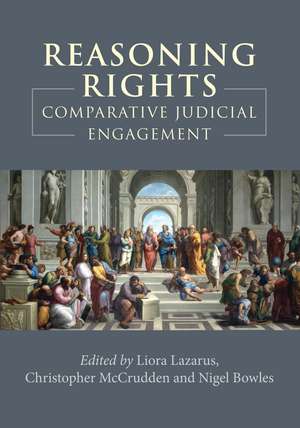
Reasoning Rights: Comparative Judicial Engagement
Editat de Dr Liora Lazarus, Professor Christopher McCrudden, Dr Nigel Bowlesen Limba Engleză Paperback – 29 sep 2016
The book, comprising contributions by a team of world-leading human rights scholars, moves beyond simply addressing the institutional questions concerning courts and human rights, which often dominate discussions of this kind, seeking instead a deeper examination of the similarities and divergence of reasonings by different courts when addressing comparable human rights questions. These differences, while partly influenced by institutional concerns, cannot be attributed to them alone. This book explores the diverse and rich underlying spectrum of human rights reasoning, as a distinctive and particular form of legal reasoning, evident in the case studies across the selected jurisdictions.
Preț: 286.81 lei
Preț vechi: 381.22 lei
-25%
Puncte Express: 430
Carte tipărită la comandă
Livrare economică 30 noiembrie-14 decembrie
Livrare prin curier în România Termenul estimat este afișat lângă disponibilitate.
Transport gratuit de la 400.00 lei Plată online sau ramburs, în funcție de opțiunile comenzii.
Retur gratuit în 14 zile Comandă securizată și suport în română.
Specificații
ISBN-13: 9781509908431
ISBN-10: 1509908439
Pagini: 392
Dimensiuni: 166 x 242 x 24 mm
Greutate: 0.76 kg
Ediția:NIPPOD
Editura: Bloomsbury Publishing
Colecția Hart Publishing
Locul publicării:London, United Kingdom
ISBN-10: 1509908439
Pagini: 392
Dimensiuni: 166 x 242 x 24 mm
Greutate: 0.76 kg
Ediția:NIPPOD
Editura: Bloomsbury Publishing
Colecția Hart Publishing
Locul publicării:London, United Kingdom
V-ar putea interesa
-
 Human Rights, Human Wrongs: Oxford Amnesty Lectures 2001Nicholas Owen-16%Preț: 200.77 lei240.14 lei
 -
 Globalizing Rights: The Oxford Amnesty Lectures 1999Matthew J. Gibney-17%Preț: 199.07 lei239.19 lei
 -
 Making Men Moral: Civil Liberties and Public MoralityRobert P. George-31%Preț: 529.06 lei768.79 lei
 -
 A Political Theory of RightsAttracta Ingram-28%Preț: 344.94 lei481.73 lei
 -
 Buying Social Justice: Equality, Government Procurement, & Legal ChangeChristopher McCrudden-24%Preț: 736.44 lei965.50 lei
 -
 -28%Preț: 452.25 lei631.50 lei
 -
 Citizenship and Immigration in Postwar BritainRandall Hansen-33%Preț: 708.47 lei1052.77 lei
 -
 Citizenship and the EnvironmentAndrew Dobson-31%Preț: 541.20 lei789.90 lei
 -
 European Human Rights Law: Text and MaterialsMark W. Janis-20%Preț: 483.22 lei602.40 lei
 -
 Principles of Human Rights AdjudicationConor Gearty-21%Preț: 385.49 lei490.09 lei
 -
 The Right to Life and Conflicting InterestsElizabeth Wicks-31%Preț: 820.86 lei1192.86 lei
 -
 -31%Preț: 921.60 lei1331.60 lei
 -
 -22%Preț: 370.07 lei471.88 lei
 -
 -35%Preț: 823.12 lei1260.09 lei
 -
 Courts and Consociations: Human Rights versus Power-SharingChristopher McCrudden-29%Preț: 517.30 lei723.92 lei
 -
 The Copyright Enforcement EnigmaM. HortenPreț: 407.29 lei
 -
 -30%Preț: 497.02 lei711.32 lei
 -
 Long Walk To Freedom Vol 2: 1962-1994Nelson MandelaPreț: 79.50 lei
 -
 Islamic Veiling in Legal DiscourseAnastasia Vakulenko-18%Preț: 1247.84 lei1521.75 lei
 -
 Q&A Civil Liberties & Human Rights 2013-2014Helen FenwickPreț: 391.06 lei
 -
 The Rights of ManThomas Paine-16%Preț: 24.79 lei29.58 lei
 -
 The Content and Context of Hate SpeechMichael HerzPreț: 442.73 lei
 -
 Judicial Reasoning Under the UK Human Rights ACTHelen FenwickPreț: 469.26 lei
 -
 Prosecuting Heads of StateEllen L. LutzPreț: 330.25 lei
 -
 The Pinochet Affair: State Terrorism and Global JusticeRoger Burbach-16%Preț: 258.61 lei307.95 lei
 -
 -27%Preț: 218.87 lei298.99 lei
 -
 Debating Social RightsProfessor Conor Gearty-17%Preț: 190.99 lei230.11 lei
Cuprins
Part 1: INTRODUCTION
1. The Pluralism of Human Rights Adjudication
Christopher McCrudden
Part 2: PROPORTIONALITY
2. Constructing the Proportionality Test: An Emerging Global Conversation
Kai Möller
3. Necessity and Proportionality: Towards a Balanced Approach
David Bilchitz
4. Proportionality Without Balancing: Why Judicial Ad hoc Balancing is Unnecessary and Potentially Detrimental to the Realisation of Individual and Collective Self-determination
Jochen von Bernstorff
5. Proportionality in United States Constitutional Law Paul Yowell
Part 3: NATIONAL SECURITY AND HUMAN RIGHTS
6. 'To the Serious Detriment of the Public': Secret Evidence and Closed Material Procedures
Ryan Goss
7. National Security Law and the Creep of Secrecy: A Transatlantic Tale
Tom Hickman and AdamTomkins
8. Navigating the Shoals of Secrecy: A Comparative Analysis of the Use of Secret Evidence and 'Cleared Counsel' in the United States, the United Kingdom, and Canada
David Cole and Stephen I Vladeck
9. The Secret Keepers: Judges, Security Detentions, and Secret Evidence Shiri Krebs
Part 4: RELIGION AND HUMAN RIGHTS
10. The Intersection of Religious Autonomy and Religious Symbols: Setting the Stage
Christopher McCrudden and Brett G Scharffs
11. Principles and Compromises: Religious Freedom in a Time of Transition
Carolyn Evans
12. State Interference in the Internal Affairs of Religious Institutions
Johan D Van der Vyver
13. The Protection of Religious Freedom in Australia: A Comparative Assessment of Autonomy and Symbols Paul Babie and James Krumrey-Quinn
Part 5: SOCIO-ECONOMIC RIGHTS
14. The Emergence and Enforcement of Socio-Economic Rights
Murray Wesson
15. The Problematic of Social Rights - Uniformity and Diversity in the Development of Social Rights Review
Colm O'Cinneide
16. A South African Perspective on the Judicial Development of Socio-Economic Rights 319
Edwin Cameron
17. Judicial Activism and the Indian Supreme Court: Lessons for Economic and Social Rights Adjudication
Anashri Pillay
18. American Exceptionalism over Social Rights
Jeff King
1. The Pluralism of Human Rights Adjudication
Christopher McCrudden
Part 2: PROPORTIONALITY
2. Constructing the Proportionality Test: An Emerging Global Conversation
Kai Möller
3. Necessity and Proportionality: Towards a Balanced Approach
David Bilchitz
4. Proportionality Without Balancing: Why Judicial Ad hoc Balancing is Unnecessary and Potentially Detrimental to the Realisation of Individual and Collective Self-determination
Jochen von Bernstorff
5. Proportionality in United States Constitutional Law Paul Yowell
Part 3: NATIONAL SECURITY AND HUMAN RIGHTS
6. 'To the Serious Detriment of the Public': Secret Evidence and Closed Material Procedures
Ryan Goss
7. National Security Law and the Creep of Secrecy: A Transatlantic Tale
Tom Hickman and AdamTomkins
8. Navigating the Shoals of Secrecy: A Comparative Analysis of the Use of Secret Evidence and 'Cleared Counsel' in the United States, the United Kingdom, and Canada
David Cole and Stephen I Vladeck
9. The Secret Keepers: Judges, Security Detentions, and Secret Evidence Shiri Krebs
Part 4: RELIGION AND HUMAN RIGHTS
10. The Intersection of Religious Autonomy and Religious Symbols: Setting the Stage
Christopher McCrudden and Brett G Scharffs
11. Principles and Compromises: Religious Freedom in a Time of Transition
Carolyn Evans
12. State Interference in the Internal Affairs of Religious Institutions
Johan D Van der Vyver
13. The Protection of Religious Freedom in Australia: A Comparative Assessment of Autonomy and Symbols Paul Babie and James Krumrey-Quinn
Part 5: SOCIO-ECONOMIC RIGHTS
14. The Emergence and Enforcement of Socio-Economic Rights
Murray Wesson
15. The Problematic of Social Rights - Uniformity and Diversity in the Development of Social Rights Review
Colm O'Cinneide
16. A South African Perspective on the Judicial Development of Socio-Economic Rights 319
Edwin Cameron
17. Judicial Activism and the Indian Supreme Court: Lessons for Economic and Social Rights Adjudication
Anashri Pillay
18. American Exceptionalism over Social Rights
Jeff King
Recenzii
...this volume constitutes a very interesting, relevant and necessary insight into the legitimacy of courts entrusted with the task of reasoning and balancing rights. All chapters are of a very high academic standard and can be used not only by legal professionals but also by undergraduate and postgraduate students.
.every university library should have this book in their catalogue. It can be recommended to a broad spectrum of law specialists interested in human rights and comparative law, European and international law as well as constitutional and administrative law.
The book is comprised of contributions by a team of world-leading human rights scholars that move beyond simply addressing the institutional questions, concerning courts and human rights (...) instead is a deeper examination of the similarities and divergence of reasonings by different courts when addressing comparable human rights questions.
.every university library should have this book in their catalogue. It can be recommended to a broad spectrum of law specialists interested in human rights and comparative law, European and international law as well as constitutional and administrative law.
The book is comprised of contributions by a team of world-leading human rights scholars that move beyond simply addressing the institutional questions, concerning courts and human rights (...) instead is a deeper examination of the similarities and divergence of reasonings by different courts when addressing comparable human rights questions.