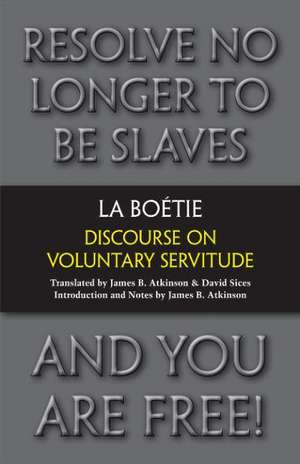
Discourse on Voluntary Servitude
Autor Etienne de La Boetie Traducere de James B. Atkinson, David Sicesen Limba Engleză Hardback – 15 sep 2012
An elegant English version of La Boetie's Discourse on Voluntary Servitude, which is both a key to understanding much of Montaigne and a major piece of early modern political thought. --Timothy Hampton, Professor of French and Comparative Literature, University of California, Berkeley
Preț: 176.31 lei
Preț vechi: 230.27 lei
-23%
Puncte Express: 264
Carte disponibilă
Livrare economică 06-20 noiembrie
Livrare prin curier în România Termenul estimat este afișat lângă disponibilitate.
Transport gratuit de la 400.00 lei Plată online sau ramburs, în funcție de opțiunile comenzii.
Retur gratuit în 14 zile Comandă securizată și suport în română.
Specificații
ISBN-13: 9781603848404
ISBN-10: 1603848401
Pagini: 96
Ilustrații: illustrations
Dimensiuni: 140 x 216 x 11 mm
Greutate: 0.23 kg
Editura: Hackett Publishing Company,Inc
Colecția Hackett Publishing Company, Inc.
Locul publicării:United States
ISBN-10: 1603848401
Pagini: 96
Ilustrații: illustrations
Dimensiuni: 140 x 216 x 11 mm
Greutate: 0.23 kg
Editura: Hackett Publishing Company,Inc
Colecția Hackett Publishing Company, Inc.
Locul publicării:United States
V-ar putea interesa
-
 The Grammar of AngelsEdward Wilson-LeePreț: 220.25 lei
 -
 The DiscoursesNicolas Machiavel-17%Preț: 78.43 lei94.91 lei
 -
 The Complete EssaysMichel Montaigne-30%Preț: 139.15 lei197.68 lei
 -
 The Old Regime and the Revolution, Volume I: The Complete TextAlexis de TocquevillePreț: 259.47 lei
 -
 The First and Second DiscoursesRoger MastersPreț: 272.05 lei
 -
 MeditationsMarcus AureliusPreț: 34.00 lei
 -
 AristotleAristotlePreț: 193.55 lei
 -
 CandideVoltairePreț: 32.48 lei
 -
 On the Orator: Books 1-2CiceroPreț: 221.20 lei
 -
 One Man's FreedomNicholas BuccolaPreț: 224.97 lei
 -
 Essays by MontaigneMichel de MontaignePreț: 89.97 lei
 -
 Locke: Political WritingsJohn Locke-17%Preț: 141.78 lei171.31 lei
 -
 -24%Preț: 416.72 lei545.63 lei
 -
 Rethinking EmancipationJacques RancièrePreț: 84.47 lei
 -
 On FreedomTimothy SnyderPreț: 93.66 lei
 -
 The PrinceNiccolò MachiavelliPreț: 33.48 lei
 -
 On PowerMark R. Levin-20%Preț: 108.64 lei135.48 leiRecomandat
 -
 UtopiaThomas MorePreț: 33.19 lei
 -
 The Social ContractJean-Jacques RousseauPreț: 61.99 lei
Recenzii
An excellent translation: clear, crisp and accurate. The introduction is also a helpful contextualization of the text, Boétie's relation to Montaigne, and a brief discussion of the history of this important text on non-cooperation in the 20th-Century. I highly recommend it for courses in the history of political theory and of non-cooperation as a means of regime change. --James Tully, Department of Political Science, University of Victoria
A powerful rendition of La Boetie's soldierly prose (as Montaigne would have it). . . . With this unassuming book, the authors have not only offered a solid introduction to Étienne de La Boétie and his legacy, but also passed on to us a living document (Harry Kurz) which may yet find resonance in our own troubled times. --Jeremie Korta, Harvard University, in Sixteenth Century Journal