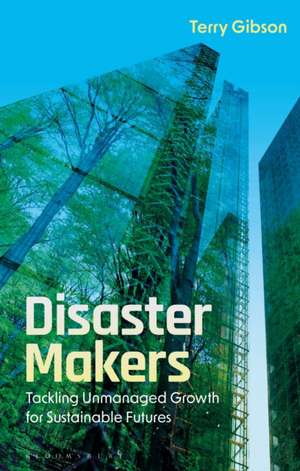
Disaster Makers: Tackling Unmanaged Growth for Sustainable Futures
Autor Terry Gibsonen Limba Engleză Paperback – 20 feb 2025
Some disasters are highly visible to us all, such as the Covid-19 pandemic or the climate emergency. Many more are hidden, everyday disasters grinding down the lives of the poor and vulnerable. Very few of these disasters just happen. Most are caused by those who create risk faster than they can mop it up, by those who pursue reckless, unmanaged economic growth that demands ever-increasing manufacture, consumption, building, food production, and energy consumption. These are the disaster makers.
In this book, Gibson provides a thorough, sophisticated, yet accessible account of who the disaster makers are, what they do, and how we can do things better. Ultimately, Gibson demonstrates the urgency of replacing growth-based economics with a fundamentally different social and economic model. This is more than a dream. As Gibson shows, it becomes a practical possibility the moment enough of us commit to building a movement.
Preț: 147.20 lei
Preț vechi: 176.05 lei
-16%
Puncte Express: 221
Carte disponibilă
Livrare economică 07-21 noiembrie
Livrare express 24-30 octombrie pentru 53.41 lei
Livrare prin curier în România Termenul estimat este afișat lângă disponibilitate.
Transport gratuit de la 400.00 lei Plată online sau ramburs, în funcție de opțiunile comenzii.
Retur gratuit în 14 zile Comandă securizată și suport în română.
Specificații
ISBN-13: 9781350430488
ISBN-10: 135043048X
Pagini: 208
Dimensiuni: 136 x 214 x 16 mm
Greutate: 0.34 kg
Editura: Bloomsbury Publishing
Colecția Bloomsbury Academic
Locul publicării:London, United Kingdom
ISBN-10: 135043048X
Pagini: 208
Dimensiuni: 136 x 214 x 16 mm
Greutate: 0.34 kg
Editura: Bloomsbury Publishing
Colecția Bloomsbury Academic
Locul publicării:London, United Kingdom
V-ar putea interesa
-
 Introduction to International Disaster ManagementDamon P. Coppola-25%Preț: 600.91 lei801.21 lei
 -
 GrowthDaniel SusskindPreț: 93.52 lei
 -
 -20%Preț: 66.99 lei84.19 lei
 -
 Preț: 202.50 lei
 -
 WreckersSimon ParkPreț: 188.88 lei
 -
 The Poverty of GrowthOlivier De SchutterPreț: 105.31 lei
 -
 Preț: 137.09 lei
 -
 Permacrisis: A Plan to Fix a Fractured WorldGordon Brown-19%Preț: 63.74 lei78.29 lei
 -
 A Liveable Future is PossibleNoam ChomskyPreț: 78.95 lei
 -
 DisastersKathleen TierneyPreț: 171.24 lei
 -
 Capitalism at the LimitUlrich BrandPreț: 159.60 lei
 -
 Hope Dies LastAlan WeismanPreț: 125.56 lei
 -
 Facing the AnthropoceneIan AngusPreț: 138.22 lei
 -
 2052Jorgen RandersPreț: 146.93 lei
 -
 Disaster NationalismRichard SeymourPreț: 92.53 lei
 -
 The Next CrisisDanny DorlingPreț: 170.42 lei
 -
 Slow Down or Die: The Economics of DegrowthTimothée Parrique-19%Preț: 98.77 lei122.14 lei
 -
 Going NuclearTim GregoryPreț: 124.00 lei
 -
 The End of GrowthRichard HeinbergPreț: 109.70 lei
 -
 Risk and Resilience in the Era of Climate ChangeVinod ThomasPreț: 200.41 lei
Cuprins
Preface: A Personal Disaster Journey
Acknowledgements
Introduction
Section 1: Unnatural Disasters
Chapter 1. Encountering Disasters
Chapter 2: The Risk Equation
Chapter 3. Vulnerability
Chapter 4: Hazards
Chapter 5. Managing Disasters and Development: The UN Frameworks
Section 2: Unmanaged Growth
Chapter 6: Adventures Into the Anthropocene
Chapter 7. Anthropocene 1. A Very English Anthropocene
Chapter 8: Anthropocene 2: 'Any colour you like as long as it's black'
Chapter 9: The Third Anthropocene - March of the Megacities.
Chapter 10: Halfway Towards Disaster
Section 3: Sustainable Futures
Chapter 11: Identifying the Disaster Makers
Chapter 12: The Public as Changemakers
Chapter 13: Changemaking for the Future we Choose
Conclusion: Unnatural Disasters, Convenient Untruths
Notes
Select Bibliography
Acknowledgements
Introduction
Section 1: Unnatural Disasters
Chapter 1. Encountering Disasters
Chapter 2: The Risk Equation
Chapter 3. Vulnerability
Chapter 4: Hazards
Chapter 5. Managing Disasters and Development: The UN Frameworks
Section 2: Unmanaged Growth
Chapter 6: Adventures Into the Anthropocene
Chapter 7. Anthropocene 1. A Very English Anthropocene
Chapter 8: Anthropocene 2: 'Any colour you like as long as it's black'
Chapter 9: The Third Anthropocene - March of the Megacities.
Chapter 10: Halfway Towards Disaster
Section 3: Sustainable Futures
Chapter 11: Identifying the Disaster Makers
Chapter 12: The Public as Changemakers
Chapter 13: Changemaking for the Future we Choose
Conclusion: Unnatural Disasters, Convenient Untruths
Notes
Select Bibliography
Recenzii
T. Gibson's book is a fascinating read. It combines theory and empirical insights to convey a powerful argument in a very clear and accessible prose; that is, disasters are the results of human decisions that must be reconsidered should we wish to aim for a safer future.
This book challenges us to re-evaluate our responsibility for natural disasters. What we previously saw as acts of God can be the result of political and personal choices - allowing the possibility of change. This radical reframing of risk and consequences is essential reading for anyone concerned about our future and how we manage it.
Gibson brings common sense and a strong moral sensibility to the naming and shaming of situations and systems that create risk.
Thank you so much to Terry for not holding back when describing the origins of and ways forward for humanity's horrific disaster difficulties. In this book delving across centuries, continents, disciplines, and experiences, he goes beyond confined, sectoral viewpoints to explain not only who makes disasters and how, but also why. Knowing the baseline reasons for disasters then leads to helpful approaches for acting to stop the disaster makers.
Disaster makers is clearly written by someone on the inside. And yet Gibson manages to take a step back and lay bare the mechanics of why and how we keep creating disaster risk - and what must happen for this to change. Recommended reading for anyone interested in risk management.
This book challenges us to re-evaluate our responsibility for natural disasters. What we previously saw as acts of God can be the result of political and personal choices - allowing the possibility of change. This radical reframing of risk and consequences is essential reading for anyone concerned about our future and how we manage it.
Gibson brings common sense and a strong moral sensibility to the naming and shaming of situations and systems that create risk.
Thank you so much to Terry for not holding back when describing the origins of and ways forward for humanity's horrific disaster difficulties. In this book delving across centuries, continents, disciplines, and experiences, he goes beyond confined, sectoral viewpoints to explain not only who makes disasters and how, but also why. Knowing the baseline reasons for disasters then leads to helpful approaches for acting to stop the disaster makers.
Disaster makers is clearly written by someone on the inside. And yet Gibson manages to take a step back and lay bare the mechanics of why and how we keep creating disaster risk - and what must happen for this to change. Recommended reading for anyone interested in risk management.
Notă biografică
Terry Gibson is a researcher and practitioner in the disasters, development and corporate responsibility industries. For eight years, Terry acted as director of GNDR network of Disaster Risk Reduction practitioners.