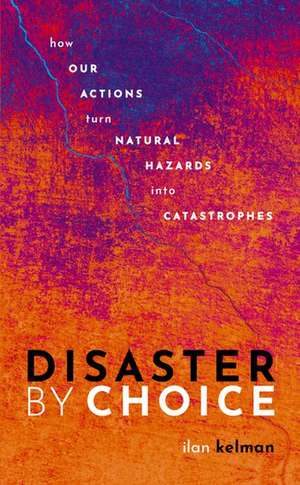
Disaster by Choice: How our actions turn natural hazards into catastrophes
Autor Ilan Kelmanen Limba Engleză Paperback – 24 feb 2022
An earthquake shatters Haiti and a hurricane slices through Texas. We hear that nature runs rampant, seeking to destroy us through these 'natural disasters'. Science recounts a different story, however: disasters are not the consequence of natural causes; they are the consequence of human choices and decisions. We put ourselves in harm's way; we fail to take measures which we know would prevent disasters, no matter what the environment does.This can be both hard to accept, and hard to unravel. A complex of factors shape disasters. They arise from the political processes dictating where and what we build, and from social circumstances which create and perpetuate poverty and discrimination. They develop from the social preference to blame nature for the damage wrought, when in fact events such as earthquakes and storms are entirely commonplace environmental processes. We feel the need to fight natural forces, to reclaim what weassume is ours, and to protect ourselves from what we perceive to be wrath from outside our communities. This attitude distracts us from the real causes of disasters: humanity's decisions, as societies and as individuals. It stops us accepting the real solutions to disasters: making better decisions.This book explores stories of some of our worst disasters to show how we can and should act to stop people dying when nature unleashes its energies. The disaster is not the tornado, the volcanic eruption, or climate change, but the deaths and injuries, the loss of irreplaceable property, and the lack and even denial of support to affected people, so that a short-term interruption becomes a long-term recovery nightmare. But we can combat this, as Kelman shows, describing inspiring examples ofeffective human action that limits damage, such as managing flooding in Toronto and villages in Bangladesh, or wildfires in Colorado.Throughout, his message is clear: there is no such thing as a natural disaster. The disaster lies in our inability to deal with the environment and with ourselves.
Preț: 66.99 lei
Preț vechi: 84.19 lei
-20%
Carte disponibilă
Livrare economică 06-11 noiembrie
Livrare express 22-28 octombrie pentru 34.81 lei
Specificații
ISBN-10: 0198841353
Pagini: 192
Dimensiuni: 130 x 200 x 15 mm
Greutate: 0.17 kg
Editura: OUP OXFORD
Colecția OUP Oxford
Locul publicării:Oxford, United Kingdom
V-ar putea interesa
-
 DoomNiall Ferguson-18%Preț: 78.03 lei94.69 lei
 -
 WreckersSimon ParkPreț: 188.88 lei
 -
 CollapseJared Diamond-34%Preț: 91.10 lei137.67 lei
 -
 Disasters – A Sociological ApproachK TierneyPreț: 184.23 lei
 -
 -16%Preț: 147.20 lei176.05 lei
 -
 Sink or Swim: How the world needs to adapt to a changing climateSusannah Fisher-26%Preț: 100.23 lei135.49 lei
 -
 The Last RhinosLawrence Anthony-33%Preț: 53.54 lei79.76 lei
 -
 Disaster NationalismVivian Y. ChoiPreț: 241.15 lei
 -
 Preț: 157.61 lei
 -
 DisastersKathleen TierneyPreț: 171.24 lei
 -
 Hope Dies LastAlan WeismanPreț: 125.56 lei
 -
 Wicked Weather: Natural Disasters that Changed Historyprofessor Alexander Gates-21%Preț: 195.39 lei246.31 lei
 -
 -33%Preț: 582.81 lei863.70 lei
 -
 CatastropheFintan DruryPreț: 131.32 lei
 -
 A Paradise Built in HellRebecca SolnitPreț: 93.46 lei
 -
 Creating a StormIsabelle SeddonPreț: 175.84 lei
 -
 Disaster NationalismRichard SeymourPreț: 92.36 lei
 -
 Human NatureKate MarvelPreț: 136.91 lei
 -
 Linden, E: Fire and FloodEugene LindenPreț: 192.74 lei
Recenzii
A choose-your-ending book for grown-ups facing a world full of real-life monsters.
Grimly informative.
I hope that this book is widely read and its message heeded.
Disaster by Choice demonstrates in a vivid and engaging way why big issues like the current climate crisis, where people are starting to accept that their actions can contribute to a collective result on a global scale, are just the tip of the iceberg.
[An] engaging book filled with rich examples and details of specific historical events Kelmans succinct and generally lucid account of the state of knowledge within the field, will likely be useful to a wide range of readers.
You can tell that Kelman had a clear, well-defined vision for the book. The writing is concise and to the point, resulting in a quick read ... Disaster by Choice really brings the examples and recommendations down to our daily lives and practices to make them more impactful.
This is an excellent little book that crystallises ideas about the influence and impact of human actions on natural catastrophes into a thoughtful and informative narrative, concluding - and rightly so - that there is no such thing as a natural disaster. A must-read book.
Notă biografică
Ilan Kelman is Professor of Disasters and Health at University College London, England and a Professor II at the University of Agder, Kristiansand, Norway. His overall research interest is linking disasters and health, including the integration of climate change into disaster research and health research.
Cuprins
- Prelude: Disasters are not natural
- 1: An island shattered
- 2: Nature's hazards
- 3: The story of vulnerability
- 4: Vulnerability by choice
- 5: Making the choice
- 6: Making the change
- Endnotes
- Further reading