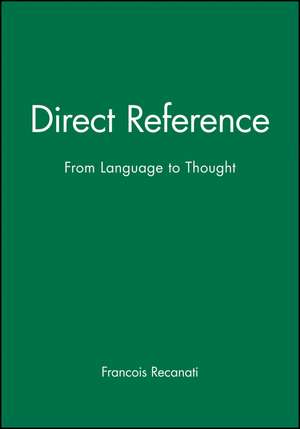
Direct Reference
Autor Francois Recanatien Limba Engleză Paperback – iul 1997
Preț: 411.16 lei
Puncte Express: 617
Carte tipărită la comandă
Livrare economică 28 noiembrie-12 decembrie
Livrare prin curier în România Termenul estimat este afișat lângă disponibilitate.
Transport gratuit pentru acest produs Plată online sau ramburs, în funcție de opțiunile comenzii.
Retur gratuit în 14 zile Comandă securizată și suport în română.
Specificații
ISBN-13: 9780631206347
ISBN-10: 0631206345
Pagini: 436
Dimensiuni: 152 x 229 x 26 mm
Greutate: 0.61 kg
Ediția:Revised
Editura: Wiley
Locul publicării:Chichester, United Kingdom
ISBN-10: 0631206345
Pagini: 436
Dimensiuni: 152 x 229 x 26 mm
Greutate: 0.61 kg
Ediția:Revised
Editura: Wiley
Locul publicării:Chichester, United Kingdom
V-ar putea interesa
-
 How Languages are LearnedPatsy LightbownPreț: 351.27 lei
 -
 Mental Files in FluxFrançois Recanati-19%Preț: 454.69 lei561.35 lei
 -
 Access to Language and Cognitive DevelopmentMichael Siegal-31%Preț: 527.14 lei762.20 lei
 -
 Applying Cognitive Linguistics to Second Language Learning and TeachingJeannette Littlemore-18%Preț: 747.59 lei911.69 lei
 -
 Alternative Approaches to Second Language AcquisitionDwight AtkinsonPreț: 455.32 lei
 -
 Preț: 502.72 lei
 -
 SLA and TBLT CLong-27%Preț: 844.77 lei1157.22 lei
 -
 -27%Preț: 969.47 lei1328.05 lei
 -
 -23%Preț: 482.94 lei627.19 lei
 -
 Strategies in Learning and Using a Second LanguageAndrew D. CohenPreț: 454.45 lei
 -
 Preț: 392.00 lei
 -
 -27%Preț: 76.90 lei105.71 lei
 -
 Preț: 544.54 lei
 -
 Language AcquisitionLeslie M Warfelt-26%Preț: 1165.88 lei1586.03 lei
 -
 -16%Preț: 257.82 lei305.22 lei
 -
 -27%Preț: 898.40 lei1230.68 lei
 -
 Hearing Impairment 2eBamford-5%Preț: 547.22 lei576.02 lei
 -
 -5%Preț: 549.32 lei578.23 lei
 -
 Context-Dependence, Perspective and RelativityFrancois Recanati-23%Preț: 1201.79 lei1560.76 lei
Public țintă
upper–level undergraduates and graduates in philosophy of languageNotă biografică
Francois Recanti
The author is Senior Researcher at CNRS/CREA. Paris. He has published many papers and several books on the philosophy of language, including Meaning and Force (1988).
The author is Senior Researcher at CNRS/CREA. Paris. He has published many papers and several books on the philosophy of language, including Meaning and Force (1988).
Cuprins
Preface.Part I: Direct Reference in Language and Thought.
I.1 De re Communication.
1. Direct Reference and Linguistic Meaning: Rigidity de jure. .
2. Singular Propositions and Thoughts.
3. The Communication of de re Thoughts.
I.2 From Language to Thought.
4. Linguistic and Psychological Modes of Presentation.
5. The Meaning and Cognitive Significance of Indexical Expressions.
I.3 De re Thoughts.
6. De re Modes of Presentation.
7. Egocentric Concepts vs. Encyclopedia Entries.
I.4 Proper Names.
8. The Meaning of Proper Names.
9. Answering Kripke's Objections.
10. Proper Names in Thought.
I.5 The Two-Component Picture: A Defence.
11. Narrow Content and Psychological Explanation.
12. Externalism and the Two-Component Picture.
Part II: The Pragmatics of Direct Reference.
II.1 Methodological Preliminaries.
13. Truth-Conditional Pragmatics.
14. Primary Pragmatic Processes.
II.2 Referential/Attributive.
15. The Referential Use of Definite Descriptions.
16. The Descriptive Use of Indexicals.
II.3 Belief Reports.
17. Belief Reports and Conversational Implicatures.
18. Belief Reports and the Semantics of That-Clauses.
19. Comparison with Other Accounts.
20. How Ambiguous are Belief Sentences?.
Bibliography.
Index.
I.1 De re Communication.
1. Direct Reference and Linguistic Meaning: Rigidity de jure. .
2. Singular Propositions and Thoughts.
3. The Communication of de re Thoughts.
I.2 From Language to Thought.
4. Linguistic and Psychological Modes of Presentation.
5. The Meaning and Cognitive Significance of Indexical Expressions.
I.3 De re Thoughts.
6. De re Modes of Presentation.
7. Egocentric Concepts vs. Encyclopedia Entries.
I.4 Proper Names.
8. The Meaning of Proper Names.
9. Answering Kripke's Objections.
10. Proper Names in Thought.
I.5 The Two-Component Picture: A Defence.
11. Narrow Content and Psychological Explanation.
12. Externalism and the Two-Component Picture.
Part II: The Pragmatics of Direct Reference.
II.1 Methodological Preliminaries.
13. Truth-Conditional Pragmatics.
14. Primary Pragmatic Processes.
II.2 Referential/Attributive.
15. The Referential Use of Definite Descriptions.
16. The Descriptive Use of Indexicals.
II.3 Belief Reports.
17. Belief Reports and Conversational Implicatures.
18. Belief Reports and the Semantics of That-Clauses.
19. Comparison with Other Accounts.
20. How Ambiguous are Belief Sentences?.
Bibliography.
Index.